




Lake Charles wrecks happen on I-10 where it bisects the city, at the I-10 and I-210 interchange, and on US-171, US-90, and Nelson Road, and the plants along the Calcasieu Ship Channel, Westlake Chemical, Sasol, Citgo, Cameron LNG, and Venture Global LNG, produce industrial injuries of their own. The people hurt are taken to Lake Charles Memorial Hospital on Oak Park Boulevard. Inside the city the Lake Charles Police Department on Enterprise Boulevard writes the crash report; outside the city limits the Calcasieu Parish Sheriff’s Office does. Calcasieu suits are filed and tried in the 14th Judicial District Court on Lakeshore Drive, and the Clerk of Court on Ryan Street holds the record. Trey Morris Injury Lawyers has an office in Lake Charles at 4865 Ihles Road, and we order the report, request the Memorial records, and send the employer or insurer written notice to preserve the incident report, the video, and the equipment involved.
The law that governs the claim is Louisiana law and it is the same in every parish. A Lake Charles injury claim is a two-year filing under La. C.C. Art. 3493.1, and for accidents on or after January 1, 2026 a 51% fault finding under La. C.C. Art. 2323 ends the claim. Trey Morris Injury Lawyers files that Calcasieu Parish case in the 14th Judicial District Court and sorts a Calcasieu Ship Channel or LNG-corridor injury onto a Jones Act or LHWCA track before the industrial file is valued as an ordinary car wreck.
Results for Louisiana Clients
- $409 MillionWrongful Death
A tragic case where an impaired driver of a commercial vehicle ran a red light, then collided with our client, causing serious bodily injury to the mother and the loss of life of her daughter.
- $49 MillionMotor Vehicle Accident
An impaired driver of a stolen vehicle driving the wrong way collided with our client head-on, resulting in brain injury and multiple broken bones.
- $32,195,000Industrial / Workplace
Failure to maintain proper safety protocols led to an explosion at an industrial plant causing a series of catastrophic injuries from broken bones, burns, spinal injury, and mental anguish.
- $31.5 MillionIndustrial / Workplace
Brain and spinal injuries followed an oil-field company failing to maintain equipment and provide a safe work site.
- $17.25 MillionCommercial Vehicle Accident
Client was struck head-on by a disconnected load of an 18-wheeler that crossed the median causing broken bones and amputation.
- $13 MillionCommercial Vehicle Accident
On the interstate, an 18-wheeler failed to yield right of way then made an unsafe lane change causing the accident which resulted in major bone breaks, damaged organs, and ultimately a leg amputation.
Past results do not guarantee future outcomes; each case is decided on its own facts.
Lake Charles: Industrial City, Industrial Injury Risk
Calcasieu Ship Channel
A 36-mile federally maintained navigation channel connecting Lake Charles to the Gulf of Mexico. It supports offshore oil and gas operations, marine cargo, and commercial fishing, and is the primary maritime artery for Southwest Louisiana’s industrial base.
Major industrial employers in the corridor include Westlake Chemical, Sasol, Citgo Refinery, Cameron LNG, and Venture Global LNG, along with dozens of upstream and downstream facilities. The Calcasieu Ship Channel connects these facilities to Gulf markets, supporting offshore drilling operations, bulk cargo shipping, and commercial fishing fleets.
Jones Act
A federal law (46 U.S.C. 30104) giving seamen the right to sue their employer for negligence if injured while working on a vessel. Maintenance and cure, which the employer owes regardless of fault, comes separately from general maritime law.
LHWCA
Longshore and Harbor Workers’ Compensation Act. A federal workers’ compensation law covering maritime workers who are not seamen, including dock workers, harbor workers, and certain offshore workers who work adjacent to navigable waters.
Workers in these industries face explosion risk, toxic chemical exposure, fall hazards, and heavy equipment injuries. An injury at a refinery is legally different from an injury in a car accident. Industrial and maritime injuries in Lake Charles are often governed by overlapping legal frameworks: Louisiana tort law, the Jones Act, the LHWCA, and federal OSHA regulations. Each legal framework has different rights, different deadlines, and different remedies.
Maritime and industrial claims are distinct practice areas. An attorney experienced only in car accidents may not know how to handle a Jones Act maintenance and cure claim or an LHWCA scheduled benefit dispute. Trey Morris Injury Lawyers handles industrial accident cases and maritime accident cases as core practice areas, not referral cases.
Not every Lake Charles injury happens at a plant or on the interstate. Falls at stores, restaurants, hotels and the city’s casinos are premises claims, and our Lake Charles slip and fall lawyers page explains how Louisiana law treats them.
People on foot are hurt on these same roads. A pedestrian struck on US-171, US-90 or Nelson Road has a claim against the driver under the same Louisiana fault rules as any other crash, and our Louisiana pedestrian accident lawyers page explains how those claims are proved.
I-10 and the Lake Charles Traffic Picture
I-10 bisects Lake Charles east-west. The I-10/I-210 interchange, which splits traffic toward Houston and Lake Charles proper, is one of the most congested and crash-prone corridors in Southwest Louisiana. The Calcasieu River Bridge creates additional hazard: merging lanes, narrow clearances, and the transition from bridge to surface road produce the conditions for rear-end and sideswipe collisions.
The numbers reflect this. Calcasieu Parish recorded 2,322 intersection crashes and 1,102 roadway departure crashes in 2024. In 2023, 28 people died in traffic crashes in the parish. The fatal crash rate was 15.22 per 100,000 residents. In 2022, Calcasieu Parish had 6,619 total traffic accidents. Lake Charles city limits accounted for 889 of those injury or fatal crashes, more than 46% of the parish total, including 6 fatalities and 1,491 non-fatal injuries. Crash statistics for Calcasieu Parish are maintained by the Center for Analytics and Research in Transportation Safety (CARTS) at Louisiana State University. CARTS is the official data source attorneys and courts reference for parish-level crash data.
ECM
Engine Control Module. The truck’s onboard computer that records pre-impact speed, braking, throttle position, and other data.
Lake Charles is also a significant commercial truck corridor. I-10 connects the Beaumont/Houston market to the west with Baton Rouge and New Orleans to the east. Heavy truck traffic is constant, particularly through the refinery and terminal access roads. When a commercial truck is involved in a crash, the legal analysis changes. Federal regulations govern driver hours, vehicle maintenance, cargo loading, and licensing. Evidence from the truck, including the ECM, must be preserved quickly.
The 14th Judicial District Court and Calcasieu Parish
Personal injury cases in Lake Charles are filed in the 14th Judicial District Court, Calcasieu Parish. The courthouse is at 1000 Lakeshore Drive, Lake Charles, LA 70601. Given the volume and variety of industrial, maritime, and motor vehicle cases that originate in Calcasieu Parish, the 14th JDC has substantial experience with these case types.
Louisiana district courts follow the Louisiana Code of Civil Procedure. Jury trials are available in civil cases. If your case involves federal maritime law or admiralty jurisdiction, your attorney may file in the U.S. District Court for the Western District of Louisiana, Lake Charles Division, which has concurrent jurisdiction over Jones Act and LHWCA claims.
One rule matters for government-related claims. If your injury involved a state road defect, a public school, or a government employer, there is no pre-suit notice and no shorter deadline. Once suit is filed, though, service on the government entity must be requested within 90 days under La. R.S. 13:5107, or the case against that entity is dismissed.
Local Office. Statewide Record.
- 14th JDC
Where your case is filed
Lake Charles injury suits are filed in the 14th Judicial District Court. We file and try cases there from our Lake Charles office.
- 11
Trial attorneys, one team
Your case is handled by the firm's own trial attorneys, and we respond in minutes, 24/7.
- 24/7
We come to you
Hospital, home, or the office at 4865 Ihles Road. Free case review, and no fee unless we win.
- 127
Cases resolved over $1 million
Verdicts and settlements of $1 million or more, won by the same trial team that handles Lake Charles cases.
Louisiana Tort Law: What Changed and What It Means
Louisiana tort law has changed significantly in recent years, and the changes did not all take effect on the same day. Some apply based on the day you were hurt, and others based on the day you file suit.
Prescriptive Period
The Prescriptive Period is two years from the date of injury under La. C.C. Art. 3493.1.
Comparative Fault
Comparative Fault under La. C.C. Art. 2323 changed as of January 1, 2026. Louisiana abolished pure comparative fault. If you are 51% or more at fault, you recover nothing. If you are 50% or less at fault, your damages are reduced by your percentage of fault.
Two other rules affect your recovery. The No Pay No Play rule under La. R.S. 32:866 applies if you owned or drove a vehicle without the required auto liability insurance and were hurt in a vehicle crash. Since August 1, 2025, it bars recovery of the first $100,000 of bodily injury damages and the first $100,000 of property damage. It does not apply if you were a passenger who does not own the uninsured vehicle, if your vehicle was legally parked, or if the other driver is convicted of DWI for the crash (or pleads no contest), caused the crash on purpose, fled the scene, or was committing a felony. The medical-expense rule also changed for lawsuits filed on or after January 1, 2026: when health insurance or Medicare paid an in-network (contracted) provider, your past medical bills are limited to what was actually paid, plus your deductibles, co-pays, coinsurance and any other share you paid or still owe, not the amount billed (La. R.S. 9:2800.27). This directly affects how your damages are calculated in settlement.
Louisiana’s direct action statute, La. R.S. 22:1269, now allows a suit directly against the at-fault party’s liability insurer only in limited situations. One of them matters when the at-fault party disappears or is uncooperative: if service cannot be made, or the insured does not answer or defend within 180 days of service, the insurer can be sued directly.
Medical Facilities Serving Lake Charles Injury Victims
Where you receive treatment affects your case. Medical records are evidence. The facility, the treating physician, and the documentation of your injuries all matter in a personal injury claim.
Lake Charles Memorial Hospital at 1701 Oak Park Blvd. is the region’s Level II trauma center, the highest trauma designation in Southwest Louisiana. A Level II trauma center can manage most major traumatic injuries through definitive care. For severe traumatic brain injuries, complex spinal injuries, or major burns, transfer to a Level I facility may be required. Ochsner Health in New Orleans and University Health Shreveport are the nearest Level I centers.
CHRISTUS St. Patrick Hospital at 524 Dr. Michael DeBakey Drive provides acute care and emergency services to the Lake Charles metro area. Industrial workers who are injured and transported quickly often land at one of these two facilities. ACADIAN Ambulance and LifeNet of Louisiana operate emergency transport throughout Calcasieu Parish.
Medical records from Lake Charles Memorial and CHRISTUS St. Patrick are key evidence in your claim. Request records within 30 days of treatment. Hospitals have standard retention schedules, and the longer you wait, the more complicated record retrieval becomes. Your attorney requests records with a specific authorization.
Lake Charles Practice Areas
 Car AccidentsRear-end, intersection, and highway collisions across Louisiana.
 Truck Accidents18-wheeler and commercial-vehicle wrecks governed by federal trucking rules.
 Catastrophic InjuryBrain, spinal-cord, amputation, and severe-burn injuries that change a life.
 Wrongful DeathClaims brought by families after a fatal accident or act of negligence.
 Premises LiabilitySlip-and-fall and unsafe-property injuries on someone else's premises.
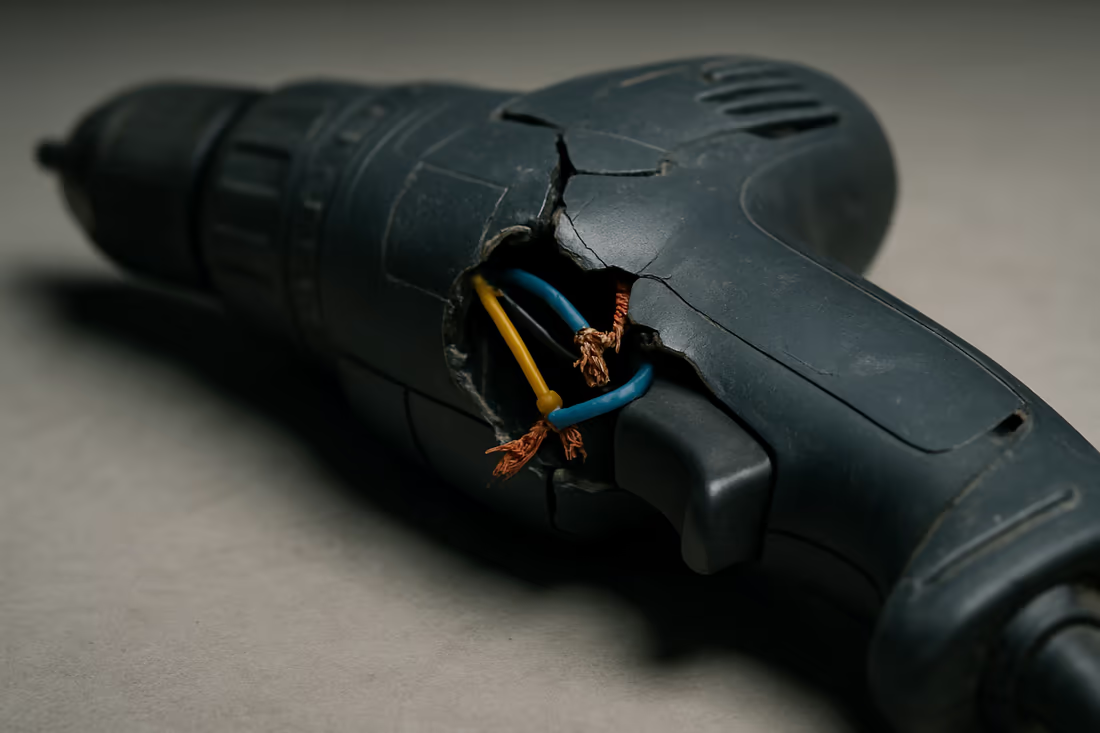 Product LiabilityInjuries caused by defective or unreasonably dangerous products.
 Oilfield AccidentsDrilling, pipeline, and refinery injuries across the energy sector.
 Industrial AccidentsPlant, warehouse, and heavy-equipment injuries in industrial settings.
 Offshore AccidentsRig, platform, and vessel injuries beyond the shoreline.
What Compensation Does Louisiana Law Allow After a Lake Charles Injury?
Louisiana law distinguishes between economic and non-economic damages. Both are recoverable in a personal injury case, subject to the tort reform rules that apply to your case type.
Loss of Earning Capacity
The difference between what you could have earned over your working lifetime and what you can earn now after the injury. Calculated by a vocational expert and converted to present value by an economist.
Economic damages cover what you can document. Medical expenses, both past treatment and reasonable future care, are recoverable. Lost wages from time you could not work are recoverable.
Loss of Consortium
A claim by the injured person’s close family for the loss of companionship, affection, and support caused by the injured person’s condition. Louisiana gives it to the same relatives who could bring a wrongful death claim, starting with the spouse and children.
Non-economic damages are harder to quantify. Pain and suffering, emotional distress, loss of enjoyment of life, Loss of Consortium, disfigurement, and scarring are all recoverable under Louisiana law. Louisiana caps recovery in some case types but not others, and whether a cap applies to your case depends on who you are suing. In a medical malpractice claim against a qualified health care provider, the cap is not limited to non-economic damages. Everything you can recover there, including lost wages and past medical bills, is capped at $500,000 plus interest and costs. Only future medical care falls outside that cap (La. R.S. 40:1231.2).
Punitive damages are rare in Louisiana. They are available only when a statute authorizes them, such as in DWI accident cases under La. C.C. Art. 2315.4. They are not available in standard negligence cases.
If you were injured in a maritime context, the recovery analysis is different. The Jones Act provides maintenance and cure (daily living expenses plus medical treatment regardless of fault), lost wages, and pain and suffering for negligence claims. The LHWCA provides scheduled benefits for covered land-based maritime workers. These federal remedies exist alongside, or sometimes instead of, Louisiana tort claims. An attorney needs to evaluate which framework applies before advising you on what recovery is available.
What Lake Charles Clients Say
- Dakota R.
Where should I start!?Trey Morris Injury Law Firm was a great fit for me! During this wild time of getting into a car wreck, dealing with insurance, and other third parties, Mrs. Brooke and Mrs. Nerren were extremely helpful! They were there for me through the whole process and never once did I doubt their professionalism. They will fight tooth and nail for you and get you what you deserve. I would recommend them to anyone.
- Jontiana W.
Brooke and Ms.Shavers did great and helped me so much and I am so grateful. Go see Trey Morris Injury Attorneys!!
- ELvia G.
We are very grateful to [Trey Morris Injury Lawyers] for all their help and support during our car accident case.Ms. Hancock and Ms. Mena were always very kind, professional, and attentive throughout the entire process. Excellent team.
- A client
Great experience working with this Injury law firm.Very professional and helpful team overall , especially Trey Morris. Communication was great throughout my case, and they made the process much less stressful. My case is now over, and I really appreciated how responsive and organized everyone was, from the case manager to their receptionist.
- Taa-Daw S.
Very professional,answers the phone when you call them and answers every question you may have..Highly recommended..
- MIRANDA G.
I spoke with a attorney from this law firm.He was very honest, gave great advice. Then I finally made a appt once I meet Joe Norman I knew he was the one for me. Usually, I don’t trust attorneys but I’m glad I gave Joe Norman with Lee Hoffas group a chance. I feel like I can exhale finally I trust them completely. Miranda [G.]
- Tammy L.
My son and daughter were in an accident and injured.T-Claude Devall was first concerned with their injuries and getting them straight into therapy, then helped us with the legalities of our options. His paralegal Missy is easy to talk to when needed and helpful when we needed things changed up medically. I would recommend them to anyone and if ever needed in the future, will be a return client.
- Michelle C.
The entire staff was professional and courtesy!I could not believe how fast they settled my case and how accommodating they were! Thank you!
- Shanendoah F.
Awesome service with Family Value .Great and friendly people to talk to would recommend to anyone .
- Nicole H.
Thank you to Missy Carter and the staff of people are Hoffoss Duvall, for all the help they are providing in handling my case!!You guys are awesome!!
- Suzanne G.
I highly recommend this firm.The staff displays the utmost professionalism, as a team. They are honest and make you feel welcomed! ☆☆☆☆☆
- Elizabeth A.
Friendly staff!The receptionist (Alecia) was very nice and went beyond her job to make sure we were taken care of fast and effectively.
Testimonials do not constitute a guarantee, warranty, or prediction regarding the outcome of your legal matter. Past results do not guarantee future outcomes.
Proving Negligence in a Lake Charles Personal Injury Case
Louisiana personal injury claims require four elements under La. C.C. Art. 2315: duty, breach, causation, and damages. The defendant must have owed you a duty of reasonable care, must have breached that duty, the breach must have caused your injuries, and you must have suffered actual damages. All four are required. Missing one means no recovery.
What “proof” looks like depends on your case type. A car accident case relies on the crash report from the Louisiana State Police or local law enforcement (LAOPD Form 1), witness statements, traffic camera footage, and ECM data from any commercial vehicle involved. An industrial case requires more: OSHA violation records, process safety management documentation, incident investigation reports, maintenance records, and industrial expert testimony. A maritime case under the Jones Act requires evidence that the vessel owner’s negligence contributed to the injury. The causation standard under the Jones Act is lower than standard negligence law: any employer negligence that played a part in causing the injury is sufficient.
Contingency Fee
A fee arrangement where the attorney is paid a percentage of the recovery and only if there is a recovery. The client pays nothing upfront and owes no attorney fees if the case is unsuccessful.
Expert witnesses are not optional in complex Lake Charles injury cases. Accident reconstructionists, industrial hygienists, vocational rehabilitation experts, and life-care planners provide the technical foundation that makes a case persuasive to a jury. The investment in expert testimony is front-loaded. Your attorney carries that cost on Contingency Fee and recovers it from the settlement or verdict.
Spoliation
The destruction or alteration of evidence after a party has notice of pending litigation. Courts can instruct juries to assume the destroyed evidence was unfavorable to the party that destroyed it.
Insurance companies understand how evidence degrades. Early in a case, they move fast. ECM data from commercial trucks can be overwritten on a 30-day cycle without a Spoliation preservation demand. Industrial incident records can be altered without a formal preservation demand. We send a preservation demand once the facts give us an honest basis for one, and we move as promptly as the law permits, because that is how evidence gets kept and found. That ECM data shows the truck’s speed and braking, and those incident records show what went wrong and who knew about the hazard.
Insurance adjusters in Lake Charles work this pattern: early recorded statement request, quick low-ball settlement offer, then a dispute over whether your injuries were pre-existing or caused by the accident. Do not give a recorded statement to the other driver’s insurance company without your attorney. Do not accept an early settlement offer before you know the full extent of your medical treatment. Once you sign a release, the claim is closed.
Fault is rarely clean in Louisiana cases. Multiple parties share percentages, and the insurer’s job is to push your percentage above 50%. The insurer for the other driver is not neutral. Their adjusters are trained to build a comparative fault argument against you from the first call. Trey Morris Injury Lawyers’ approach is to document your percentage from the evidence. We work with accident reconstructionists on complex cases to establish fault percentages from physical evidence.
Your Lake Charles Trial Team
The lawyers who work your file. Every Lake Charles case is handled by the firm's own trial attorneys.