









What Makes Cameron Parish Injury Claims Different From Other Louisiana Parishes?
Cameron Parish sits at the bottom of southwest Louisiana, where the Gulf of Mexico, the Calcasieu Ship Channel, the Sabine Lake estuary, and miles of marsh shape both daily life and the kinds of injury claims that arise here. Most Louisiana parishes funnel injury cases through one or two predictable lanes: highway wrecks and on-the-job accidents at familiar industrial sites. Cameron Parish does not fit that pattern. The geography, the industries, and the way people get to and from work change what the claim looks like before a single pleading is filed.
Results for Louisiana Clients
- $409 MillionWrongful Death
A tragic case where an impaired driver of a commercial vehicle ran a red light, then collided with our client, causing serious bodily injury to the mother and the loss of life of her daughter.
- $49 MillionMotor Vehicle Accident
An impaired driver of a stolen vehicle driving the wrong way collided with our client head-on, resulting in brain injury and multiple broken bones.
- $32,195,000Industrial / Workplace
Failure to maintain proper safety protocols led to an explosion at an industrial plant causing a series of catastrophic injuries from broken bones, burns, spinal injury, and mental anguish.
- $31.5 MillionIndustrial / Workplace
Brain and spinal injuries followed an oil-field company failing to maintain equipment and provide a safe work site.
- $17.25 MillionCommercial Vehicle Accident
Client was struck head-on by a disconnected load of an 18-wheeler that crossed the median causing broken bones and amputation.
- $13 MillionCommercial Vehicle Accident
On the interstate, an 18-wheeler failed to yield right of way then made an unsafe lane change causing the accident which resulted in major bone breaks, damaged organs, and ultimately a leg amputation.
Past results do not guarantee future outcomes; each case is decided on its own facts.
The parish is sparsely populated and physically large. That combination matters for an injury case. Emergency response times are longer than in an urban parish. Witnesses are often co-workers on a vessel, a rig, or an LNG construction site rather than uninvolved bystanders. Roads like LA-82 and LA-27 carry heavy industrial traffic across long stretches with limited shoulders, no median barriers in many segments, and few intersections. Each of those facts shows up later in the file as a question about response timing, evidence preservation, and who actually saw what happened.
Geography and infrastructure that shape the claim
Cameron Parish is bordered on the south by the Gulf and crossed by navigable waterways tied to commercial shipping, commercial fishing, and offshore energy. A worker injured on the water is rarely in a straight Louisiana tort posture. The same incident can implicate federal maritime law, state law, or both, depending on the vessel, the job, and where the injury occurred. That federal-versus-state question is one of the first things to sort out, and it is a question that simply does not arise in most inland parishes.
The road network is the other defining feature. LA-82 runs east to west along the coast. LA-27 runs north toward Sulphur and Lake Charles. Both are two-lane highways that mix passenger vehicles with commercial trucks serving LNG facilities, oilfield service yards, and port operations. Crash dynamics on those roads (closing speeds, run-off-road events, head-on exposure) are different from what you see on an interstate, and the available evidence (dashcam coverage, traffic cameras, third-party witnesses) is thinner.
Industries that drive the docket
The economic base here is energy, maritime, commercial fishing, and construction tied to LNG export facilities. Workers commute in from Calcasieu, Beauregard, and Cameron itself, and many job sites are reachable only by long drives on rural highways or by boat. That industrial mix means injury claims in Cameron Parish frequently involve overlapping legal frameworks: Louisiana tort law for third-party negligence, the Jones Act and general maritime law for vessel-based workers, the Longshore and Harbor Workers’ Compensation Act for certain maritime employment, and federal safety regulations for offshore and pipeline work. Sorting which framework controls is not optional. It decides who can be sued, what damages are available, where the case is filed, and how long the claimant has to act.
Venue, court access, and practical logistics
Cameron Parish is part of Louisiana’s 38th Judicial District Court, with the courthouse located in Cameron. After Hurricane Rita in 2005 and Hurricane Laura in 2020, parish facilities and infrastructure have been rebuilt and reconfigured more than once, and many residents and businesses moved or now split time between Cameron and neighboring parishes. For an injury claimant, that affects practical things: where records are kept, how a defendant is served, how witnesses are located, and how a jury pool is assembled. None of that changes the underlying Louisiana law. It changes how the case is actually worked.
The takeaway for someone evaluating a Cameron Parish injury claim is straightforward. The parish is not a smaller version of Calcasieu or Vermilion. It has its own mix of maritime exposure, rural-highway crash patterns, heavy-industrial worksites, and post-storm logistical realities. The later sections on this page break those pieces apart. The right starting question is which framework your incident actually falls under, because that answer drives everything else.
Local Coverage. Statewide Record.
- $1 Billion+
Outcomes for Louisiana clients
Verdicts and settlements won across the state by the same trial team that handles Cameron Parish cases.
- 11
Trial attorneys, one team
Your case is handled by the firm's own trial attorneys, and we respond in minutes, 24/7.
- 24/7
We come to you
An attorney travels to you in Cameron Parish, at home or at the hospital, or meets by video the same day. Free case review, and no fee unless we win.
- 127
Cases resolved over $1 million
Verdicts and settlements of $1 million or more, won by the same trial team that handles Cameron Parish cases.
What Does a Cameron Parish Injury Lawyer Do After an Accident?
A personal injury lawyer’s work in Cameron Parish runs through investigation, negotiation, and, if needed, trial. The job is not a single act. It is a sequence of investigative, procedural, and advocacy tasks that move a claim from raw facts to a resolution. Below is what that sequence actually looks like.
Initial Case Review and Investigation
The first task is gathering facts. That means obtaining the crash report or incident report, identifying witnesses, requesting 911 audio when relevant, and preserving physical evidence. In Cameron Parish, where many incidents happen on remote stretches of LA-82, LA-27, or at industrial sites along the coast, evidence can be lost quickly to weather, tides, or routine cleanup at a facility. A lawyer sends preservation letters to put defendants and their insurers on notice that vehicles, equipment, surveillance video, electronic control module data, and maintenance logs must be retained.
The lawyer also identifies every party who may bear responsibility. That can include another driver, a trucking company, a vessel owner, a rig operator, a contractor, or a property owner. Naming the right defendants matters because it determines who is on the hook for damages and which insurance policies apply.
Medical Documentation and Damages Workup
The second task is building the medical record. The lawyer coordinates with treating physicians, gathers records and bills, and tracks ongoing treatment. When injuries are serious, life-care planners, vocational experts, and economists may be retained to project future medical costs and lost earning capacity. Documentation is the spine of any damages claim. Without it, an adjuster has no reason to value the case at anything more than what is plainly on paper.
Dealing With Insurance Adjusters and Opposing Counsel
Once the file is built, the lawyer handles communication with insurers and defense counsel so the client does not have to. Recorded statements are declined or carefully managed. Settlement demands are written with supporting exhibits. Offers are evaluated against the realistic value of the claim, not the first number the adjuster floats. If the case involves a maritime employer, an oilfield contractor, or a large trucking carrier, the lawyer also coordinates with any union representatives, longshore administrators, or workers’ compensation carriers whose interests overlap.
Filing Suit and Litigation
If negotiation does not produce a fair result, the lawyer files suit in the appropriate court. For Cameron Parish residents, that is often the 38th Judicial District Court in Cameron, although maritime cases may go to federal court and some claims belong in a neighboring venue depending on where the incident occurred and where defendants are located. Litigation involves written discovery, depositions, expert reports, motion practice, mediation, and, when necessary, trial. Throughout, the lawyer is the client’s voice in court and the manager of every deadline.
Client Communication and Decision Support
A lawyer’s role is not only technical. It is also explaining options. Settle or try the case. Accept a structured payout or a lump sum. Pursue one defendant or several. These are the client’s decisions, but they should be made with a clear picture of the risks and likely outcomes. Ask any attorney you interview how often they update clients, who in the office returns calls, and how settlement decisions are communicated. The answer tells you what the working relationship will look like.
The short version: a Cameron Parish injury lawyer investigates the facts, documents the damages, manages every conversation with the insurance side, and litigates when the offer on the table does not reflect what the case is worth.
Cameron Parish Practice Areas
 Car AccidentsRear-end, intersection, and highway collisions across Louisiana.
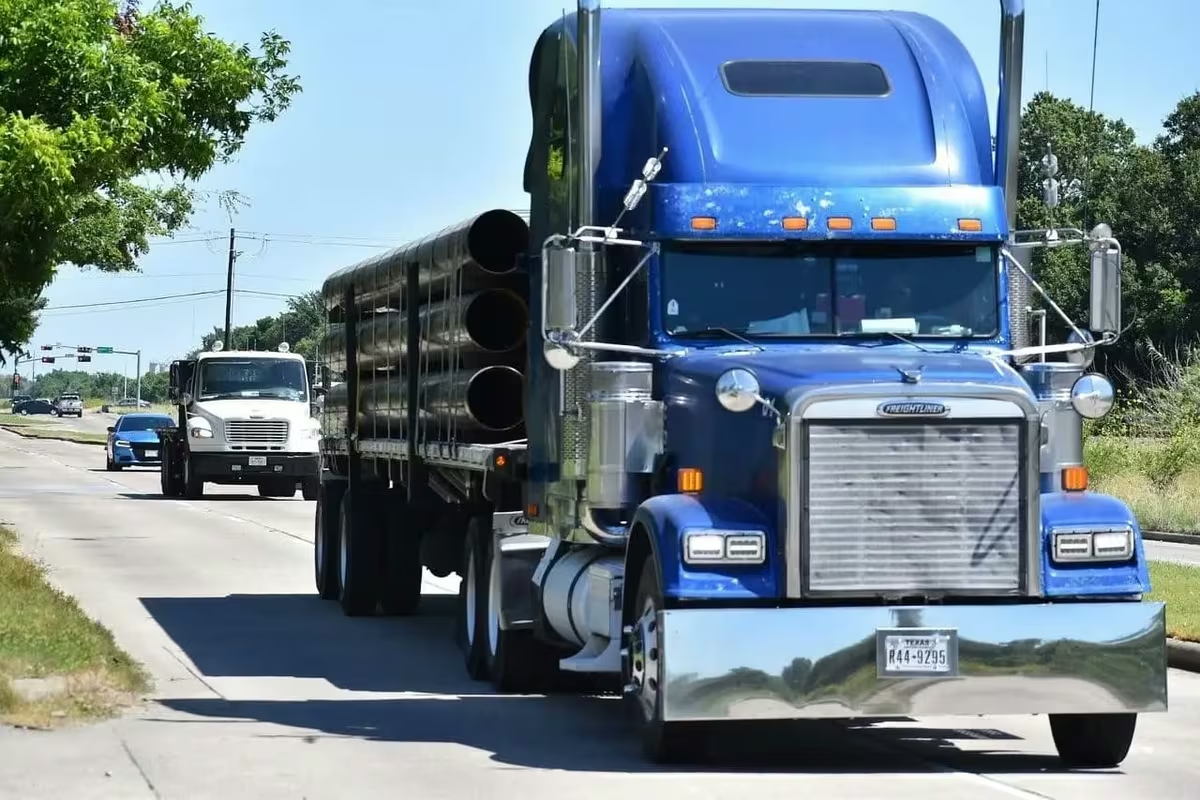 Truck Accidents18-wheeler and commercial-vehicle wrecks governed by federal trucking rules.
 Catastrophic InjuryBrain, spinal-cord, amputation, and severe-burn injuries that change a life.
 Wrongful DeathClaims brought by families after a fatal accident or act of negligence.
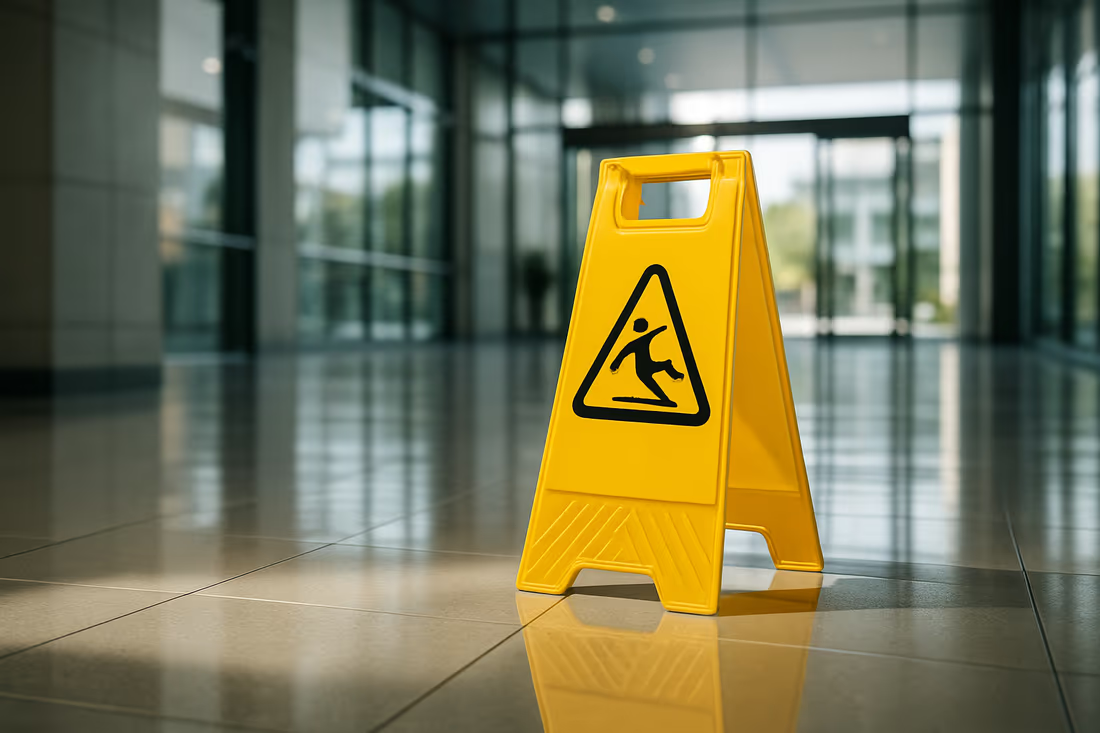 Premises LiabilitySlip-and-fall and unsafe-property injuries on someone else's premises.
 Product LiabilityInjuries caused by defective or unreasonably dangerous products.
 Oilfield AccidentsDrilling, pipeline, and refinery injuries across the energy sector.
 Industrial AccidentsPlant, warehouse, and heavy-equipment injuries in industrial settings.
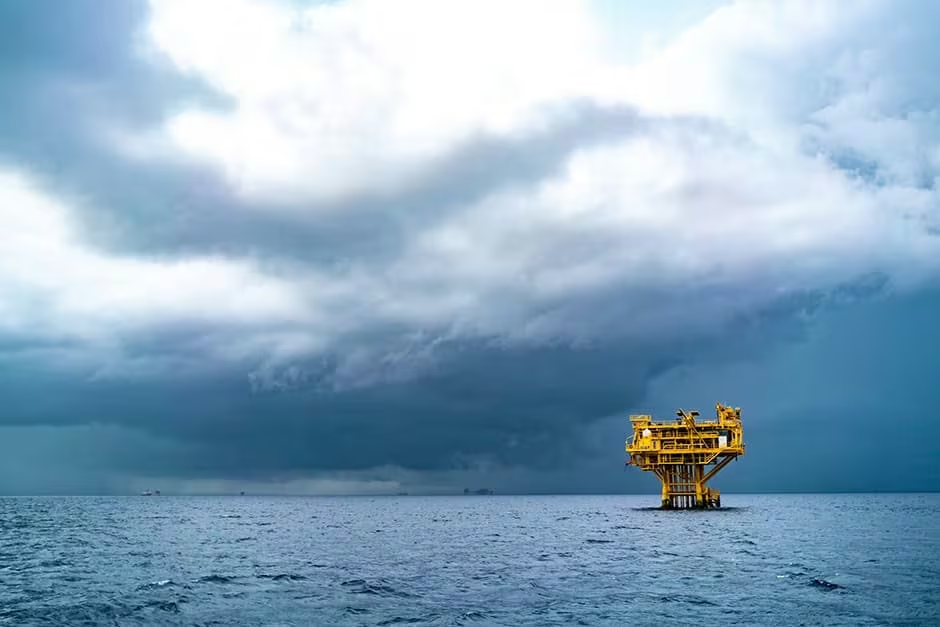 Offshore AccidentsRig, platform, and vessel injuries beyond the shoreline.
What Types of Injury Cases Are Most Common in Cameron Parish?
Cameron Parish injury cases cluster around the parish’s three defining industries: offshore and inland waterway work, energy infrastructure on the coast, and long-haul highway traffic moving workers and equipment to and from those job sites. The case mix here looks different from a typical inland Louisiana parish. A working list of categories tells a researcher what kind of evidence, witnesses, and legal frameworks tend to come up when an injury happens in this part of southwest Louisiana.
The categories below are an overview. Each one has its own section later on this page that goes into how the claim works, what governs it, and what an attorney looks at first.
Maritime and offshore injuries
Deckhands, tugboat crew, dredge workers, and offshore platform crew make up a meaningful share of the injured workers in the parish. These claims are not ordinary workers’ compensation cases. They run under federal maritime law, the Jones Act, and the Longshore and Harbor Workers’ Compensation Act, depending on the worker’s job and the vessel involved. The evidence package looks different too: vessel logs, USCG reports, crew statements, and maintenance records.
Motor vehicle and commercial truck collisions
LA-82 along the coast and LA-27 running north toward I-10 carry a steady mix of passenger traffic, oilfield service trucks, and 18-wheelers hauling equipment and product. Head-on collisions, rear-end crashes at construction zones, and rollovers on rural straightaways are the recurring patterns. Truck cases bring in federal motor carrier regulations, driver logs, and corporate defendants.
Oilfield, LNG, and industrial accidents
Cameron Parish hosts large LNG export terminals and supports a heavy oilfield service footprint. Crush injuries, falls from height, burns, equipment failures, and chemical exposures show up regularly. These cases often involve multiple contractors and subcontractors on a single site, which makes identifying the responsible party a separate investigative step before the injury claim itself takes shape.
Hurricane and storm-related claims
The parish took direct hits from Hurricane Rita in 2005 and Hurricane Laura in 2020. Post-storm injury claims include structures collapsing during cleanup, debris-related vehicle crashes, and construction-site accidents during the long rebuild cycles that follow major storms.
Wrongful death
Fatal accidents in maritime, oilfield, and highway settings all generate wrongful death claims under Louisiana Civil Code article 2315.2 or under federal maritime law, depending on where the death occurred and what the worker was doing. Surviving family members are the claimants, and the procedural rules differ sharply between state and federal tracks.
Premises liability and other claims
Slip-and-fall and premises cases at marinas, fuel docks, convenience stores along the highway corridors, and short-term rentals during fishing season round out the case mix. These are less common than the industrial and traffic cases but still part of the local picture.
A Cameron Parish injury claim almost always sits in one of these categories. Identifying which one comes first because it determines which body of law controls, which deadlines apply, and what evidence has to be preserved immediately.
Maritime, Jones Act, and Offshore Oil Rig Injuries in Cameron Parish
Cameron Parish sits where Louisiana’s working coast meets the Gulf. The Calcasieu Ship Channel, the Mermentau River, and the Gulf shipping lanes off Cameron and Holly Beach carry crew boats, supply vessels, tugs, barges, shrimpers, and offshore oil and gas rigs serving deepwater operations. When a worker on the water is hurt, the law that applies is usually not the same Louisiana tort law that governs a wreck on LA-82. It is federal maritime law, and which branch of that law applies depends on the job and where the injury happened.
Getting the legal category right is the first decision in the case. The Jones Act, the Longshore and Harbor Workers’ Compensation Act, and general maritime law each have different rules for who can sue, what must be proved, what compensation is available, and how long a worker has to file. A claim filed under the wrong framework can be dismissed or undervalued. Ask any attorney handling an offshore Cameron Parish case to explain, in plain terms, which statute governs the worker’s status and why.
Who Counts as a Jones Act Seaman
The Jones Act covers seamen: workers who contribute to the function of a vessel in navigation and have a substantial connection to that vessel or an identifiable fleet. Captains, deckhands, engineers, cooks on crew boats and supply boats, and many offshore rig workers assigned to a mobile drilling unit can qualify. The test comes from the U.S. Supreme Court’s decision in Chandris, Inc. v. Latsis, which generally treats workers who spend roughly 30 percent or more of their time in service of a vessel as seamen.
A Jones Act seaman who is injured because of the employer’s negligence can sue the employer directly in state or federal court. The negligence standard is light: if the employer’s fault played any part, however slight, in causing the injury, liability attaches. That “featherweight” causation standard is one reason the seaman classification matters so much.
Unseaworthiness and Maintenance and Cure
Alongside the Jones Act, general maritime law gives a seaman two more remedies against the vessel owner. The first is unseaworthiness: the vessel and its gear, crew, and appurtenances must be reasonably fit for their intended use. A frayed line, a defective winch, an undermanned crew, or an untrained worker assigned to a dangerous task can each render a vessel unseaworthy. Unseaworthiness does not require proof of negligence; it is closer to strict liability against the vessel owner.
The second is maintenance and cure. A seaman injured or taken ill in the service of the vessel is entitled to a daily living stipend (maintenance) and payment of reasonable medical expenses (cure) until maximum medical improvement, regardless of fault. Employers sometimes pay maintenance at outdated rates set decades ago in a union contract. A worker who is being paid twenty or thirty dollars a day for maintenance should ask whether that figure actually reflects the cost of food and lodging today.
Longshore and Harbor Workers (LHWCA)
Not every Cameron Parish maritime worker is a seaman. Longshoremen, harbor workers, ship repairers, shipbuilders, and shipbreakers working on navigable waters or adjoining piers, wharves, and terminals are typically covered by the Longshore and Harbor Workers’ Compensation Act (33 U.S.C. § 901 et seq.). LHWCA is a federal no-fault compensation system. The worker gets medical care and wage-replacement benefits without proving employer negligence, but generally cannot sue the employer in tort.
LHWCA workers can still sue third parties whose negligence contributed to the injury, such as a vessel owner under Section 905(b) of the Act, or an equipment manufacturer. Identifying every potentially responsible party outside the employer is often where real compensation in a longshore case is found.
Offshore Oil and Gas: OCSLA and the Platform Question
Many Cameron Parish workers are employed on fixed platforms, jack-up rigs, and floating production units on the Outer Continental Shelf. The Outer Continental Shelf Lands Act (43 U.S.C. § 1331 et seq.) treats fixed platforms on the OCS as artificial islands. Injuries on a fixed platform are generally governed by the law of the adjacent state, here Louisiana, adopted as surrogate federal law, rather than by general maritime law.
Workers on mobile offshore drilling units that float and move, by contrast, are often seamen under the Jones Act. The same job title can carry very different rights depending on the structure the worker was assigned to. Two questions drive the analysis: was the structure a vessel in navigation, and did the worker have a substantial connection to it? Ask the attorney to walk through both questions on the facts of the case before accepting any settlement framework.
Filing Deadlines on the Water
Maritime deadlines do not match Louisiana’s tort prescriptive period. Jones Act and general maritime negligence and unseaworthiness claims are generally subject to a three-year statute of limitations under 46 U.S.C. § 30106. LHWCA claims have their own notice and filing requirements, typically a 30-day notice of injury to the employer and one year to file a formal claim, with longer periods in occupational disease cases. Death on the High Seas Act claims and contractual indemnity disputes have separate timing rules.
A worker who assumes the standard Louisiana two-year prescriptive period applies to an offshore injury can lose rights that federal law would otherwise have preserved, or miss a shorter administrative deadline that federal law imposes. The first conversation with counsel after a Cameron Parish offshore injury should pin down which clock is running and when it started.
Car and Truck Accidents on LA-82, LA-27, and Cameron Parish Roads
Cameron Parish road crashes happen in a place with no interstate, no median barriers on most stretches, and long distances between hospitals. LA-82 runs along the coast through Holly Beach, Cameron, and Creole. LA-27 cuts north-south from Sulphur down through Hackberry and into Cameron. Both routes carry a mix of passenger cars, oilfield service trucks, tanker rigs, and crew transports. The legal analysis is the same Louisiana negligence framework that applies anywhere in the state, but the practical evidence picture is different on these roads.
This section explains how the road environment shapes a crash claim, what changes when a commercial truck is involved, and what evidence tends to decide these cases. Treat what follows as the baseline you should hear from any attorney you interview about a Cameron Parish wreck.
Why LA-82 and LA-27 Crash Scenes Are Different
These are mostly two-lane undivided highways. Head-on and run-off-road crashes carry higher energy than the same impact on a divided interstate. Shoulders are narrow, drainage ditches are deep, and long stretches have no overhead lighting. After Hurricane Rita in 2005 and Hurricane Laura in 2020, sections of LA-82 were rebuilt and elevated, but the road still runs through marsh and is exposed to wind, standing water, and salt corrosion on vehicles and signage.
Response time matters. The Cameron Parish Sheriff’s Office and Louisiana State Police Troop D out of Lake Charles handle traffic crash investigations in the parish. EMS transport for serious injuries often goes to Lake Charles hospitals rather than a local facility. That gap between crash and trauma care affects medical records, toxicology timing, and the chain of custody for evidence pulled from the vehicles.
Passenger Vehicle Crashes: What an Investigation Should Cover
A standard car-on-car crash claim in Cameron Parish runs on Louisiana negligence law. Liability turns on duty, breach, causation, and damages. For accidents on or after January 1, 2026, Louisiana applies a modified comparative fault system with a 51% bar under La. C.C. Art. 2323, so a plaintiff found 51% or more at fault recovers nothing and a plaintiff 50% or less at fault has the award reduced by that share. Accidents before January 1, 2026 remain under pure comparative fault, which reduces a plaintiff’s award by the plaintiff’s percentage of fault. A competent investigation pulls the Louisiana Uniform Motor Vehicle Crash Report, scene photographs, 911 audio if available, and any dash camera or nearby business camera footage.
Ask any attorney how they handle preservation letters and scene inspection on a remote stretch of highway. The answer tells you whether they have actually worked crashes outside of city limits. On LA-82 and LA-27, skid marks, gouge marks, and debris fields can be washed out by a single heavy rain. Drone photography and a scene visit that record them are the difference between a reconstructed crash and a he-said-she-said file.
Commercial Truck Crashes: A Different Evidence Picture
When a tractor-trailer, tanker, or oilfield service truck is involved, the case shifts. The driver works for a motor carrier subject to the Federal Motor Carrier Safety Regulations, codified at 49 C.F.R. Parts 350 to 399 and enforced by the Federal Motor Carrier Safety Administration. Hours-of-service limits, drug and alcohol testing protocols, driver qualification files, and maintenance records all become discoverable evidence. The truck itself usually carries an electronic logging device and an event data recorder. Those data sources have to be preserved before the carrier or its insurer cycles the unit back into service.
A spoliation letter to the motor carrier is standard practice. It should identify the tractor and trailer by VIN, demand preservation of the ELD data, the engine control module download, driver qualification file, post-crash drug and alcohol test results, dispatch records, bills of lading, and any in-cab or forward-facing camera footage. Ask the attorneys you interview to walk you through their preservation letter template. If they cannot, they have not handled commercial truck cases.
Liability in a commercial truck crash often reaches beyond the driver. The motor carrier, the shipper, a maintenance contractor, or a broker may all have independent duties. Sorting out the right defendants early changes how the case is built and which insurance policies respond.
Oilfield Service Vehicles and Crew Transports
Cameron Parish road traffic includes a steady volume of pickup trucks, crew vans, and service rigs moving between worksites, ports, and LNG facilities. A crash involving a worker driving a company vehicle in the course of employment can trigger employer liability under Louisiana respondeat superior principles, separate from any workers’ compensation issue the worker himself may have. The vehicle’s GPS data, fuel card records, and dispatch logs become relevant in ways they would not be in a private passenger crash.
Weather, Wildlife, and Roadway Condition Issues
Fog off the marsh, sudden squalls, and standing water are real factors on these roads. So is wildlife. Deer and alligator strikes happen. None of these is automatically a defense for the other driver. Louisiana law still asks whether each driver operated reasonably under the conditions. A driver who outran his headlights in fog at 65 miles per hour is not absolved because visibility was bad. The condition is part of the analysis, not the end of it.
Roadway design and maintenance can also matter. If a crash involves a defective signal, missing signage, an unrepaired shoulder drop-off, or standing water from a clogged drain, a claim against the responsible public entity is governed by separate Louisiana procedural rules with shorter notice requirements than ordinary tort claims. Ask any attorney you interview whether they have screened the case for a public-entity claim and how they handle the notice deadlines.
What Decides These Cases
Three things tend to decide a Cameron Parish road crash claim. First, whether the evidence was locked down. Second, how clearly the medical record ties the diagnosed injury to the crash mechanism. Third, whether the right defendants and the right insurance layers were identified before suit was filed. None of those is unique to Cameron Parish, but each is harder here because of distance, weather, and the commercial traffic mix. Use those three points as your measuring stick when you talk to attorneys about a wreck on LA-82, LA-27, or any other road in the parish.
Oilfield, LNG, and Industrial Accident Claims in Cameron Parish
Cameron Parish is one of the most concentrated land-based energy corridors in Louisiana. Liquefied natural gas export terminals, pipeline rights-of-way, gas processing plants, salt domes, and onshore oilfield service yards run from Hackberry down to Cameron and Johnson Bayou. Workers in these facilities are exposed to high-pressure systems, cryogenic fluids, hydrogen sulfide, confined spaces, and heavy mechanical loads every shift. When something goes wrong, the legal picture is rarely as simple as one employer and one injured worker.
An onshore industrial injury claim in Cameron Parish usually sits at the intersection of Louisiana workers’ compensation, third-party tort claims, and contractor indemnity agreements. The starting point in most cases is identifying every entity present on the worksite the day of the incident. A typical LNG or gas processing site can have an owner-operator, an engineering firm, a general construction contractor, multiple specialty subcontractors, a staffing company, and equipment lessors all working under interlocking master service agreements. Determining which entity controlled the activity that caused the injury is the central investigative task.
Louisiana Workers’ Compensation Versus Third-Party Claims
If a worker is hurt on the job in Cameron Parish, Louisiana workers’ compensation typically pays medical treatment and a portion of lost wages without the worker proving fault, but it also limits what can be recovered directly from the employer. The compensation system is generally the exclusive remedy against the direct employer. That does not end the analysis. A worker injured because of the conduct of a separate company on the same site can often pursue a third-party tort claim against that other company while still receiving workers’ compensation benefits. These third-party claims are where most of the meaningful compensation in industrial cases comes from.
Ask any lawyer evaluating an industrial case how they separate the compensation claim from the third-party claim. The answer should include a worksite mapping, identification of all contractors and their roles, review of the master service agreements, and an early decision about which entities are statutory employers under La. R.S. 23:1061 and which are not. If the lawyer treats every defendant the same, the case has not been worked.
LNG Terminal and Gas Processing Plant Incidents
LNG and gas processing facilities present a distinct risk profile. Workers face exposure to extremely cold liquefied gas, high-pressure piping, rotating equipment, electrical systems, and elevated work platforms. Common incident categories include flash fires and thermal burns, cryogenic exposure injuries, falls from height during turnaround work, crush injuries during heavy lifts, chemical and gas releases, and traumatic injuries from dropped objects or struck-by events.
Investigation in these cases focuses on permit-to-work records, lockout-tagout procedures, job safety analyses, contractor safety plans, and the chain of supervision in effect at the time of the incident. Site cameras, control room data, gas detector logs, and radio traffic recordings are often available but only for a limited time. A preservation letter is the practical step that protects this evidence.
Pipeline, Tank Battery, and Oilfield Service Injuries
Upstream and midstream oilfield work in Cameron Parish carries its own hazards. Pipeline construction crews, hydrostatic testing crews, tank cleaning workers, and well-service hands work with high-pressure equipment, hydrocarbon vapors, and heavy iron in remote locations. A failed connection, an improperly rated valve, an unsecured load, or a defective piece of equipment can produce catastrophic injuries far from a hospital.
Product liability claims against equipment manufacturers are an important part of the analysis under the Louisiana Products Liability Act, La. R.S. 9:2800.51 et seq., when a piece of equipment failed in a way that suggests a design defect, manufacturing defect, inadequate warning, or breach of express warranty. Identifying the actual piece of equipment, its serial number, its maintenance history, and its chain of custody after the incident is essential and often requires court intervention to preserve.
Contractor and Subcontractor Liability
Most industrial incidents in Cameron Parish involve at least one layer of contracting. The injured worker is employed by a subcontractor. The subcontractor is working for a general contractor. The general contractor is working for the facility owner. Between each tier sits a master service agreement that allocates indemnity, additional insured status, and waiver of subrogation in ways that frequently violate the Louisiana Oilfield Anti-Indemnity Act, La. R.S. 9:2780, when applied to oilfield work in this state.
The statutory employer doctrine under La. R.S. 23:1061 also runs through these arrangements. If a principal is the worker’s statutory employer for compensation purposes, tort immunity attaches to that principal and the analysis shifts to other entities on site. The contracts that exist on paper before the incident often determine which doors stay open and which close. A lawyer who has not read the master service agreement, the work order, and the certificates of insurance on a Cameron Parish industrial case has not finished the intake.
Evidence That Disappears Quickly
Industrial sites generate a large volume of contemporaneous evidence that exists only for a short period unless someone formally demands its preservation. The shortlist includes incident reports, near-miss logs, daily safety meeting sign-in sheets, the permit-to-work for the activity involved, lockout-tagout records, equipment inspection logs, training records for everyone involved, control room data, alarm histories, video from fixed cameras and contractor body or vehicle cameras, gas detector and personal monitor downloads, the equipment itself, and witness statements taken by the employer or contractor safety personnel in the hours after the incident.
A preservation letter that names each of these categories, sent to every entity that may have a copy, is one of the highest-value actions an attorney takes in a Cameron Parish industrial case. Ask any attorney how broadly that letter is addressed. The answer separates lawyers who handle these cases from lawyers who refer them out.
Wrongful Death Claims in Cameron Parish: Who Can File and What to Expect
When a Cameron Parish family loses someone in a preventable accident, two separate claims usually exist at the same time. One is a wrongful death claim, brought by surviving family members for their own losses. The other is a survival claim, brought on behalf of the person who died for what they went through between the injury and death.
Who Has the Right to File a Wrongful Death Claim
Louisiana sorts the right to file by class. A spouse and the children of the deceased come first.
Wrongful Death Versus Survival Action
A wrongful death claim pays the family for what they lost when the person died.
A survival action pays the estate for what the deceased experienced from the moment of injury until death.
Special Rules When the Death Happens Offshore or on Navigable Water
Cameron Parish wrongful death cases frequently involve maritime work. When a seaman or maritime worker dies on navigable waters or on the outer continental shelf, federal statutes can govern the claim instead of, or alongside, Louisiana law. The Jones Act covers seamen killed through employer negligence. The Death on the High Seas Act covers deaths occurring beyond state territorial waters. Longshore and harbor workers fall under a different federal scheme.
Which body of law applies changes who can file, what damages are available, and where the case is heard. A widow of a deckhand killed on a vessel in the Calcasieu Ship Channel is not in the same legal posture as a widow of a plant worker killed onshore at an LNG facility. Ask any attorney how they identify which statute governs before filing suit. The wrong choice of forum or law early in the case can shrink the claim.
What to Expect Procedurally
Wrongful death cases in Cameron Parish move on a longer timeline than ordinary injury claims. Early steps usually include securing the scene evidence, obtaining the death certificate and autopsy report, identifying every potentially responsible party, and preserving employment and medical records. In industrial deaths, investigators from regulatory agencies often produce reports that become central evidence later.
Settlements in wrongful death cases require careful allocation among the family members who hold the claim, and minor children’s portions typically need court approval.
What Compensation Can You Recover After an Injury in Cameron Parish?
La. C.C. art. 2315 establishes the basic right: every act that causes damage to another obliges the person at fault to repair it. In a Cameron Parish injury claim, that repair is divided into categories the law recognizes as economic damages, non-economic damages, and, in narrow circumstances, additional categories tied to the nature of the wrong. What a specific claim will produce depends on the proof available, the conduct of the defendant, and the applicable body of law (Louisiana civil code, the Jones Act, or general maritime law).
Economic damages
Economic damages are the out-of-pocket and provable financial losses caused by the injury. They include past medical bills already incurred, future medical care that physicians say will be reasonably necessary, lost wages from time missed at work, and loss of future earning capacity when an injury limits what the person can earn going forward. They also include property damage, such as the cost to repair or replace a vehicle after a wreck on LA-82 or LA-27, and out-of-pocket costs like prescription co-pays, mileage to medical appointments, and home modifications when an injury requires them.
Non-economic damages
Non-economic damages compensate for the human losses that do not arrive with an invoice. Louisiana courts recognize categories that include physical pain and suffering (past and future), mental anguish, disfigurement and scarring, loss of enjoyment of life, and loss of consortium for a spouse or, in some circumstances, other close family members.
Damages in maritime and Jones Act claims
When a Cameron Parish injury arises offshore, on a vessel, or in another maritime context, the damages framework shifts. A seaman injured in the course of employment is entitled to maintenance and cure (a daily living stipend and medical care) regardless of fault, and may pursue Jones Act negligence damages for lost wages, lost earning capacity, pain and suffering, and medical expenses. General maritime law also provides remedies for unseaworthiness. These are distinct from the civil code categories above and are handled in the maritime portion of the page.
Wrongful death and survival damages
When an injury results in death, Louisiana recognizes two separate claims under La. C.C. arts. 2315.1 and 2315.2: a survival action for the damages the decedent sustained between injury and death, and a wrongful death action for the losses the surviving family members suffer because of the death. Who may bring each claim and what each claim compensates is set out in the statutes and is addressed in the wrongful death portion of this page.
What affects the final number
Several things determine what a Cameron Parish claim actually pays. The clarity of liability matters: a clear-fault rear-end collision documented by a State Police crash report reads differently than a disputed-fault intersection wreck.
What Should You Do After an Accident in Cameron Parish?
The steps you take in the first hours and days after a Cameron Parish accident shape what evidence survives and what a claim can prove later. Cameron Parish is rural, coastal, and spread thin. Cell service drops along stretches of LA-82 and LA-27. The nearest hospital with a trauma program is in Lake Charles, not in the parish itself.
Call 911 and Get a Police Report
Call 911 first, even if the crash or incident seems minor. For wrecks on parish roads and state highways, Louisiana State Police Troop D out of Lake Charles or the Cameron Parish Sheriff’s Office will respond. On private industrial sites and LNG facilities, the company will usually have its own incident response, but you still want a public-agency report when the location and circumstances allow it.
Get Medical Treatment, Even If You Feel Okay
Go to an emergency room or urgent care the same day when possible. In Cameron Parish, that usually means transport to Lake Charles Memorial, CHRISTUS Ochsner Lake Area, or another Calcasieu Parish facility. If you are offshore or on a rig, document the company medic visit and ask for a copy of the incident report and any drug or alcohol testing results.
Document the Scene Before It Changes
Coastal weather and tidal flooding can wash a roadside scene clean within a day. Industrial scenes get cleaned up faster than that.
Report the Accident, But Be Careful What You Say
Report the accident to your own insurance company promptly. Do not give a recorded statement to the other driver’s insurance company before you have talked to a lawyer. The same caution applies to workplace and offshore incidents. Cooperate with the required incident report, but treat any recorded statement, written narrative, or release of medical records request as something to review with counsel first.
Preserve Evidence That Will Otherwise Disappear
Some evidence has a short shelf life and a Cameron Parish accident often involves more of it than a typical city wreck.
- Commercial truck data: electronic logging devices, engine control modules, and dashcam footage are often overwritten on a rolling schedule, sometimes within days.
- Industrial and LNG facility records: control room logs, surveillance video, maintenance records, and safety meeting notes can be routinely destroyed under document retention policies.
- Vessel and rig records: voyage data recorders, captain’s logs, JSA forms, and crew statements are company-controlled and not always shared voluntarily.
- Roadway evidence: skid marks fade, debris gets cleared, and damaged guardrails or signs get repaired by DOTD within weeks.
A written preservation letter to the trucking company, employer, vessel owner, or facility operator can stop the routine destruction of this evidence. We aim to send that letter once we have a good-faith basis for the claim, because moving as early as the law permits gives a client the best chance to keep the proof the case depends on. Those records show how fast a truck was moving and how long its driver had been on duty, what failed on a rig, vessel, or plant and who controlled the work, and what the road looked like on the day of the crash.
When to Call a Lawyer
There is no waiting period. You can call before you leave the hospital. For serious injuries, offshore incidents, commercial truck wrecks, LNG and industrial accidents, and any fatal accident, calling early matters because the evidence preservation steps above need to happen before company representatives, insurers, or routine document retention policies move first. A consultation costs nothing and does not commit you to hiring anyone. Ask the lawyer what they would do in the next 30 days on your case. The answer tells you whether they have a plan or a pitch.
How Does the Personal Injury Claim Process Work in Cameron Parish?
The claim process moves through predictable stages: investigation, medical treatment and documentation, demand, suit, discovery, mediation or trial, and resolution. Cameron Parish cases run through the 38th Judicial District Court, which sits in the Cameron Parish Courthouse.
Investigation and Evidence Preservation
The first stage is gathering and locking down evidence. That means crash reports, scene photographs, vehicle data, witness statements, employer records for on-the-job incidents, vessel logs and crew statements for maritime claims, and surveillance or dashcam footage when available. In industrial and oilfield matters, evidence often sits inside a corporate defendant’s records system, which makes a written preservation demand a priority.
Pre-Suit Demand and Negotiation
Once treatment reaches a stable point, the attorney assembles a demand package: liability analysis, medical records and bills, wage-loss documentation, and a written demand to the at-fault party or its insurer. Some claims resolve at this stage.
Filing Suit and Discovery
If negotiation does not produce a fair offer, suit is filed. For incidents in Cameron Parish, the typical venue is the 38th Judicial District Court. Maritime and Jones Act claims may proceed in federal court or under federal substantive law depending on the facts. After suit, both sides exchange written discovery, take depositions, and retain experts.
Mediation, Trial, and Resolution
Most cases resolve through mediation or negotiated settlement after discovery exposes the strengths and weaknesses on both sides. Cases that do not settle proceed to trial before a judge or jury. Resolution at any stage is followed by payment of medical liens, costs, and the contingency fee, with the balance going to the client.
What Is the Deadline to File a Personal Injury Lawsuit in Louisiana?
Louisiana now gives most injury victims two years to file a personal injury lawsuit. That change took effect July 1, 2024, when the Louisiana Legislature extended what used to be a one-year prescriptive period to two years for tort claims arising after that date. Injuries that happened on or before July 1, 2024 are still governed by the old one-year rule. The deadline applies whether the accident happened on LA-82 near Holly Beach, at an LNG facility in Hackberry, or offshore in the Gulf.
The clock generally starts running on the date the injury was sustained. If the injury was not immediately apparent, Louisiana courts apply the doctrine of contra non valentem, which can delay the start of prescription until the victim knew or reasonably should have known of the injury and its cause.
When the two-year clock starts
For a car or truck wreck, the date of the collision is almost always the trigger date. For wrongful death claims, the period runs from the date of death rather than the date of the underlying injury. Claims against governmental entities under the Louisiana Governmental Claims Act carry their own notice and procedural requirements that sit on top of the prescriptive period.
Federal and maritime deadlines are different
A Cameron Parish injury claim may not be a Louisiana tort claim at all. Jones Act seaman claims and general maritime claims under federal law carry a three-year statute of limitations, not the Louisiana two-year period. Longshore and Harbor Workers’ Compensation Act claims have their own notice and filing deadlines measured in days and months, not years. Identifying the correct legal track early matters, because filing under the wrong statute does not stop the right clock.
What happens if the deadline passes
Under La. C.C. art. 3447, prescription extinguishes the claim. A defendant who is sued after the deadline can file an exception of prescription, and Louisiana courts routinely dismiss late-filed cases.
Why earlier is better than later
Waiting until the final weeks of the prescriptive period puts every part of a case under pressure. Witnesses scatter. Surveillance video at gas stations along LA-27 or at industrial sites gets overwritten. Vehicle data, electronic control modules, and maintenance records can disappear on routine retention cycles. Evidence preservation letters, scene inspections, and medical documentation are easier to do well when there is time to do them at all. Ask any attorney how they handle preservation letters and crash data.
What If I Was Partly at Fault for the Accident Under Louisiana Law?
Being partly at fault does not automatically bar you from compensation in Louisiana, but the rule depends on when the accident happened. For causes of action arising on or after January 1, 2026, Louisiana applies a modified comparative fault system under La. C.C. Art. 2323, as amended by Act 15 of the 2025 Regular Session. If you are found 51% or more at fault, you recover nothing. If you are 50% or less at fault, your damages are reduced by your share of the fault. Accidents before January 1, 2026 remain under the prior pure comparative fault rule, which reduced damages by the plaintiff’s percentage of fault no matter how high that percentage ran.
How Comparative Fault Works in Practice
The trier of fact assigns a percentage of fault to every party whose conduct contributed to the harm, including non-parties and the plaintiff.
Fault can be spread across multiple defendants and non-parties. In a chain-reaction crash on LA-27, fault might land on three drivers, a trucking company, and a road contractor whose striping had faded. Under La. C.C. art. 2324, most defendants in tort cases are liable only for their own share. Joint and solidary liability is limited. That changes the strategy: the lawyer has to identify and pursue every responsible party, because one defendant rarely pays for another’s share.
Why Insurers Push Fault Onto the Injured Person
Every percentage point of fault assigned to you reduces what the insurer pays. Recorded statements taken in the days after a wreck are designed to extract admissions that support a higher plaintiff-fault percentage.
In maritime and Jones Act cases, a comparable doctrine applies but with different mechanics, and seamen’s contributory negligence is reduced under federal standards rather than La. C.C. Art. 2323.
What Evidence Moves the Fault Percentage
Fault assignments respond to documented evidence, not to what either party remembers. The evidence that tends to shift fault away from the injured person includes the crash report, scene photographs, vehicle damage patterns, event data recorder downloads, dashcam and surveillance footage, electronic logging device records in trucking cases, cell phone records, toxicology on the other driver, witness statements taken before memories drift, and engineering reconstruction. Roadway design records held by the Louisiana Department of Transportation and Development matter when a curve, sight line, or shoulder condition contributed to the wreck.
The practical implication: do not give a recorded statement to the other side’s insurer before talking to a lawyer, do not post about the wreck on social media, and document treatment consistently. The fault percentage is negotiable until a jury fixes it. Everything you do in the weeks after the incident either supports or undermines that negotiation.
What Our Clients Say
- Dakota R.
Where should I start!?Trey Morris Injury Law Firm was a great fit for me! During this wild time of getting into a car wreck, dealing with insurance, and other third parties, Mrs. Brooke and Mrs. Nerren were extremely helpful! They were there for me through the whole process and never once did I doubt their professionalism. They will fight tooth and nail for you and get you what you deserve. I would recommend them to anyone.
- Jontiana W.
Brooke and Ms.Shavers did great and helped me so much and I am so grateful. Go see Trey Morris Injury Attorneys!!
- ELvia G.
We are very grateful to [Trey Morris Injury Lawyers] for all their help and support during our car accident case.Ms. Hancock and Ms. Mena were always very kind, professional, and attentive throughout the entire process. Excellent team.
- A client
Great experience working with this Injury law firm.Very professional and helpful team overall , especially Trey Morris. Communication was great throughout my case, and they made the process much less stressful. My case is now over, and I really appreciated how responsive and organized everyone was, from the case manager to their receptionist.
- Taa-Daw S.
Very professional,answers the phone when you call them and answers every question you may have..Highly recommended..
- MIRANDA G.
I spoke with a attorney from this law firm.He was very honest, gave great advice. Then I finally made a appt once I meet Joe Norman I knew he was the one for me. Usually, I don’t trust attorneys but I’m glad I gave Joe Norman with Lee Hoffas group a chance. I feel like I can exhale finally I trust them completely. Miranda [G.]
- Tammy L.
My son and daughter were in an accident and injured.T-Claude Devall was first concerned with their injuries and getting them straight into therapy, then helped us with the legalities of our options. His paralegal Missy is easy to talk to when needed and helpful when we needed things changed up medically. I would recommend them to anyone and if ever needed in the future, will be a return client.
- Michelle C.
The entire staff was professional and courtesy!I could not believe how fast they settled my case and how accommodating they were! Thank you!
- Shanendoah F.
Awesome service with Family Value .Great and friendly people to talk to would recommend to anyone .
- Nicole H.
Thank you to Missy Carter and the staff of people are Hoffoss Duvall, for all the help they are providing in handling my case!!You guys are awesome!!
- Suzanne G.
I highly recommend this firm.The staff displays the utmost professionalism, as a team. They are honest and make you feel welcomed! ☆☆☆☆☆
- Elizabeth A.
Friendly staff!The receptionist (Alecia) was very nice and went beyond her job to make sure we were taken care of fast and effectively.
Testimonials do not constitute a guarantee, warranty, or prediction regarding the outcome of your legal matter. Past results do not guarantee future outcomes.
Your Cameron Parish Trial Team
The lawyers who work your file. Every Cameron Parish case is handled by the firm's own trial attorneys.









How Much Does a Cameron Parish Injury Lawyer Cost?
Personal injury attorneys in Louisiana typically work on a contingency fee. You pay no hourly rate and no upfront retainer. The lawyer is paid a percentage of the settlement or judgment, and only if the case results in compensation. If there is no compensation, there is no attorney fee.
The percentage, case expenses, and how costs are handled are spelled out in a written contingency fee agreement before representation begins. Read that document carefully and ask questions before signing. A clear fee conversation at the first meeting is one of the better indicators that a firm runs an organized practice.
What a Contingency Fee Covers
The contingency percentage is the attorney’s fee for legal work: investigation, demand letters, negotiation with adjusters, drafting pleadings, depositions, motion practice, mediation, and trial if the case goes that far. The percentage is commonly tiered, with one rate applying if the case settles before suit is filed and a higher rate applying after suit is filed or the case proceeds to trial. The specific numbers belong in the written agreement, not in a verbal estimate.
Ask any attorney to walk you through their fee tiers in plain language. Ask when the higher tier kicks in. Ask whether the percentage is calculated on the gross settlement or after case expenses are deducted. Those answers should be consistent with what the written agreement says.
Case Expenses Are Separate From the Fee
Case expenses are the out-of-pocket costs of building the claim. These can include medical records and billing requests, accident reconstruction, expert witnesses, court filing fees, deposition transcripts, exhibit preparation, and travel for site inspections in places like Cameron, Hackberry, Holly Beach, or offshore platforms staged out of the parish. Maritime and oilfield cases tend to carry higher expert costs than a routine auto claim because liability often turns on engineering, safety standards, or vessel operations.
Most personal injury firms advance these expenses during the case and are reimbursed from the settlement at the end. Confirm in writing who advances expenses, whether you owe them back if the case does not result in compensation, and how expenses are itemized on the final settlement statement.
The Free Initial Consultation
The first meeting with a Cameron Parish injury attorney is generally free. There is no charge to discuss what happened, review records you already have, and hear an honest assessment of whether a claim makes sense. You are not obligated to hire the firm after that meeting.
Use the consultation to evaluate the lawyer. Ask how often they handle maritime, oilfield, and trucking cases tied to southwest Louisiana. Ask who in the office will actually work the file. Ask how they communicate with clients and how often. The way those questions are answered tells you more about the practice than a brochure does.
What You Receive at the End of a Case
When a case resolves, Louisiana attorneys provide a written settlement statement showing the gross amount, the contingency fee, itemized case expenses, medical liens or subrogation claims paid, and the net amount paid to the client. Ask to see a sample settlement statement at the consultation if it helps you understand the math. There should be no surprises at the end. Every deduction should match the written agreement signed at the beginning.