











Sulphur wrecks happen on I-10, on Highway 90 and Highway 27 through town, and on Cities Service Highway, Highway 108, where plant and refinery truck traffic mixes with everyone else. The people hurt in them are taken to West Calcasieu Cameron Hospital on Cypress Street. The Sulphur Police Department writes the report inside city limits and the Calcasieu Parish Sheriff’s Office writes it outside them. Suits are filed at the Calcasieu Parish Courthouse on Lakeshore Drive in Lake Charles, and the record is kept by the Calcasieu Parish Clerk of Court on Ryan Street. Trey Morris Injury Lawyers handles Sulphur cases from our Lake Charles office on Ihles Road. We request the police report, send preservation letters to any plant contractor or carrier whose vehicle was involved, and collect the emergency room records from West Calcasieu Cameron.
The law that governs the claim is Louisiana law, the same in Calcasieu Parish as everywhere else in the state. If you were hurt in Sulphur, your case is heard in the 14th Judicial District Court in Calcasieu Parish, and your filing deadline is two years under La. C.C. Art. 3493.1 for injuries after July 1, 2024, or one year under La. C.C. Art. 3492 for injuries on or before that date. For accidents on or after January 1, 2026, a finding that you were 51% or more at fault under La. C.C. Art. 2323 ends the claim, which matters in the plant and refinery wrecks along I-10 and Highway 108.
Results for Louisiana Clients
- $409 MillionWrongful Death
A tragic case where an impaired driver of a commercial vehicle ran a red light, then collided with our client, causing serious bodily injury to the mother and the loss of life of her daughter.
- $49 MillionMotor Vehicle Accident
An impaired driver of a stolen vehicle driving the wrong way collided with our client head-on, resulting in brain injury and multiple broken bones.
- $32,195,000Industrial / Workplace
Failure to maintain proper safety protocols led to an explosion at an industrial plant causing a series of catastrophic injuries from broken bones, burns, spinal injury, and mental anguish.
- $31.5 MillionIndustrial / Workplace
Brain and spinal injuries followed an oil-field company failing to maintain equipment and provide a safe work site.
- $17.25 MillionCommercial Vehicle Accident
Client was struck head-on by a disconnected load of an 18-wheeler that crossed the median causing broken bones and amputation.
- $13 MillionCommercial Vehicle Accident
On the interstate, an 18-wheeler failed to yield right of way then made an unsafe lane change causing the accident which resulted in major bone breaks, damaged organs, and ultimately a leg amputation.
Past results do not guarantee future outcomes; each case is decided on its own facts.
Sulphur sits in the middle of one of Louisiana’s most concentrated industrial corridors. Chemical plants, refineries, and processing facilities line the highways on both sides of town. No one researches injury lawyers for fun. Something happened, and now you need to understand your legal options.
This page explains how personal injury and industrial accident claims work in Louisiana, what the 2024 and 2025 tort reform changes mean for Calcasieu Parish cases, and how cases move through the 14th Judicial District Court. Trey Morris Injury Lawyers has handled industrial injury cases and vehicle accident claims across Louisiana for over 20 years, including cases arising from the Sulphur petrochemical corridor. Read this page. Compare us to other firms. Make the decision that is right for your situation.
Industrial Accidents and Workplace Injuries in the Sulphur Petrochemical Corridor
Sulphur and the surrounding area between Lake Charles and Westlake contain one of Louisiana’s densest concentrations of petrochemical and refinery operations. Chemical plants, sulfur processing facilities, and oil refineries line I-10 and Highway 108 through this corridor. The industrial workforce here faces hazards that most Louisiana workers never encounter.
Hydrogen sulfide
A toxic gas produced during petroleum refining and sulfur processing. Exposure causes respiratory failure, nervous system damage, and death at high concentrations. OSHA’s permissible exposure limit is 20 parts per million over an 8-hour period.
Common industrial injury types in this corridor include chemical exposure, thermal and chemical burns, explosions, equipment malfunction, and falls from elevated structures. Hydrogen sulfide exposure is a specific risk in sulfur processing and refinery operations. Even brief exposure at high concentrations causes respiratory failure. Workers in these facilities face both acute injury risks and long-term occupational health consequences.
Workers’ Compensation vs. Third-Party Claims
Louisiana workers’ compensation covers medical expenses and a portion of lost wages regardless of fault. But it does not cover pain and suffering, and the wage replacement is capped. When a third party caused or contributed to your injury, you may have a separate negligence claim in addition to workers’ compensation. Third parties in industrial settings include equipment manufacturers, contractors, subcontractors, and facility owners who are not your direct employer.
Ask any attorney you are considering whether they handle both workers’ compensation and third-party industrial claims. These cases require understanding how the two systems interact. Filing one incorrectly can affect the other. Trey Morris Injury Lawyers handles both claim types and coordinates them to maximize total recovery for the injured worker.
Contractor and Subcontractor Liability
Petrochemical facilities in Sulphur use layers of contractors and subcontractors. A refinery may own the facility, hire a general contractor for a turnaround project, and that contractor hires specialized subcontractors for specific tasks. When an injury happens, identifying every responsible party determines how much compensation is available.
Louisiana law holds each negligent party responsible for their share of fault. If a facility owner failed to maintain equipment, a contractor skipped safety protocols, and a subcontractor provided defective materials, all three may owe compensation. OSHA citations and investigation records from these sites become evidence in your case. Your attorney should know how to obtain and use OSHA records in litigation. Trey Morris Injury Lawyers sends preservation demands to all involved parties to prevent evidence destruction.
Local Coverage. Statewide Record.
- $1 Billion+
Outcomes for Louisiana clients
Verdicts and settlements won across the state by the same trial team that handles Sulphur cases.
- 11
Trial attorneys, one team
Your case is handled by the firm's own trial attorneys, and we respond in minutes, 24/7.
- 24/7
We come to you
An attorney travels to you in Sulphur, at home or at the hospital, or meets by video the same day. Free case review, and no fee unless we win.
- 127
Cases resolved over $1 million
Verdicts and settlements of $1 million or more, won by the same trial team that handles Sulphur cases.
I-10 Corridor Crash Patterns in Calcasieu Parish
I-10 carries heavy commercial truck traffic directly through Sulphur, connecting Lake Charles to the Texas border at Orange. The petrochemical industry generates a concentration of tanker trucks and 18-wheelers on this stretch that exceeds most Louisiana interstate corridors. Tanker trucks, 18-wheelers hauling industrial materials, and heavy equipment transport vehicles share the road with commuter traffic daily.
Highway 90 and Highway 27 serve as major surface road connectors through Sulphur. Cities Service Highway (Highway 108) runs through the industrial areas with heavy truck traffic mixing with residential and commercial vehicles. The combination of industrial truck volume and passenger vehicles creates crash patterns specific to this part of Calcasieu Parish.
Truck accidents involving hazardous materials add complexity beyond standard vehicle collision claims. When a tanker carrying industrial chemicals is involved in a crash, the case may involve environmental contamination, evacuation costs, and exposure injuries to people beyond those in the vehicles. These cases require attorneys who understand both personal injury law and the federal regulations governing hazardous material transport.
Weather compounds the risk along this corridor. Fog over the Calcasieu River reduces visibility on I-10 during fall and winter months. Heavy rain creates hydroplaning conditions on industrial access roads. Hurricane evacuation routes funnel massive traffic volumes through I-10 at Sulphur, creating congestion-related crash spikes. Car accident claims from this corridor require an attorney familiar with the specific traffic dynamics of the Sulphur and Lake Charles area.
Sulphur Practice Areas
 Car AccidentsRear-end, intersection, and highway collisions across Louisiana.
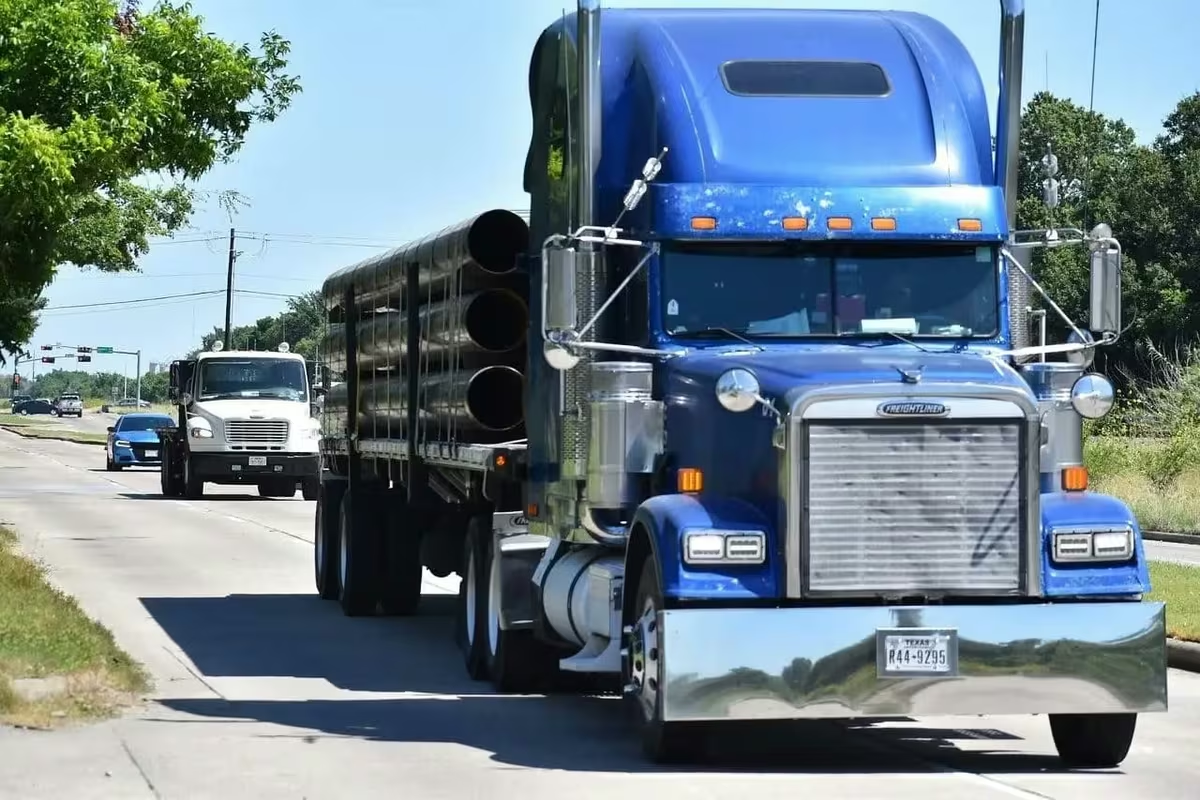 Truck Accidents18-wheeler and commercial-vehicle wrecks governed by federal trucking rules.
 Catastrophic InjuryBrain, spinal-cord, amputation, and severe-burn injuries that change a life.
 Wrongful DeathClaims brought by families after a fatal accident or act of negligence.
 Premises LiabilitySlip-and-fall and unsafe-property injuries on someone else's premises.
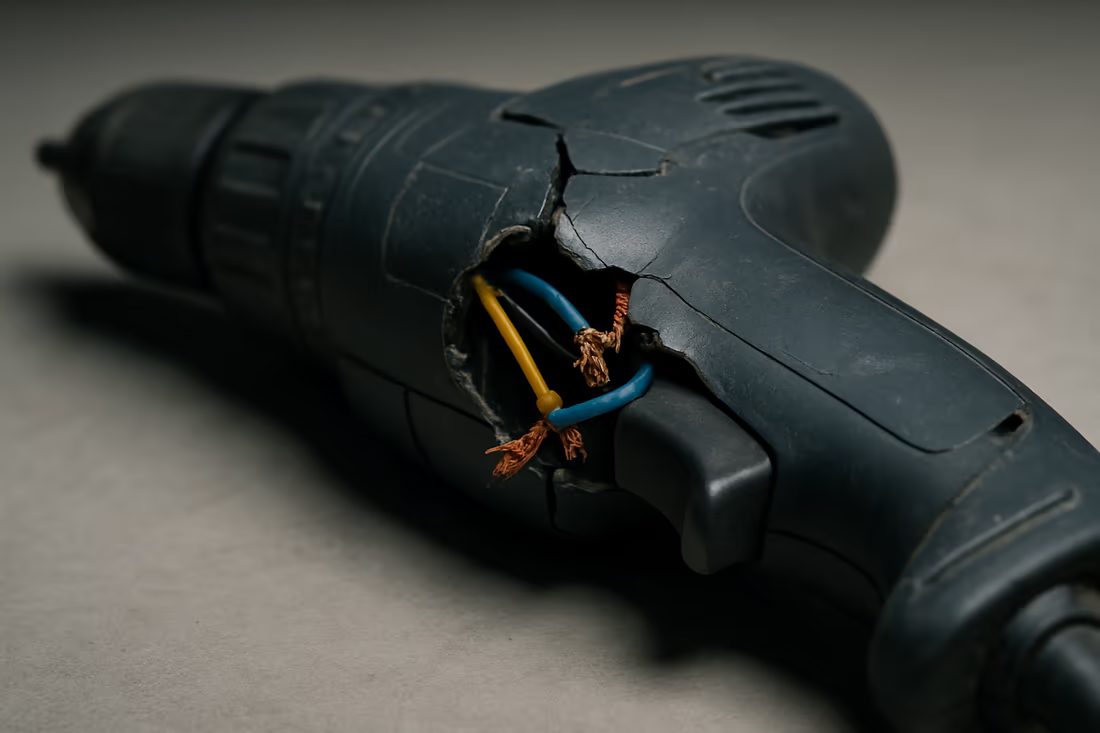 Product LiabilityInjuries caused by defective or unreasonably dangerous products.
 Oilfield AccidentsDrilling, pipeline, and refinery injuries across the energy sector.
 Industrial AccidentsPlant, warehouse, and heavy-equipment injuries in industrial settings.
 Offshore AccidentsRig, platform, and vessel injuries beyond the shoreline.
What Types of Injury Cases Arise in Sulphur and Calcasieu Parish?
Sulphur injury cases include motor vehicle accidents, industrial and refinery injuries, construction accidents, premises liability, wrongful death, and product liability. The industrial economy shapes the types of claims here more than in most Louisiana communities.
Motor Vehicle Accidents
Car accidents on I-10, Highway 90, Highway 27, and parish roads make up a significant portion of injury cases in this area. Interstate crashes often involve commercial vehicles at highway speeds. Surface road accidents on Highway 108 and local roads frequently involve industrial truck traffic mixing with residential vehicles.
The Calcasieu Parish Sheriff’s Office and Sulphur Police Department investigate crashes in this jurisdiction. Obtaining the police report early matters because it contains the responding officer’s observations, witness contact information, and initial fault assessments that shape the direction of your claim.
Industrial and Refinery Accidents
The petrochemical corridor produces industrial injury cases involving chemical exposure, explosions, equipment failures, and structural collapses. Plant turnaround periods, when facilities shut down for maintenance and upgrades, bring in hundreds of temporary contractors and increase the accident rate.
Oil field and refinery accident claims from these facilities often involve multiple defendants and complex liability disputes. Ask any attorney you are considering whether they have handled multi-defendant industrial cases. The number of parties changes everything about how the case is investigated and litigated.
Construction Accidents
Construction site accidents in Sulphur frequently occur during industrial expansion projects and plant turnarounds. Falls from cooling towers, storage tanks, and scaffolding at height are common. Struck-by injuries from falling objects and moving equipment create severe trauma cases.
Workers on these sites may have claims against the general contractor, the facility owner, and equipment suppliers. Identifying all potentially liable parties early determines the total pool of compensation available. A case against one subcontractor with minimal insurance coverage looks different from a case that includes the facility owner and general contractor.
Premises Liability and Product Liability
Slip-and-fall injuries at commercial properties and industrial facilities create premises liability claims. Louisiana law requires property owners to maintain safe conditions and warn visitors of known hazards. Product liability cases involve defective industrial equipment, safety gear that failed, or vehicles with manufacturing defects.
Both claim types use Louisiana’s negligence framework but have distinct evidence requirements. Premises liability turns on what the property owner knew and when they knew it. Product liability may involve strict liability, where you prove the product was defective without having to prove the manufacturer was negligent.
Wrongful Death
When an injury results in death, Louisiana allows surviving family members to file a wrongful death claim under La. C.C. Art. 2315.2. A separate survival action under La. C.C. Art. 2315.1 recovers damages for the victim’s suffering before death. Industrial fatalities in the Sulphur corridor often give rise to both claims.
How Do You Prove Negligence in a Sulphur Injury Case?
duty-risk analysis
Louisiana uses a negligence framework called duty-risk analysis.
Duty-risk analysis requires four elements. First, the defendant owed you a duty of care. Second, the defendant breached that duty through action or inaction. Third, the breach was a cause-in-fact of your injury. Fourth, the breach was within the scope of the duty.
Evidence in Industrial Injury Cases
Industrial cases in Sulphur produce specific categories of evidence. OSHA citations document safety violations at facilities. Incident investigation reports prepared by the facility or its contractors contain witness statements and root cause analysis. Maintenance records reveal whether equipment was properly serviced. Air quality monitoring data documents chemical exposure levels.
Spoliation
The destruction or alteration of evidence after a party has notice of pending litigation. Courts can instruct juries to assume the destroyed evidence was unfavorable to the party that destroyed it.
Spoliation is a serious concern in industrial cases. Companies may overwrite safety monitoring data, discard maintenance logs, or alter incident reports after an accident. Your attorney sends written preservation demands to every responsible party. Ask any attorney you are considering how they handle preservation letters after taking a case. Trey Morris Injury Lawyers sends preservation demands covering electronic data, maintenance records, and safety monitoring logs, because those records show what failed, whether the equipment was serviced, what workers were exposed to, and which company controlled the work. We send them once the facts give us a sound basis to ask, and we move as promptly as the law permits, because prompt action is what keeps those records available as proof.
Expert witnesses strengthen industrial injury cases. Industrial hygienists evaluate chemical exposure levels and safety compliance. Accident reconstructionists determine how equipment failures or explosions occurred. Medical experts connect your injuries to the specific exposure or event. Vocational economists calculate the financial impact on your earning capacity.
How Louisiana Tort Reform Changes Affect Sulphur Injury Cases
Louisiana passed significant tort reform legislation in 2024 and 2025. These changes directly affect how personal injury cases are valued, filed, and argued in the 14th Judicial District Court. If you were injured in Sulphur or anywhere in Calcasieu Parish, you need to understand what changed.
The Two-Year Filing Deadline
Prescriptive Period
Louisiana’s term for statute of limitations. The legal deadline to file a lawsuit. For personal injury, it is two years from the date of injury under La. C.C. Art. 3493.1 (effective July 1, 2024).
For injuries after July 1, 2024, you have two years to file suit (La. C.C. Art. 3493.1). If you were hurt on or before July 1, 2024, the one-year deadline under La. C.C. Art. 3492 still governs your claim. Product liability claims get the same two years.
The 51% Comparative Fault Bar
Comparative Fault
A legal rule that reduces your recovery by your percentage of fault. In Louisiana, if you are 51% or more at fault, you recover nothing. If you are 50% or less at fault, your damages are reduced proportionally.
For causes of action arising on or after January 1, 2026, Louisiana applies modified comparative fault under La. C.C. Art. 2323, as amended by Act 15 of the 2025 Regular Session (HB 431). If you are found 51% or more at fault, you collect nothing. If you are 50% or less at fault, your damages are reduced by your share. Accidents before January 1, 2026 remain under pure comparative fault, where recovery is reduced by your percentage of fault with no bar.
Insurance adjusters and corporate defendants in industrial cases build their defense strategy around pushing your fault percentage above 50%. Every statement you make after an accident, every safety training record, every deviation from protocol becomes ammunition for this argument. Ask any attorney you are considering how they handle comparative fault disputes in industrial settings. Trey Morris Injury Lawyers works with accident reconstructionists and industrial safety experts to establish fault percentages.
Collateral Source Rule Changes
The collateral source rule determines whether the jury hears about insurance payments or other benefits you received. Louisiana’s tort reform modified this rule to allow evidence of collateral source payments in certain circumstances. This can reduce the damages a jury awards.
In practical terms, if your health insurance paid $50,000 in medical bills, the defense may now argue the jury should consider that payment when calculating your damages. Your attorney needs a strategy for addressing this at trial. Ask whether they have experience presenting collateral source arguments to juries under the new rules.
Direct Action Statute
Louisiana’s direct action statute, La. R.S. 22:1269, now allows a lawsuit directly against the at-fault party’s insurance company only in limited situations, such as when the insured is bankrupt, insolvent, or deceased, cannot be served, or when the claim is against your own uninsured motorist carrier. In most cases the suit names the at-fault party, the insurer stays out of the caption, and the jury is not told about the insurance.
This changes settlement dynamics and trial strategy. When the insurer is at the table as a defendant, it cannot hide behind the at-fault party during negotiations. This remains one of the most significant advantages of filing an injury claim in Louisiana.
Filing an Injury Claim in the 14th Judicial District Court
The 14th Judicial District Court serves Calcasieu Parish. If you were injured in Sulphur, your case will be filed in this court. The courthouse is located in Lake Charles, the parish seat of Calcasieu Parish.
Venue rules in Louisiana generally require filing where the accident occurred or where the defendant is domiciled. For accidents in Sulphur, the 14th JDC is the appropriate venue. If the defendant is an out-of-state corporation, which is common in industrial cases involving national contractors, federal court may have jurisdiction under diversity rules when the amount in controversy exceeds $75,000.
Industrial injury cases in the 14th JDC often involve multiple defendants. The facility owner, the general contractor, subcontractors, and equipment manufacturers may all be named. Discovery in these cases involves obtaining safety records, maintenance logs, personnel files, and corporate communications from each defendant. This phase typically takes 6 to 18 months depending on the number of parties.
Mediation is commonly required before trial in the 14th JDC. If mediation does not produce a settlement, the case proceeds to a jury trial. Ask your attorney whether they have tried cases in the 14th JDC. Knowing the local judges, court procedures, and typical case timelines matters. Trey Morris Injury Lawyers has handled cases in the 14th Judicial District Court and understands the practical realities of litigating industrial and vehicle accident claims in Calcasieu Parish.
What Compensation Does Louisiana Law Allow After a Sulphur Injury?
Louisiana divides personal injury damages into categories.
Economic Damages
Economic damages cover measurable financial losses.
Loss of Earning Capacity
The difference between what you could have earned over your working lifetime and what you can earn now after the injury. Calculated by a vocational expert and converted to present value by an economist.
If your injuries permanently reduce your Loss of Earning Capacity, a vocational economist calculates the difference between your pre-injury and post-injury earning potential. Industrial workers with specialized skills often have significant earning capacity claims because the wage differential is large.
Non-Economic Damages
Loss of Consortium
A claim by the injured person’s close family for the loss of companionship, affection, and support caused by the injured person’s condition. Louisiana gives it to the same relatives who could bring a wrongful death claim, starting with the spouse and children. It is a separate damage category from the injured person’s own claims.
Non-economic damages compensate for losses that do not have a receipt. Pain and suffering, emotional distress, and Loss of Consortium are the primary categories. Loss of enjoyment of life covers activities you can no longer do because of your injuries.
Industrial Injury Damages
Industrial injuries create additional damage categories. Long-term chemical exposure may require ongoing medical monitoring even before symptoms develop. Courts recognize the cost of monitoring as a compensable damage when the exposure creates a medically documented risk.
Occupational disease claims cover conditions that develop over time from workplace exposure. These damages extend beyond the immediate injury and require medical experts who specialize in occupational health. Ask whether your attorney has experience with occupational disease claims, because the causation evidence in these cases differs from acute injury cases.
Future Damages and Life Care Plans
A life care plan, prepared by a medical professional, outlines all future treatment you will need and its cost. An economist converts those future costs to present value.
Industrial injuries involving chemical exposure or permanent physical impairment often produce future damage calculations that exceed the initial medical bills.
Punitive Damages
Punitive damages are rare in Louisiana. They are available for egregious conduct such as drunk driving crashes or intentional safety violations. In industrial cases, punitive damages may apply when a company knowingly ignored safety hazards that caused injury.
Louisiana law limits punitive damages in most cases. When they do apply, they serve as a penalty beyond compensating the injured person. The threshold for punitive damages is high, but documented corporate knowledge of a safety hazard can meet it.
What Our Clients Say
- Dakota R.
Where should I start!?Trey Morris Injury Law Firm was a great fit for me! During this wild time of getting into a car wreck, dealing with insurance, and other third parties, Mrs. Brooke and Mrs. Nerren were extremely helpful! They were there for me through the whole process and never once did I doubt their professionalism. They will fight tooth and nail for you and get you what you deserve. I would recommend them to anyone.
- Jontiana W.
Brooke and Ms.Shavers did great and helped me so much and I am so grateful. Go see Trey Morris Injury Attorneys!!
- ELvia G.
We are very grateful to [Trey Morris Injury Lawyers] for all their help and support during our car accident case.Ms. Hancock and Ms. Mena were always very kind, professional, and attentive throughout the entire process. Excellent team.
- A client
Great experience working with this Injury law firm.Very professional and helpful team overall , especially Trey Morris. Communication was great throughout my case, and they made the process much less stressful. My case is now over, and I really appreciated how responsive and organized everyone was, from the case manager to their receptionist.
- Taa-Daw S.
Very professional,answers the phone when you call them and answers every question you may have..Highly recommended..
- MIRANDA G.
I spoke with a attorney from this law firm.He was very honest, gave great advice. Then I finally made a appt once I meet Joe Norman I knew he was the one for me. Usually, I don’t trust attorneys but I’m glad I gave Joe Norman with Lee Hoffas group a chance. I feel like I can exhale finally I trust them completely. Miranda [G.]
- Tammy L.
My son and daughter were in an accident and injured.T-Claude Devall was first concerned with their injuries and getting them straight into therapy, then helped us with the legalities of our options. His paralegal Missy is easy to talk to when needed and helpful when we needed things changed up medically. I would recommend them to anyone and if ever needed in the future, will be a return client.
- Michelle C.
The entire staff was professional and courtesy!I could not believe how fast they settled my case and how accommodating they were! Thank you!
- Shanendoah F.
Awesome service with Family Value .Great and friendly people to talk to would recommend to anyone .
- Nicole H.
Thank you to Missy Carter and the staff of people are Hoffoss Duvall, for all the help they are providing in handling my case!!You guys are awesome!!
- Suzanne G.
I highly recommend this firm.The staff displays the utmost professionalism, as a team. They are honest and make you feel welcomed! ☆☆☆☆☆
- Elizabeth A.
Friendly staff!The receptionist (Alecia) was very nice and went beyond her job to make sure we were taken care of fast and effectively.
Testimonials do not constitute a guarantee, warranty, or prediction regarding the outcome of your legal matter. Past results do not guarantee future outcomes.
Your Sulphur Trial Team
The lawyers who work your file. Every Sulphur case is handled by the firm's own trial attorneys.









Trey Morris Injury Lawyers Serving Sulphur and Calcasieu Parish
Trey Morris Injury Lawyers’ Lake Charles office serves Sulphur and the Calcasieu Parish region. The firm has handled personal injury and industrial injury cases across Louisiana for over 20 years, with more than 5,000 cases completed.
The firm holds an AV Preeminent rating from Martindale-Hubbell, the highest peer review rating available. Multiple attorneys at the firm have been recognized by Super Lawyers. The firm has accumulated more than 2,815 five-star Google reviews from clients across Louisiana.
Local knowledge matters in Sulphur injury cases. Understanding the petrochemical corridor, knowing which facilities produce which types of injuries, and having experience in the 14th Judicial District Court all affect case outcomes. Trey Morris Injury Lawyers has handled cases involving refinery accidents, chemical plant explosions, I-10 corridor crashes, and industrial workplace injuries throughout Calcasieu Parish.
Contingency Fee
A fee arrangement where the attorney is paid a percentage of the recovery and only if there is a recovery. The client pays nothing upfront and owes no attorney fees if the case is unsuccessful.
The firm operates on a Contingency Fee basis. You pay nothing unless the firm recovers compensation for you. There is no upfront cost and no hourly billing. View our case results and client testimonials to evaluate our track record. Reach out when you are ready.