








Pedestrians in Shreveport are struck on Youree Drive, Line Avenue, Jewella Avenue, and Bert Kouns, in crosswalks and mid-block, and the people hit there are taken to Ochsner LSU Health Shreveport on Kings Highway, the Level I trauma center, or to Willis-Knighton on Greenwood Road, which also treats serious trauma across the metro, or to CHRISTUS Highland. The Shreveport Police Department writes the report inside the city limits, and the Caddo Parish Sheriff’s Office writes it outside them. Caddo suits can be filed and tried in the First Judicial District Court at 501 Texas Street. Trey Morris Injury Lawyers is at 509 Milam Street, across the street from the Caddo Parish Courthouse.
You have two years from the day you were hurt to file suit (La. C.C. art. 3493.1). If the accident happened on or after January 1, 2026, a finding that you were 51% or more at fault under Art. 2323 ends the case and you collect nothing. We start on the crosswalk fault evidence before an insurer can push your share of the blame over that bar.
Results for Louisiana Clients
- $49 MillionMotor Vehicle Accident
An impaired driver of a stolen vehicle driving the wrong way collided with our client head-on, resulting in brain injury and multiple broken bones.
- $12.1 MillionMotor Vehicle Accident
A commercial vehicle failed to stop at a red light subsequently crashing into our client causing serious brain injury and permanent loss of function.
- $7 MillionMotor Vehicle Accident
When the other vehicle struck our client, the result was a major hemorrhage and a stroke.
- $6.25 MillionMotor Vehicle Accident
A fatigued commercial-vehicle driver fell asleep at the wheel and rear-ended our client, leaving our client with severe neck and back injuries.
- $3.3 MillionMotor Vehicle Accident
Motor vehicle collision. Details not publicly disclosed.
- $3 MillionMotor Vehicle Accident
Out on the highway, the at-fault driver hit our client.
Past results do not guarantee future outcomes; each case is decided on its own facts.
What to Do After a Pedestrian Accident in Shreveport
- Get emergency medical care first. A person struck by a vehicle can have internal bleeding or a brain injury that shows nothing at the scene. Accept the transport. A chart created that day ties what is wrong with you to the vehicle that hit you, and that link is hard for an insurer to argue around later.
- Make sure law enforcement responds. The officer writes down the location, the lighting, the road conditions, what the driver said, and any citation while all of it is still fresh. If you are hurt too badly to stay, a companion or a witness can wait for the officer. That report becomes the spine of the case on the day the driver decides you stepped out in front of him.
- Get the driver’s information and the vehicle details. Name, phone, carrier, policy number, plate, make, model, and color. If it is a work truck, copy whatever is painted on the door. In a hit-and-run, write down everything you saw and report it to law enforcement, because that report is what keeps an uninsured motorist claim alive.
- Document the scene if you are able. Photograph the crosswalk or the spot where you stepped off, the signal head, where the vehicle came to rest, the skid marks, the debris, and every visible injury, with wide frames showing the whole intersection and any paint on the pavement. If you cannot hold a phone, ask a bystander. An adjuster can argue with your memory. Arguing with your photographs is harder.
- Collect witness names and phone numbers. Bystanders scatter within minutes. One neutral person who saw whether you were inside the lines and whether the driver ever slowed can settle the entire fault dispute.
- Keep following up on your medical care. Traumatic brain injury symptoms can take 24 to 72 hours to surface. Go to every follow-up and do what the doctor tells you. A delay or a gap in treatment is the first thing an adjuster points at to argue that the vehicle did not cause the injury or that it is not serious, and because these injuries are serious, any gap looks strange to a jury. See our guide on delayed-onset injuries.
- Report the accident to your own insurance company. If the driver had no insurance, too little of it, or left the scene, your own uninsured and underinsured motorist coverage can pay even though you were on foot, because UM coverage follows the insured person rather than the car, and Louisiana treats an unidentified hit-and-run driver as an uninsured motorist. Give your insurer the date, the time, the location, and the driver’s information, but do not guess at fault or walk them through your injuries. Then pull the declarations page for every auto policy in your household and confirm in writing whether UM coverage was accepted or rejected and at what limits. An attorney handling uninsured motorist claims in Shreveport can tell you how that coverage reaches your facts.
- Keep all medical records and receipts. The emergency room bill, the imaging reports, the prescriptions, the physical therapy invoices, and the mileage log are what economic damages get built from: medical bills, lost wages, and out-of-pocket costs you can prove on paper.
This week, start one folder for the photographs, the report number, the driver’s information, and every receipt. Give us the date and the location, and we will pull the crash report ourselves.
Local Office. Statewide Record.
- Across the Street
From the 1st JDC
Our 509 Milam St office sits across the street from the First Judicial District Court, where Shreveport injury suits are filed and tried.
- 11
Trial attorneys, one team
Your case is handled by the firm's own trial attorneys, and we respond in minutes, 24/7.
- 24/7
We come to you
Hospital, home, or the office at 509 Milam St. Free case review, and no fee unless we win.
- 127
Cases resolved over $1 million
Verdicts and settlements of $1 million or more, won by the same trial team that handles Shreveport cases.
Mistakes That Can Hurt Your Pedestrian Claim
The driver’s insurer will call within days and will sound perfectly pleasant. Its job is to close your file for as little as the company can pay, and careful people make the same handful of errors because nobody ever explained how an insurer treats a person who was on foot.
- Telling the driver or the adjuster where you crossed before you have counsel. Saying you never saw the car, or that you were not quite in the crosswalk, feels like plain honesty. It gets written down as an admission and used to raise your fault percentage.
- Giving a recorded statement without legal counsel. The recorded statement exists to lock you into a version of where you stepped and whether you looked. If your memory shifts, or the injuries turn out worse than anyone first thought, that recording gets read back to you. You are not required to give one to the driver’s insurer.
- Posting about the accident on social media. Insurance defense teams read social platforms, and a photograph of you standing up at a family cookout becomes an argument that you are fine. Post nothing about the accident, your treatment, or how your body feels until the claim is closed.
- Accepting the first settlement offer without legal review. Early offers are priced to close the file cheaply, and they arrive before anyone knows the full extent of a brain injury or spinal damage that will need years of care. Sign the release and there is no going back. A legal review tells you whether the number covers future medical costs and lost earning capacity or only the bills already on your table.
- Putting off legal advice. There are real reasons people delay seeking legal advice after an accident, and nearly every one of them ends up costing the person who waited. In a pedestrian case, waiting costs evidence that cannot be recreated on the two questions that decide everything: where you were standing, and how fast the vehicle was going.
These apply to anyone a motor vehicle strikes, on foot or on two wheels. If you were riding when a car hit you, our Shreveport bicycle accident page covers what changes for cyclists.
Pedestrian Accidents in Shreveport
Shreveport sits where I-20 and I-49 cross, and the commercial corridors feeding them carry heavy traffic right past people on foot. A pedestrian collision is rarely a fender-bender. An unprotected body against a few thousand pounds of steel means even a low-speed impact does real damage, and a high-speed impact is frequently catastrophic. Vehicle speed is the single largest factor in how badly a pedestrian is hurt: stopping distance, the distance over which the force is absorbed, whether the driver braked at all before contact.
Sightlines matter nearly as much. A driver turning across a crosswalk, a vehicle hidden behind a larger one in the next lane, a dark stretch of pavement: any of those leaves a person invisible until impact, and those conditions become the facts a fault dispute turns on.
High-Risk Roads and Intersections for Pedestrians
A handful of roads around here show up over and over in crash reports, and several of them are hard on people walking. If your accident happened at one of these, the location itself is part of your claim.
-
Youree Drive from South Shreveport to Pierremont. Shopping centers, restaurants, and medical offices line this corridor, which puts people on foot beside heavy traffic. Short signal cycles and constant turning across lanes push drivers and pedestrians into the same square of pavement all day.
-
Line Avenue. A north-south commercial street with storefronts and houses mixed together, where people cross between the parking and the front door. Cars turning in and out of those lots create the exposure.
-
Jewella Avenue between Greenwood Road and Interstate 20. It runs north and south through residential and commercial blocks. Lighting is inconsistent and the pedestrian crossings are poorly marked in several stretches, so the risk climbs sharply after dark.
-
Bert Kouns Industrial Loop. It connects I-49 to I-20 along the southern edge of Shreveport and functions as a de facto highway with signalized intersections dropped into it. Anyone crossing meets vehicles moving at highway speed with highway stopping distance.
-
Interstate 20 and Interstate 49 frontage and service roads. Pedestrians are not permitted on the interstates themselves, but the frontage roads and the crossings near the ramps mix highway-speed traffic transitioning onto surface streets. A driver coming off a ramp is not looking for a person on foot, and neither of you has much margin.
Signal timing logs, traffic engineering reports, lighting and maintenance records, and the prior crash history at a location can all be pulled through public records requests and put in front of a jury. Where the roadway itself contributed, that same paper can support a claim against the public body responsible for the road, but only if it shows the body knew, or must have known, about that particular defect before your crash, had a reasonable chance to fix it, and did not (La. R.S. 9:2800). If your crash happened at one of these spots, go back this week at the same hour of day and photograph what the driver could actually see.
Common Pedestrian Accident Injuries
Because pedestrian injuries are often catastrophic, the case overlaps with catastrophic injury claims, where severity and length of treatment drive the damages. A person knocked onto the pavement often has more than one of these injuries at once.
-
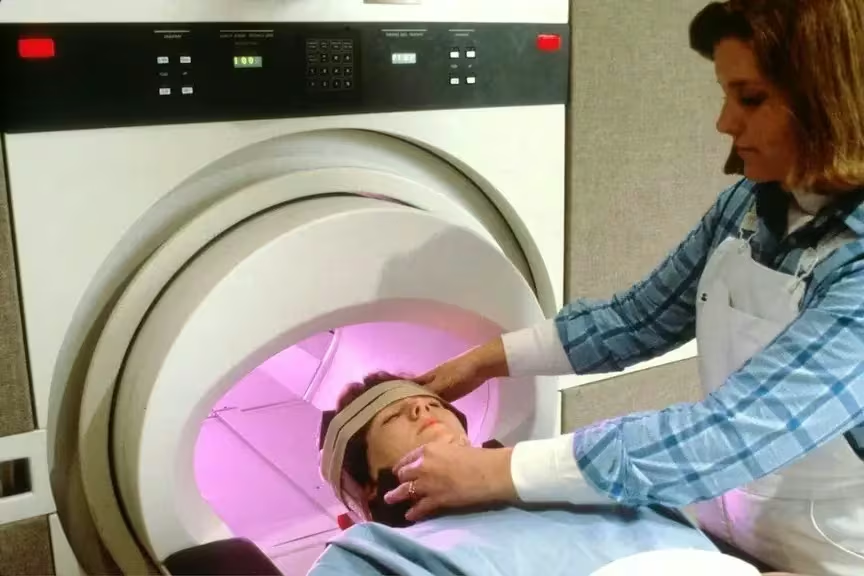
Traumatic Brain Injuries The head strikes the hood, the windshield, or the pavement, or the brain moves inside the skull on impact. Confusion, memory trouble, and sensitivity to light often surface days later, and our Shreveport brain injury page covers how these claims are proven.
-
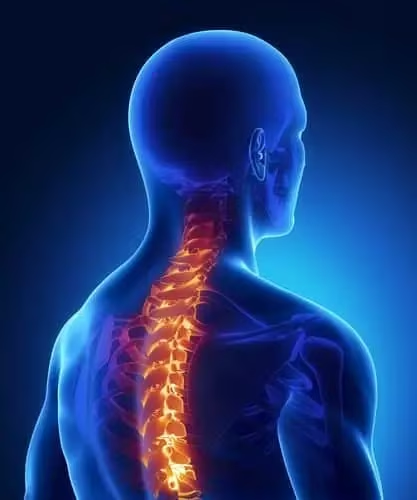
Spinal Cord Injuries Spinal cord injuries come from compression, severing, or swelling after a pedestrian is struck and thrown, and whether the injury is complete or incomplete decides the type of paralysis. Lifetime care costs run higher than in any other category, so these cases take expert witnesses who can calculate future medical costs in a way a jury will accept.
-
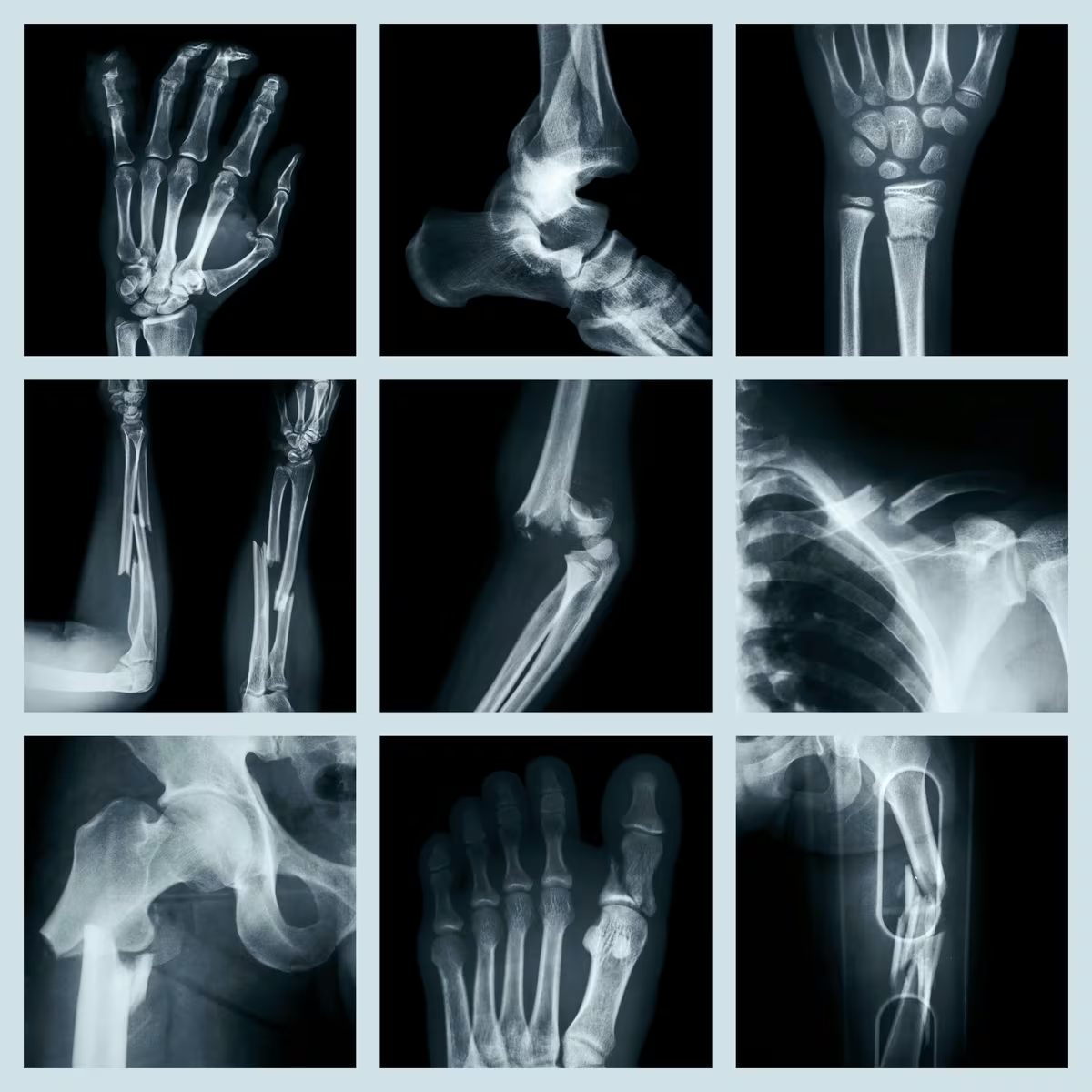
Fractures and Crush Injuries A vehicle striking a person on foot frequently fractures legs, pelvis, hips, ribs, and arms, and can crush a limb that gets pinned. The economic damage tracks the job you hold: a desk worker with a broken wrist is out for weeks, a manual laborer with a fractured pelvis for months.
-

Internal Injuries Internal injuries, meaning organ damage or bleeding inside the body, produce no external sign at the scene, and a ruptured spleen or a lacerated liver is life-threatening within hours.
-
Soft Tissue, Nerve, and Disc Injuries A clean X-ray does not mean a minor injury. A person thrown to the ground tears ligaments, damages muscle, and injures discs, and a herniated disc can send pain, numbness, and weakness into the arms or legs. Louisiana law does not bar compensation for the aggravation of a pre-existing condition, but you need records documenting the before and the after clearly, because the adjuster will argue your symptoms come from prior injuries.
Documenting what happened to your body is half the job. The other half is proving the driver caused it. Ask your treating physician this week for the complete record and the itemized bills, not the discharge summary.
Proving Fault in a Pedestrian Accident
Every driver in Shreveport owes the people on foot around them a duty to keep a proper lookout, yield where the law says to yield, and drive at a speed that fits the conditions. Winning your claim takes evidence that the driver broke that duty, by failing to yield in a crosswalk, speeding, running a signal, or not seeing a person a careful driver would have seen, and that the breach caused your documented injuries.
Under Louisiana’s recent tort reform, Act No. 18 of 2025 eliminated the Housley presumption for injury claims from crashes on or after May 28, 2025. For those claims, being healthy before the crash and having symptoms after it no longer leads the courts to presume the crash caused them. If you were hit before May 28, 2025, the Act does not reach your claim, and the old presumption still applies. Early, thorough medical documentation matters more than it ever has.
Comparative Fault and the Crosswalk Question
Pedestrian cases turn on the crosswalk: where you were when the vehicle struck you, whether a signal governed the crossing, and whether the driver could have seen and avoided you. Inside a marked crosswalk with the signal, you have a strong right-of-way argument. Crossing mid-block or against the light draws a jaywalking argument, but that is not an absolute defense. Crossing outside a crosswalk is one fact the jury weighs against the driver’s duty to keep a proper lookout and to drive at a safe speed.
Under La. C.C. Art. 2323, each party is assigned a percentage of the fault, and your compensation drops by whatever percentage lands on you. For accidents before January 1, 2026, a plaintiff assigned 99% of the fault still collects 1% of the damages. Act No. 15 of 2025 amended Art. 2323 to impose a 51% bar: for any accident on or after January 1, 2026, a plaintiff assigned 51% or more of the fault collects nothing, with no exceptions. That bar gives the driver’s insurer a strong financial reason to shovel blame onto the person who was walking, and in a jaywalking case that incentive is at its sharpest. Expect the insurer to argue you crossed against the signal or mid-block, stepped off the curb without looking, or were staring at your phone. Our Louisiana pedestrian accident page explains how comparative fault works for pedestrians statewide.
What a Strong Fault Investigation Looks Like
We pull the police report, the witness statements, and whatever physical evidence survives, and we document the scene before conditions change. The point of impact, where the vehicle came to rest, the skid marks, and where your belongings landed let an expert work backward to speed and to whether the driver ever braked. Intersection and business cameras along Youree Drive, Line Avenue, and Bert Kouns often answer the crosswalk question outright and show whether the vehicle slowed. Once the facts give an honest basis, we send preservation letters to the businesses whose cameras face the road, so that footage is kept rather than overwritten. We also locate independent witnesses, since their accounts carry the most weight on where you were standing.
That evidence does not last. Surveillance systems at Shreveport businesses overwrite on cycles as short as 48 hours, vehicles get repaired or hauled to a salvage yard before anyone downloads the data, and witness memories go soft within weeks.
When fault is disputed, we hire accident reconstruction experts. They use the physical evidence, the damage pattern, and the skid marks to establish vehicle speed and how the collision happened, which is central where speed governs both fault and injury severity. Modern vehicles carry an Event Data Recorder, the black box, which records speed, braking, and steering input in the seconds before a crash, and that data is objective and hard to dispute. We subpoena cell phone records when distraction is suspected, because a text timestamped seconds before impact is about as clean a proof of breach as this work offers.
Identifying All Liable Parties
The driver is not always the only party responsible. Fault is assigned to everyone whose negligence contributed, whether or not they are named in your claim, but you can collect only from the parties you bring your claim against, so naming every one of them changes who can be made to pay you and how much insurance is available. If the driver hit you while doing the job they were employed to do, the employer answers for it under respondeat superior (La. C.C. Art. 2320), Latin for let the master answer. That often opens a commercial policy far larger than any personal one. Delivery drivers, sales representatives, and commercial vehicle operators often fall in this category, but a company does not answer under this rule for a driver who is an independent contractor rather than its employee.
Government entities responsible for road design and maintenance carry fault in pedestrian cases more often than in ordinary crashes, because so many of these collisions involve a faded or missing crosswalk, a pedestrian signal that does not work, poor lighting, or a badly built intersection. The entity that maintains the road shares liability if the defect caused your injuries, the entity knew or should have known about it before the crash, and it had a reasonable chance to fix it but did not (La. R.S. 9:2800). Claims against it run under the Louisiana Governmental Claims Act, La. R.S. 13:5101, and service must be requested within 90 days of filing the suit that first names it under La. R.S. 13:5107. Miss the service deadline and, unless the entity waived it in writing, the entity can ask the court to drop it from the suit. You can sue it again, but the first suit never stopped the clock on your claim against it. If your time to file has run out by then, that portion of your claim is gone, even where the road defect plainly contributed. Our Shreveport injury attorney page covers the other rules for claims against a city, parish, or state agency.
What Compensation Does Louisiana Law Allow After a Pedestrian Accident?
You can recover economic damages, the losses with a receipt behind them, and non-economic damages for the pain and the parts of your daily life the injury took. In a catastrophic pedestrian injury, the projected cost of future treatment, including long-term care, is usually the largest single number in the case. Mental anguish can include the fear of crossing a street or walking near traffic, scarring and disfigurement are common in pedestrian impacts, and your spouse has a claim of their own for the loss of companionship, intimacy, and partnership, called loss of consortium. There is no statutory cap on damages in general personal injury cases in this state, except claims against public bodies and medical malpractice claims.
What your case is worth turns on injury severity, the fault allocation, the insurance actually available, and the quality of your evidence. An attorney who quotes a figure before reading your medical records and the crash file is guessing. You can read how settlements take shape in our guide to average personal injury settlements in Louisiana. This week, start a running list of everything you have had to stop doing since the crash, with dates on it. That list becomes the non-economic side of your case.
What Shreveport Clients Say
- Adam W.
Trey Morris what a great experience if I ever have to suggest a lawyer's office Morris is my first choice will be suggesting to friends and family
- Jaime C.
I had a great experience with [Trey Morris Injury Lawyers] in Shreveport.Trey Morris and his team really took care of everything from the beginning and kept me informed the whole time. They were easy to work with and always made sure I understood what was going on. I truly felt like they fought for me.
- Dena H.
I would greatly recommend [Trey Morris Injury Lawyers] wholeheartedly, I have known Kristen for years and to know that she has moved to such a wonderful law firm and continues to be such a wonderful person, extremely knowledgeable in her field.I highly recommend her as a paralegal to answer all your questions, as all of the group, couldn't ask for more professional and helpful law firm that puts you first and at ease.
- Kasey L.
Maliyah and Leah have been nothing but great!They are always so pleasant to speak with, very informative, and truly go above and beyond to assist. One of the things I appreciate most is that they always pick up the phone, making communication effortless. It's clear they genuinely have your best interests at heart. I Highly recommend them.
- Caroline M.
[Trey Morris Injury Lawyers] is an amazing personal injury firm.Meghan Nolen and her team are extremely capable, professional and knowledgeable!
- Meyoka A.
I got into an accident and I didn't know who to call.A friend of mines told me to call [Trey Morris Injury Lawyers] and I did. They changed my life and I never felt better about that decision. Thank you all
- Shawanda H.
They was so amazing, communication was awesome!Made sure I was comfortable with my case and I’m grateful for them!
- Catherine H.
[Trey Morris Injury Lawyers]yer has been the biggest help to me, i highly recommend this company.They are all so nice and they treated me like family.
- Beverly T.
My experience with this Injury Law Firm.Was was Truly a 5 Star experience. They give back the community. They are truly a blessing.
- Julianne D.
Liz did a great job.She is an awesome attorney. Very professional office and made my experience very simplistic.
- Karen S.
They have been wonderful!They answered all my questions and kept me up to date during the whole process! I'm so glad I had them to deal with the insurance company! Would absolutely recommend them!
- Debra C.
My husband was a client of Attorney Morris last year and we were very pleased.The most intelligent and friendly staff that would just make you find reasons to call or stop by. Out of my many years of working with and hiring attorneys, I must say that Attorney Tre Morris and staff are just OUTSTANDING!!! If you're looking for a honest hard working attorney with a pleasant staff. Contact Attorney Morris and he's handsome too😉
Testimonials do not constitute a guarantee, warranty, or prediction regarding the outcome of your legal matter. Past results do not guarantee future outcomes.
How Your Pedestrian Case Moves Forward
Once the initial evidence is in hand, we send the driver’s carrier a demand with your medical records, the bills, proof of lost income, and a detailed account of how the collision happened. The adjuster comes back with an offer or a denial, and in pedestrian cases the standard move is arguing you share fault for stepping into the road. When the adjuster starts assigning you a percentage, we answer with the photographs, the video, and the reconstruction.
When the offer stays too low, we file a petition in the First Judicial District Court for Caddo Parish, across the street from our office, and the case runs under that court’s local rules, the same ones a Shreveport injury attorney works under every week. Filing suit does not mean you are going to trial. It means the court system is now what makes the insurer take the claim seriously.
The suit has to be filed within the two-year prescriptive period, Louisiana’s term for a statute of limitations. Once it runs, the claim is gone regardless of how strong the evidence is. A child’s age is usually not an exception, because prescription runs against minors (La. C.C. art. 3468), which matters here because children are frequently the ones struck. The discovery rule applies to a latent injury, and contra non valentem suspends prescription when the injured party had no reasonable way of knowing about the injury or who caused it. These exceptions are narrow and turn entirely on the facts, and our breakdown of Louisiana’s prescriptive periods for personal injury claims covers how the deadlines differ by case type.
After the petition is filed, discovery, the formal exchange of evidence, documents, and sworn depositions, typically runs several months in Caddo Parish, depending on the court calendar and the complexity of the injuries. Most cases go through mediation before trial, a structured negotiation with a neutral third party, and most that reach mediation settle there. If it does not resolve there, a Caddo Parish jury hears the evidence and decides both fault and damages.
A straightforward pedestrian case with clear liability and injuries that have healed can settle in several months. One built on a traumatic brain injury or a spinal cord injury, where future care has to be projected before anyone can value the claim, can run eighteen months to three years or longer. We wait until your doctors give a clear prognosis before putting a number on it, because settling mid-treatment leaves money on the table. Bring the crash date, the report number, and your medical records to our office, and we will walk the phases with your own facts in front of us.
Your Shreveport Trial Team
The lawyers who work your file. Every Shreveport case is handled by the firm's own trial attorneys.