





Need Legal Help in Shreveport for a Car Accident?
Our firm has helped clients dealing with the aftermath of a car accident for over twenty years. Our promise to you is we will go to work fast, get your treatment set, take over the negotiations with insurance, and get your vehicle sorted. For most common accidents the advantage of hiring a personal injury lawyer for a car wreck is to reduce the hassle. You are probably hurt, missing work, and hopefully you haven’t been in a wreck before and may not know the process. We take that off your shoulders and take the stress so you can focus on your health and family. Trey Morris Injury Lawyers are available for consultation any time of the day: call us, visit us, or if you can’t travel we will come to you.
If you are seriously injured, in a coma or in the hospital, then there is no better firm to have on your side working for you. Our results are the best in Shreveport and Caddo Parish. No other firm can point you to the level of result we have obtained for other clients. Most importantly, we live here. We know where the courthouse is, and we know what traffic is like on I-20 and I-49 or on Youree on a Saturday. We have relationships with the best medical staff in the area and with specialists who can aid your physical and mental healing.
Quick Facts About Caddo Parish Services
Shreveport wrecks happen, and the people in them are taken to Ochsner LSU Health Shreveport on Kings Highway, Willis-Knighton on Greenwood Road, or CHRISTUS Highland on Bert Kouns. The Shreveport Police Department writes the report inside the city limits, and the Caddo Parish Sheriff’s Office writes it out in the parish. Trey Morris Injury Lawyers is at 509 Milam Street downtown, across the street from the Caddo Parish Courthouse at 501 Texas Street, where Caddo suits can be filed and tried in the First Judicial District Court. That court has 15 judges, three of them in the civil division.
Car Accident Laws that Affect Shreveport Drivers
The law that governs the claim is Louisiana law, and it is the same in every parish. You have two years from the day you were hurt to file suit under La. C.C. Art. 3493.1. Louisiana also divides fault by percentage, a system called comparative fault. If your wreck happened on or after January 1, 2026, a finding that you were 51% or more at fault under Art. 2323 ends the claim outright, while at 50% or less your award is cut by your share, so a single percentage point on either side of that line decides whether you collect anything. For an earlier wreck, fault still cuts what you collect, but the claim survives. Our Louisiana car accident page explains both rules in full.
Results for Louisiana Clients
- $49 MillionMotor Vehicle Accident
An impaired driver of a stolen vehicle driving the wrong way collided with our client head-on, resulting in brain injury and multiple broken bones.
- $12.1 MillionMotor Vehicle Accident
A commercial vehicle failed to stop at a red light subsequently crashing into our client causing serious brain injury and permanent loss of function.
- $7 MillionMotor Vehicle Accident
When the other vehicle struck our client, the result was a major hemorrhage and a stroke.
- $6.25 MillionMotor Vehicle Accident
A fatigued commercial-vehicle driver fell asleep at the wheel and rear-ended our client, leaving our client with severe neck and back injuries.
- $3.3 MillionMotor Vehicle Accident
Motor vehicle collision. Details not publicly disclosed.
- $3 MillionMotor Vehicle Accident
Out on the highway, the at-fault driver hit our client.
Past results do not guarantee future outcomes; each case is decided on its own facts.
What to Do After a Crash
- Check for injuries and call 911. Get yourself and your passengers looked at first. The officer who works the scene writes down the location, the road conditions, what each driver said, and any citations, while all of it is still fresh. That report carries weight later when the other side tells a different story.
- Move to a safe location if you can. Louisiana law tells you to clear the travel lanes when it is possible to do so. Pull onto the shoulder or into the nearest parking lot and turn on your hazards. Sitting still in a live lane on I-20, I-49, or Youree Drive is how a second wreck happens.
- Exchange insurance and contact information. Write down the other driver’s name, phone, carrier, and policy number, plus the plate, make, model, and color. If a commercial truck is involved, copy the name painted on the door or the trailer.
- Document the scene with photos and video. Shoot the damage from several angles, the skid marks, the signals, the debris, and any injury you can see. Take wide frames that show the whole intersection. Video is better than stills. An adjuster can argue with your memory three weeks later; arguing with your photographs is harder.
- Collect witness names and phone numbers. Bystanders scatter within minutes. If somebody watched it happen, get a name and a number before they pull away. A neutral witness settles a swearing match between two drivers.
- Seek medical attention, even without obvious symptoms. Some injuries stay quiet at first. A brain injury can take 24 to 72 hours to show itself. Internal bleeding shows nothing at all from the outside. Getting evaluated creates a dated record tying what is wrong with you to the crash. See our guide on delayed-onset injuries.
- Report the accident to your own insurance company. Your policy obligates you to tell them. Give the date, the time, the location, and the other driver’s information. Do not guess at fault, and do not walk them through your injuries.
- Keep all medical records and receipts. Save the emergency room bill, the imaging reports, the prescriptions, the therapy invoices, the mileage log. Those pages are what economic damages are built from: medical bills, lost wages, and out-of-pocket costs you can prove on paper.
- Contact an attorney before signing anything. Talk to a lawyer before you sign a release, cash a check, or agree to a recorded statement.
This week, start one folder and put the photos, the other driver’s information, the report number, and every receipt in it. There are real reasons people delay seeking legal advice after an accident, and nearly all of them end up costing the person who waited.
Local Office. Statewide Record.
- Across the Street
From the 1st JDC
Our 509 Milam St office sits across the street from the First Judicial District Court, where Shreveport injury suits are filed and tried.
- 11
Trial attorneys, one team
Your case is handled by the firm's own trial attorneys, and we respond in minutes, 24/7.
- 24/7
We come to you
Hospital, home, or the office at 509 Milam St. Free case review, and no fee unless we win.
- 127
Cases resolved over $1 million
Verdicts and settlements of $1 million or more, won by the same trial team that handles Shreveport cases.
Mistakes That Can Hurt Your Claim
Careful people make these errors all the time, because nobody ever explained how an insurance file and Louisiana tort law actually operate.
- Admitting fault at the scene. Saying you are sorry, or that you never saw them, is the human reflex. It can also be treated as an admission and read back to you later, and that apology at the curb is exactly the material an adjuster uses to push your fault percentage upward.
- Giving a recorded statement without legal counsel. Adjusters describe recorded statements as routine or required. They are neither: you are not required by law to give one to the other driver’s insurer. The adjuster is paid to protect their company’s money, and a recording pins you to one version of events. When your memory sharpens or your symptoms get worse, that early recording is used to question your credibility, and even saying you are doing okay comes back later as proof you were not badly hurt.
- Posting about the accident on social media. Defense teams read Facebook, Instagram, and TikTok. One photo of you standing at a family cookout becomes an argument that your back is fine. One comment about the wreck gets clipped out of context. Post nothing about the crash, your treatment, or how you feel until the claim is closed.
- Delaying medical treatment or skipping follow-ups. Wait two weeks to see a doctor and the insurer will say something else caused your injury. A gap in the middle of treatment does the same damage. Keep the appointments.
- Accepting the first settlement offer without legal review. Early offers are priced to close the file cheap, and they land before anyone knows what your treatment will cost. Soft tissue damage and concussion symptoms usually get worse before they level off. Sign the release and there is no going back for the surgery you needed six months later. A review tells you whether the offer accounts for future medical costs and lost earning capacity.
Before you take any adjuster call this week, write down the date you first saw a doctor and keep it in front of you.
Accidents We Handle
Shreveport wrecks do not come in one shape. They happen on I-20 in the morning push, at Youree Drive and East 70th Street, and in the parking lots off Airline Drive. What kind of collision you were in decides how fault gets investigated, which evidence matters, and how the carrier prices the file.
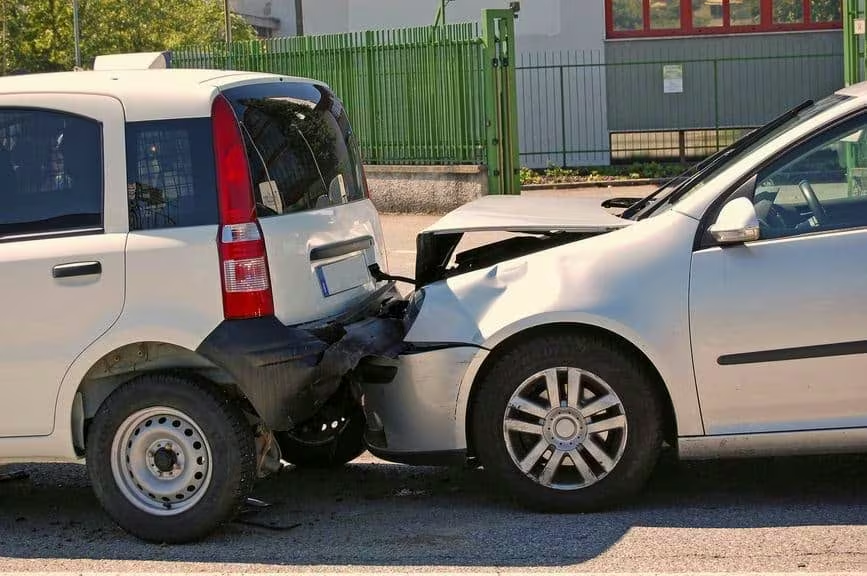
Rear-end crashes are the most common type across the metro, and they stack up on the tight stretches of I-49 and along the commercial corridors. Louisiana presumes the trailing driver is at fault, on the theory that a following driver keeps a safe distance and stays awake. That presumption can be rebutted, though, and adjusters rebut it routinely: you stopped suddenly, you changed lanes without warning, your brake lights were out. Even when you were the one who got hit from behind, expect their carrier to try to move part of the fault onto you, and every point they move comes off the check. If your wreck happened on or after January 1, 2026 and they push your share to 51% or more, you get nothing at all (La. C.C. art. 2323); if it happened before that date, your share only reduces the check, however large it is.
-
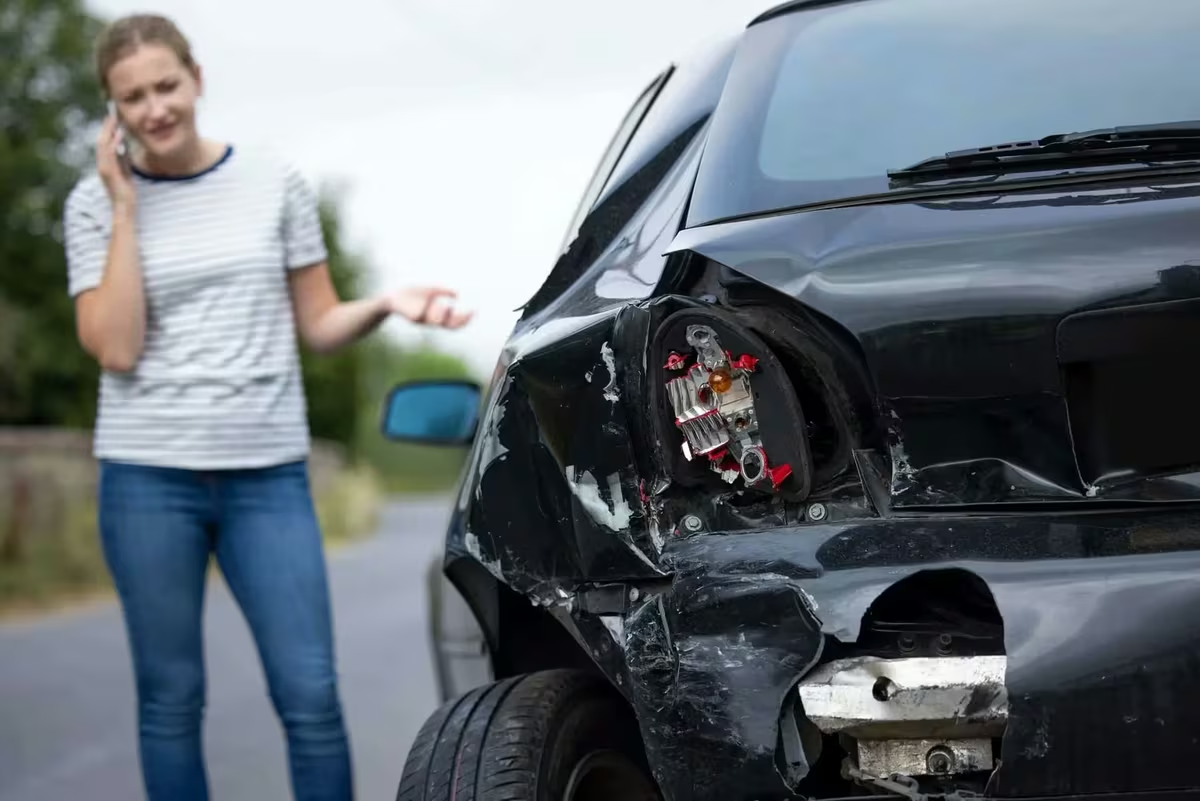
Broadside and T-bone wrecks pile up at the busy lights in town, and they almost always turn into a fight over who had the green. Signal timing records, camera footage, and a neutral witness are what settle it. Pull three or four cars into the wreck and you are dealing with several carriers and several competing fault theories at once.
-
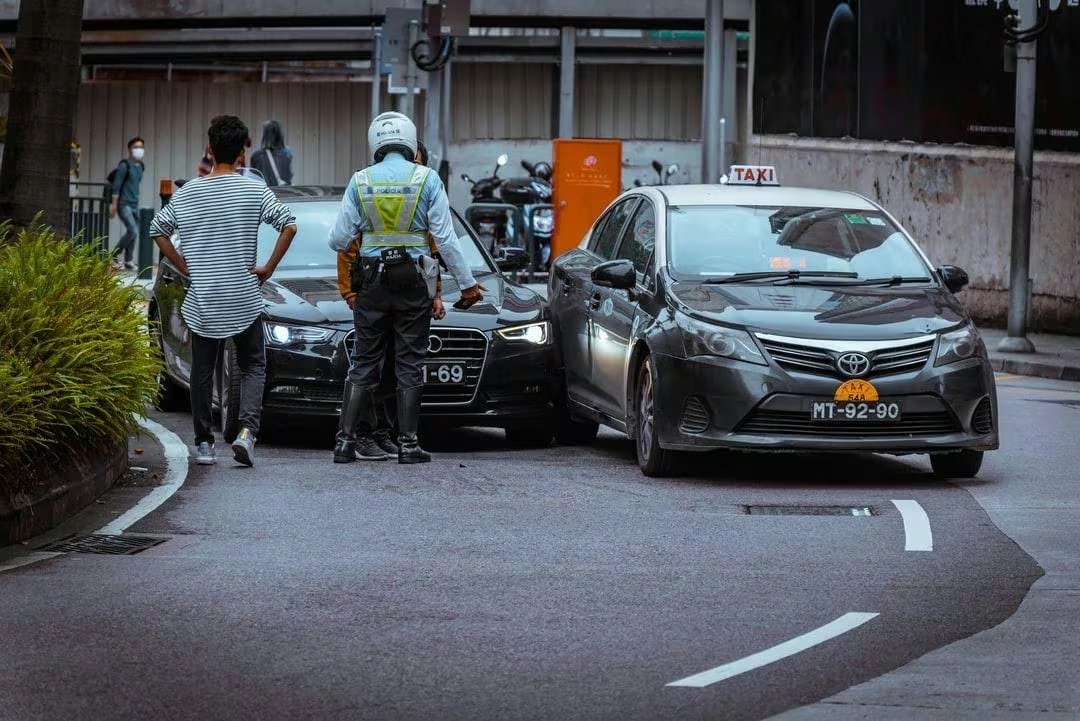
When the driver who hit you keeps going, your own uninsured motorist (UM) coverage is where the money comes from, and the company you have paid for years starts treating you like the other side.
-

Single-Vehicle Accidents
Not every wreck involves a second driver. Broken pavement, debris in the lane, and a shoulder that drops off cause single-vehicle crashes all over Caddo Parish, and those road-defect claims often run against whichever public body maintains the road, which brings its own rules, covered with the other liable parties below.
-

Rideshare & Commercial Vehicles
An Uber, a Lyft, or a company truck adds a layer of insurance. Rideshare coverage is tiered by what the driver was doing at that moment, and commercial policies usually run higher and come with defense counsel who handle these files every day. Our rideshare accident page and Shreveport truck accident page cover those claims.
-

A rider has nothing around them when the impact comes, and adjusters carry a bias against riders that they use to push the fault percentage up.
-

A cyclist takes the whole impact, and Youree Drive, Line Avenue, Bert Kouns Industrial Loop, and the I-49 service roads put bicycles and heavy traffic in the same narrow space.
-

A person on foot has no protection at all, and the defense fights over crosswalk use, how fast the car was going, and what the driver could see.
-

A public transit bus puts you against a government defendant, and when a dozen passengers are hurt, all of those claims compete for the same limits.
If you are not sure which category yours falls in, give us the date and the location this week and we will tell you what evidence needs preserving first.
Common Car Accident Injuries
Car wreck injuries run from a strain that clears up in a few weeks to damage that changes what you can do for a living, and how badly you were hurt is the single largest factor in what the claim is worth. Some of it is obvious at the scene: a broken femur or a deep laceration gets the paramedics’ attention immediately. The rest keeps quiet. Brain injuries, internal bleeding, and herniated discs can take days or weeks to announce themselves, and with no medical record tying the symptom back to the crash, the carrier says it came from somewhere else.
Fuel ignition, an electrical fire, or a chemical release can also leave burn injuries, with skin grafts, long rehabilitation, and permanent scarring.
The difference between a serious injury and a standard personal injury claim drives the strategy, the experts you need, and the future medical care projections that carry the back half of the number.
-
Whiplash & Neck Injuries
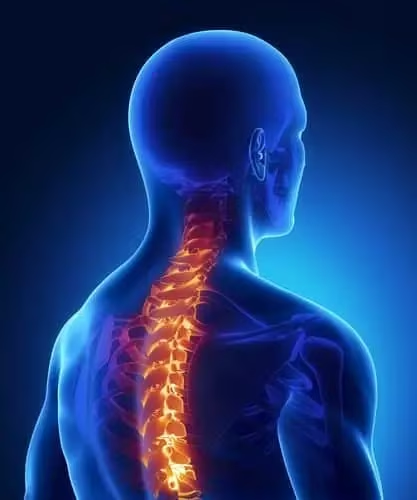
Whiplash is what happens when your head snaps forward and back on impact and the soft tissue in your neck stretches and tears. Symptoms usually take 24 to 72 hours: you can walk away feeling fine and wake up unable to turn your head. Adjusters use that delay, and a standard X-ray shows nothing, which gives them room to call the injury minor. An MRI, a detailed clinical exam, and follow-up visits you actually attend build the record the claim runs on.
-
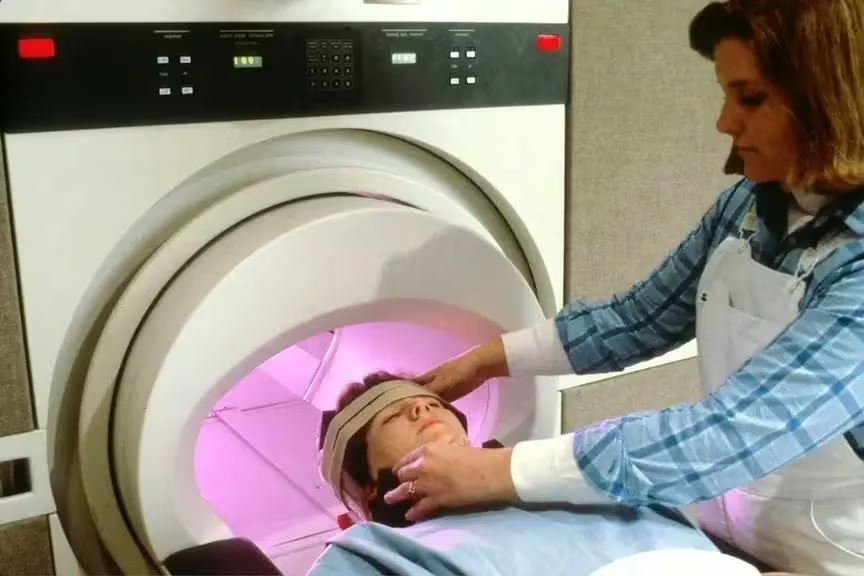
Traumatic Brain Injuries
A brain injury can come from the force of the collision with no head impact at all, and its delayed symptoms (confusion, memory trouble, sensitivity to light) are routinely missed in an emergency room triage.
-
A complete injury leaves no function below the damage point and an incomplete one leaves some, and lifetime care puts these among the highest-value files in the practice.
-
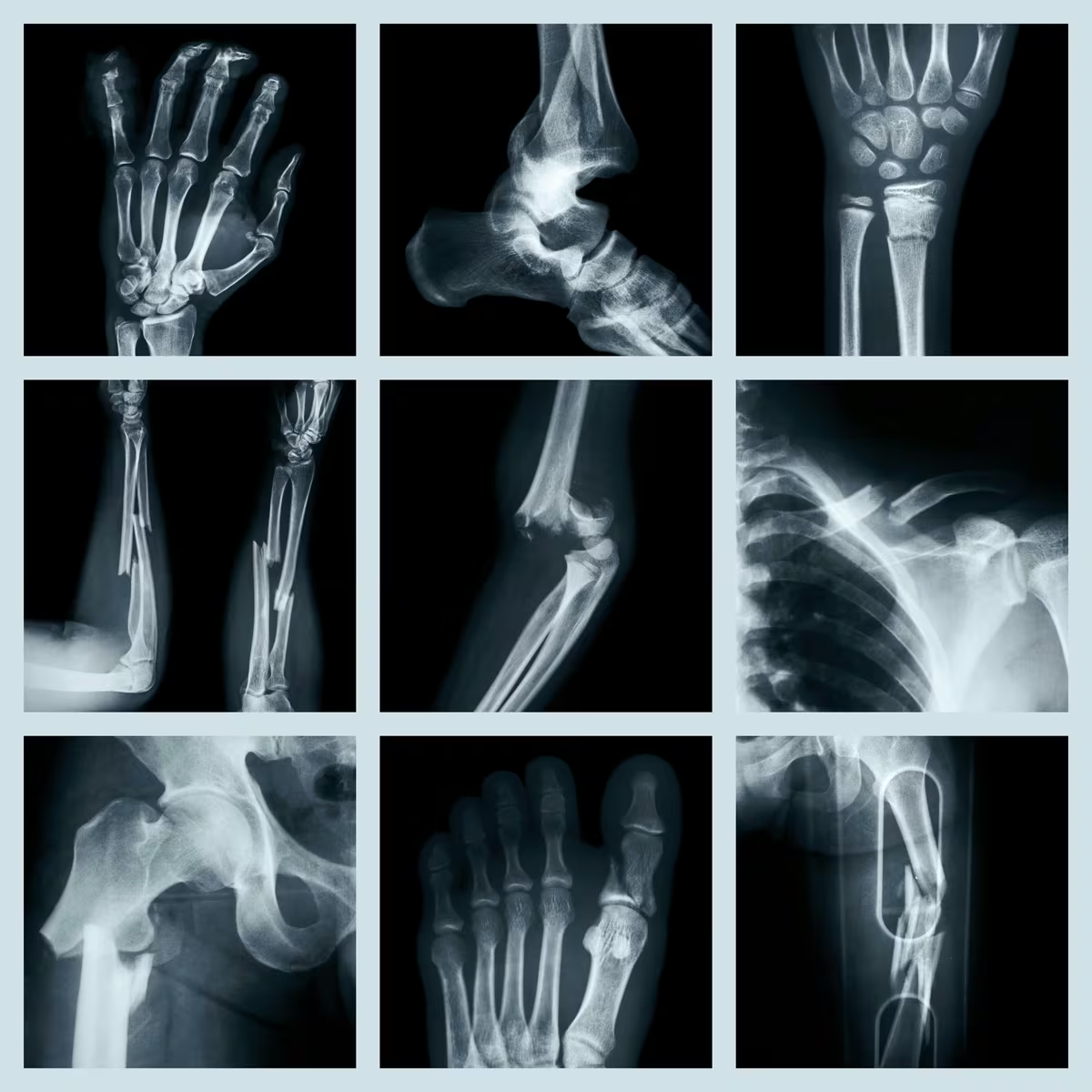
Broken Bones & Fractures
Wrecks break ribs, wrists, femurs, pelvises, and facial bones. A surgical fracture means plates, screws, or rods, and healing measured in months rather than weeks. Nonunion, where the bone does not knit, means another surgery and a much larger medical bill. What it costs you depends on the work you do: a desk job with a broken wrist is out for weeks, and a man on a plant floor with a broken femur is out for months.
-

Internal Injuries
Organ damage and internal bleeding show nothing on the outside at the scene. Adrenaline covers the pain while the bleeding builds underneath. A ruptured spleen or a lacerated liver can kill within hours, and by the time it is obvious the situation is critical. This is the strongest reason to get a full evaluation after any wreck, even when you feel more or less normal.
-
Soft Tissue & Herniated Discs
Soft tissue injuries are torn ligaments, strained muscles, and damaged tendons with no broken bone anywhere. A herniated disc happens when the outer layer of the disc tears and the inner material presses on the nerve, sending pain, numbness, and weakness down an arm or a leg. Carriers argue that no fracture means no real injury.
Documenting the injury is half of it. You still have to prove the other party caused it. Ask your doctor’s office this week for a complete copy of your chart, not the visit summary.
Proving Fault After a Crash
Winning a car accident claim in Louisiana takes evidence that another party was negligent, which means proving all four elements of negligence: duty, breach, causation, and damages. Our Shreveport injury lawyers page walks through each one.
Causation is harder to prove than it used to be. Act No. 18 of 2025 (La. Code Evid. Art. 306.1, effective May 28, 2025) removed the Housley presumption in civil tort cases. That presumption was a shortcut: healthy before the wreck, symptomatic after, and the court presumed the wreck did it. Healthy before and hurting after is no longer enough to establish medical causation, which makes early, complete medical records more important than they were. If you had prior injuries, expect the adjuster to say your symptoms are all pre-existing.
What a Strong Fault Investigation Looks Like
A real investigation starts with the police report, the witness statements, and whatever physical evidence is left at the scene, and evidence has a shelf life. Intersection cameras along Youree Drive, Bert Kouns, and I-20 catch a great deal, but surveillance systems at Shreveport businesses recycle their footage on cycles as short as 48 hours. Cars get repaired or hauled to salvage. Memories blur inside a few weeks. Waiting months to call a lawyer loses evidence nobody can recreate.
Here is what we do. We pull the police report, which carries the responding officer’s observations, the road conditions, any citations, the witness names, and sometimes an early read on fault, along with the EMS records. We go after traffic camera footage from the signal intersections and surveillance video from the businesses nearby before those systems loop, photograph the scene before the road changes, and find the eyewitnesses and interview them while it is still fresh. Every modern car carries an Event Data Recorder, the black box. It records speed, braking, steering input, and belt status in the seconds before impact, and that data is hard for the other side to talk around. We download your own vehicle’s recorder, and once the facts give an honest basis, we send a preservation letter for the other vehicle’s recorder and any other evidence at risk.
When liability is contested, accident reconstruction experts use the physical evidence, the damage patterns, and the skid marks to rebuild the collision, and biomechanical engineers connect the forces in that collision to the specific injuries you sustained. Cell phone records get subpoenaed when distraction is suspected, because a text timestamped seconds before the crash is about as clean a breach as evidence gets. The at-fault driver’s history matters too: prior tickets, a suspended license, earlier wrecks. Each piece answers one specific defense. If your wreck was near a business with cameras, call them this week and ask them to hold the footage.
Identifying All Liable Parties
The other driver is not always the only one who owes you. Louisiana lets you bring a claim against each party whose negligence contributed and who is not immune from suit, and finding all of them changes two things: how much insurance is actually available, and how the fault percentages get divided up.
If the driver who hit you was working at the time, their employer answers for it under respondeat superior (La. C.C. Art. 2320). The Latin means let the master answer, and it holds employers responsible for what an employee does within the scope of the job, when the employer could have stopped the harmful act and failed to. Delivery drivers, sales reps, and commercial operators fall inside it when the company employs them, but a driver the company hires as an independent contractor is not its employee, and this rule does not make the company answer for that driver. Employer liability usually opens a much larger commercial policy.
Brakes, tires, or an airbag that fails on impact can support a product liability claim against the manufacturer or parts supplier, separate from the negligence claim against the driver, but only with proof that the part was defective and that the defect caused or worsened your injuries.
Bad maintenance, missing signage, or a dangerous intersection design can make the state or local body that maintains the road share the liability. The road defect does not have to have caused the crash. It is enough that the defect caused the crash or caused or worsened your injuries, even if another driver started the wreck. That body must also have known or should have known about the defect, had a reasonable chance to fix it, and failed to. Those claims follow the Louisiana Governmental Claims Act, La. R.S. 13:5101, and its procedural rules, including a deadline to request service once suit is filed, are covered on our Shreveport injury lawyers page.
A bar or restaurant that serves an adult of legal drinking age, even one who is visibly drunk, is generally not responsible to the people that driver later hurts; it can be held responsible only in narrow cases, such as serving someone under 21 or forcing or tricking someone into drinking alcohol. Our drunk driving accident page covers those claims.
Knowing who is responsible is only half the picture. Louisiana’s own rules, several of which changed in the last two years, decide what those fault findings are actually worth.
Louisiana Laws That Affect Your Claim
Louisiana is the only state whose legal system grew out of French and Spanish civil law instead of English common law. That means the rules running your car accident claim look different from the ones in Texas, Arkansas, or Mississippi. The vocabulary is different, the deadlines are different, and a strategy that works an hour west on I-20 can fail here.
If you were uninsured when the wreck happened, Louisiana’s No Pay, No Play law (La. R.S. 32:866) keeps you from collecting the first $100,000 in bodily injury damages and the first $100,000 in property damage from the at-fault driver. Act No. 16 of 2025 raised those thresholds from the earlier $15,000 and $25,000 figures, effective August 1, 2025. The reduction is not automatic: the at-fault driver has to raise it as a defense, and several exceptions remove it completely, which our No Pay No Play guide covers. If you had at least minimum liability coverage, this law does not reduce what you can collect.
Louisiana has also narrowed when you can sue the at-fault driver’s insurance company directly, one of several recent tort reform changes that moved the balance toward insurers. Our direct action guide explains the current rule.
What Compensation Does Louisiana Law Allow After a Car Accident?
Louisiana sorts car accident damages into two buckets. Economic damages are the losses you can add up from receipts, pay stubs, and bills: past and future medical care, lost wages, diminished earning capacity, property damage, out-of-pocket costs, and rehabilitation. Non-economic damages cover what has no invoice: pain and suffering, mental anguish, loss of enjoyment, scarring and disfigurement, permanent disability, and your spouse’s own claim for loss of consortium. Louisiana puts no cap on non-economic damages in car accident cases against private drivers; unlike medical malpractice or a claim against a public body, they are assessed with no artificial ceiling. Whether what you collect is taxable depends on the category of damages, which we break down on our page about whether personal injury lawsuit proceeds are taxable.
What Affects Your Case Value
No formula sets what a case is worth, and any lawyer who quotes you a number before reading your medical records is guessing. Our guide to average personal injury settlements in Louisiana covers how those numbers take shape. These are the factors that move them.
- Injury severity and permanence. A fracture that heals in eight weeks is a different claim from a spinal cord injury that needs lifelong care. The more severe and permanent the injury, the larger both the economic and non-economic damages.
- Consistency of medical treatment. Stop seeing your doctor for three months and pick back up, and the carrier will say you were fine during those three months. Steady, documented treatment from the date of the wreck forward is worth real money.
- Comparative fault percentage. Your share of the fault cuts or ends the claim under the rules summarized at the top of this page.
- Available insurance policy limits. The at-fault driver’s policy is a practical ceiling. Louisiana’s minimum liability is $15,000 per person. When your damages run past that, your own underinsured motorist coverage is what fills the gap.
- Pre-existing conditions. Louisiana follows the eggshell plaintiff rule: a defendant takes the plaintiff as they find them. A bad back made worse by the wreck is compensable. It takes medical records that draw a clean line between the before and the after.
- Strength and quality of evidence. Police reports, photographs, dashcam video, witness statements, cell records, medical charts. Files built on strong contemporaneous evidence settle for more than files where the proof is thin or contradicts itself.
- Egregious defendant conduct. A driver who was drunk, texting, or running from police brings recklessness into the case, which can raise its value. Punitive (exemplary) damages under La. C.C. Art. 2315.4 are available only against a drunk or impaired driver whose intoxication helped cause the crash and whose driving showed wanton or reckless disregard for others’ safety. Texting or running from police does not qualify on its own.
Before you weigh any offer this week, add up the bills you have already paid out of your own pocket, because that is the floor nobody should be asking you to go below.
What Shreveport Clients Say
- Adam W.
Trey Morris what a great experience if I ever have to suggest a lawyer's office Morris is my first choice will be suggesting to friends and family
- Jaime C.
I had a great experience with [Trey Morris Injury Lawyers] in Shreveport.Trey Morris and his team really took care of everything from the beginning and kept me informed the whole time. They were easy to work with and always made sure I understood what was going on. I truly felt like they fought for me.
- Dena H.
I would greatly recommend [Trey Morris Injury Lawyers] wholeheartedly, I have known Kristen for years and to know that she has moved to such a wonderful law firm and continues to be such a wonderful person, extremely knowledgeable in her field.I highly recommend her as a paralegal to answer all your questions, as all of the group, couldn't ask for more professional and helpful law firm that puts you first and at ease.
- Kasey L.
Maliyah and Leah have been nothing but great!They are always so pleasant to speak with, very informative, and truly go above and beyond to assist. One of the things I appreciate most is that they always pick up the phone, making communication effortless. It's clear they genuinely have your best interests at heart. I Highly recommend them.
- Caroline M.
[Trey Morris Injury Lawyers] is an amazing personal injury firm.Meghan Nolen and her team are extremely capable, professional and knowledgeable!
- Meyoka A.
I got into an accident and I didn't know who to call.A friend of mines told me to call [Trey Morris Injury Lawyers] and I did. They changed my life and I never felt better about that decision. Thank you all
- Shawanda H.
They was so amazing, communication was awesome!Made sure I was comfortable with my case and I’m grateful for them!
- Catherine H.
[Trey Morris Injury Lawyers]yer has been the biggest help to me, i highly recommend this company.They are all so nice and they treated me like family.
- Beverly T.
My experience with this Injury Law Firm.Was was Truly a 5 Star experience. They give back the community. They are truly a blessing.
- Julianne D.
Liz did a great job.She is an awesome attorney. Very professional office and made my experience very simplistic.
- Karen S.
They have been wonderful!They answered all my questions and kept me up to date during the whole process! I'm so glad I had them to deal with the insurance company! Would absolutely recommend them!
- Debra C.
My husband was a client of Attorney Morris last year and we were very pleased.The most intelligent and friendly staff that would just make you find reasons to call or stop by. Out of my many years of working with and hiring attorneys, I must say that Attorney Tre Morris and staff are just OUTSTANDING!!! If you're looking for a honest hard working attorney with a pleasant staff. Contact Attorney Morris and he's handsome too😉
Testimonials do not constitute a guarantee, warranty, or prediction regarding the outcome of your legal matter. Past results do not guarantee future outcomes.
Insurance Company Tactics
An adjuster will call you within hours of a Shreveport wreck, and they will be perfectly friendly about it. Their assignment is to close your file for the smallest number that works. Nothing they are trying to accomplish lines up with what you need.
Shifting fault. They will point at your speed, your lane position, your phone, or an old injury they say affected your driving, and a carrier who cannot argue with your MRI will argue about your driving instead. Assumption of risk, for example when a passenger knowingly got in with an impaired driver, is another argument they use to shift blame. The answer is documentary: how the fault was actually allocated, and exactly why their figure is inflated.
Disputing medical treatment. They will say you did not need the MRI, that therapy should have stopped sooner, that the treatment was excessive, and they will hire their own reviewers to say it for them. See how insurers use malingering arguments.
Pre-existing condition arguments. Any prior injury to the same body part becomes their theory of the case. The legal question is whether the wreck aggravated that condition. They will request years of old records looking for anything they can pin your pain on instead.
Surveillance. Investigators get hired to photograph you carrying groceries, lifting a grandchild, or pulling weeds. They want footage that contradicts what you told your doctor. It is legal. What protects you is that your daily activity and your reported symptoms actually match.
Delay. Asking for the same records three times, taking weeks to return a call, moving your file to a new adjuster. Delay pays them, because bills at home push people toward a number they would never otherwise accept, and because the carrier knows your two-year filing deadline as well as you do.
What to do when they call. Be polite. Give your name, your phone number, the date, and the location. Do not discuss your injuries, your treatment, or how you feel. Do not agree to a recording. Tell them to call your attorney, and if you do not have one yet, tell them your attorney will be in touch.
Uninsured & Underinsured Motorists
Plenty of drivers in Shreveport carry nothing, and plenty more carry the state minimum. When the person who hit you has no coverage or not enough of it, your own uninsured and underinsured motorist coverage becomes the source of the money, and the claim runs against your own company, which owes you good faith and is still working to pay as little as it can. A hit-and-run driver who is never identified counts as an uninsured motorist, so a UM claim works even when nobody ever identifies the car. If the other car never touched you or your car, for example when it ran you off the road and drove away, you have to prove through an independent, disinterested witness that the other driver caused your injury (La. R.S. 22:1295). Our uninsured motorist page covers how Louisiana’s UM rules work, including its limits on stacking coverage.
Car Accidents in Shreveport
Shreveport sits where two interstates cross, and the metro, Bossier City included, produces a steady volume of collisions every year. The roads themselves shape how these wrecks happen and how the blame gets assigned.
On the fast stretches of I-20 and I-49, rear-end wrecks do far more damage than the same crash on a surface street, because the speed differential at impact is what drives the injury. Getting struck at 70 miles per hour produces the forces that cause brain injuries, spinal cord damage, and multiple fractures at once. Those same corridors carry the 18-wheelers and commercial fleets, which bring federal regulations and a different insurance structure with them.
High-Risk Roads and Intersections
Certain roads in the Shreveport-Bossier City metro turn up in crash reports again and again, each for its own reason.
-
Interstate 20 through downtown Shreveport. Heavy east-west traffic between Dallas and Jackson runs through here. The lane merges near the Texas Street and Market Street exits create pinch points, and rear-end and sideswipe crashes cluster in those merge zones during the morning and evening commute.
-
Interstate 49 between Shreveport and South Bossier. I-49 runs north-south through the metro at 65 miles per hour or better. The drop from highway speed to a surface-street exit catches people out, and the deceleration zone on the ramp near Bert Kouns is a documented cluster point for high-speed rear-end crashes.
-
Youree Drive from South Shreveport to Pierremont. Shopping centers, restaurants, and medical offices line the whole corridor. Short signal cycles plus constant cross-lane turning produce a steady run of T-bone and left-turn collisions. Cyclists get hit along this stretch too, sharing narrow lanes with heavy traffic.
-
Bert Kouns Industrial Loop. This arterial ties I-49 to I-20 along the south edge of town and functions as a highway, except that it has at-grade intersections with signals. Drivers moving at highway speed meet a red light with very little warning, which produces rear-end and intersection crashes.
-
Jewella Avenue between Greenwood Road and I-20. A north-south road through mixed residential and commercial blocks. The lighting is inconsistent, the pavement is uneven in stretches, and the pedestrian crossings are poorly marked. Crash frequency climbs after dark, when visibility drops and the traffic volume holds steady.
-
The I-20 and I-220 interchange. This multi-level interchange in northwest Shreveport asks drivers to change lanes across short distances. People who do not know the layout make last-second moves, and the ramp geometry cuts the sight lines and leaves no room to correct at highway speed.
Where your wreck happened is itself evidence. Traffic engineering reports, signal timing logs, maintenance records, and the prior crash history of that spot can be pulled through public records requests and used in your case. Note the nearest cross street and mile marker while you still remember them.
How Your Case Moves Forward
A Shreveport car accident claim does not run in a straight line. It moves in phases, and each phase has its own clock, its own requirements, and its own way of going sideways. It starts with the investigation described above, along with the medical records that connect your injuries to the collision.
Filing the Insurance Claim
Once the initial evidence is in hand, a demand goes to the at-fault driver’s carrier. The package carries your medical records, your bills, proof of the income you lost, and a detailed account of how the wreck happened. The carrier assigns an adjuster who reads it and comes back with either an offer or a denial. Adjusters in Louisiana are trained to find ways to pay less, and the usual first move is arguing that you share fault.
Negotiation Fails: Filing a Lawsuit
Not every case settles with the carrier. When the offer stays unfair, we file a petition in Caddo Parish District Court, inside the two-year filing deadline. Filing does not mean you are going to trial. It means the court schedule, not the adjuster, now sets the pace.
Discovery, Mediation, and Trial Preparation
After filing, both sides enter discovery, the formal exchange of evidence, depositions, and document requests. A deposition is a recorded, sworn interview where the lawyers question a witness or a party under oath. In Caddo Parish this phase usually runs six to twelve months, depending on the court’s calendar and how complicated the injuries are.
Most cases pass through mediation first. Mediation is a structured negotiation with a neutral third party, usually a retired judge or a seasoned attorney, whose job is to find the resolution. Most cases that get that far settle there. If mediation does not resolve it, the case goes to trial. Louisiana gives a right to a jury trial, but not in every case (La. C.C.P. art. 1731). A Caddo Parish jury decides fault and damages only when your claim is worth enough to qualify for a jury, a party asks for a jury on time and pays the jury bond, and the defendant is not a city, parish or other local government body that has refused a jury. Otherwise the judge decides both fault and damages.
Realistic Timelines
A straightforward Shreveport case with clear liability and treatment that has ended usually settles in four to eight months. Serious injuries stretch that to eighteen months or three years, and longer when a spinal or brain injury needs future care projections. Nobody can value the claim until your doctors can give a clear prognosis, and pushing a case to settlement while the treatment is unfinished leaves money on the table every time. Whether your attorney has actually tried cases in Caddo Parish shapes every stage of the file, starting with knowing when it is ripe to settle.
The type of wreck moves the timeline too. Bicycle and pedestrian cases carry different coverage questions and more complicated injury patterns. Ask about your specific facts at the first meeting, and bring the date of the wreck, the report number, and your declarations page with you.
Your Shreveport Trial Team
The lawyers who work your file. Every Shreveport case is handled by the firm's own trial attorneys.