










Bossier City riders go down on I-20 and I-220 where the interstates feed traffic across the river, at the retail driveways and signals along Airline Drive and Benton Road, and on Barksdale Boulevard after dark. The ambulance goes to Willis Knighton Bossier on Hospital Drive, and a severe head, spine, or crush injury may cross the river to the Level I trauma center at Ochsner LSU Health Shreveport on Kings Highway. Inside the city limits the Bossier City Police Department at 620 Benton Road writes the crash report; on a parish road or the interstate it is the Bossier Parish Sheriff’s Office or the Louisiana State Police. A Bossier Parish suit can be filed in the 26th Judicial District Court, which sits with the Clerk of Court at 204 Burt Boulevard in Benton. Trey Morris Injury Lawyers is at 1815 Benton Road in Bossier City.
Results for Louisiana Clients
- $49 MillionMotor Vehicle Accident
An impaired driver of a stolen vehicle driving the wrong way collided with our client head-on, resulting in brain injury and multiple broken bones.
- $12.1 MillionMotor Vehicle Accident
A commercial vehicle failed to stop at a red light subsequently crashing into our client causing serious brain injury and permanent loss of function.
- $7 MillionMotor Vehicle Accident
When the other vehicle struck our client, the result was a major hemorrhage and a stroke.
- $6.25 MillionMotor Vehicle Accident
A fatigued commercial-vehicle driver fell asleep at the wheel and rear-ended our client, leaving our client with severe neck and back injuries.
- $3.3 MillionMotor Vehicle Accident
Motor vehicle collision. Details not publicly disclosed.
- $3 MillionMotor Vehicle Accident
Out on the highway, the at-fault driver hit our client.
Past results do not guarantee future outcomes; each case is decided on its own facts.
Why Hire a Bossier City Motorcycle Accident Lawyer After a Crash?
A motorcycle case carries problems a two-car fender bender on Airline Drive does not. You absorbed force a car body would have absorbed. The driver who hit you will say he never saw you, and that sentence turns into a fault dispute. A lawyer’s job is to answer those problems with evidence before they harden into a denial or a low offer.
What a motorcycle accident lawyer does for injured riders
A motorcycle accident lawyer handles the parts of a claim you should not be managing from a hospital bed at Willis Knighton Bossier. That starts with investigation: securing the crash report, identifying every party who may share fault, preserving video and physical evidence, and building the medical record that documents the full extent of the harm.
Then there is the insurance company. An adjuster opens your file with one goal, which is to close it for as little as possible. We take over that contact, present the claim as a documented demand, and negotiate from there. If the insurer will not pay fair value, we file suit and try the case.
How local knowledge of Bossier City and Bossier Parish helps your case
Your claim moves through local offices, not through a general idea of a system: the agency that wrote the crash report, the Clerk of Court, and the court in Benton. Knowing how those offices release records and how the docket in Benton moves saves weeks you cannot spare.
Local knowledge is also the roads themselves. Someone who works these cases knows the merge pattern where I-20 and I-220 feed traffic across the river, the driveway-by-driveway turning conflicts on Airline Drive, and the stretch of Benton Road where the speed limit changes just before a signal. That context shapes how an investigator reads your scene and whether a reconstruction holds up.
Local Office. Statewide Record.
- 26th JDC
Where your case is filed
Bossier City injury suits are filed in the 26th Judicial District Court. We file and try cases there from our Bossier City office.
- 11
Trial attorneys, one team
Your case is handled by the firm's own trial attorneys, and we respond in minutes, 24/7.
- 24/7
We come to you
Hospital, home, or the office at 1815 Benton Rd. Free case review, and no fee unless we win.
- 127
Cases resolved over $1 million
Verdicts and settlements of $1 million or more, won by the same trial team that handles Bossier City cases.
What Should You Do Immediately After a Motorcycle Accident in Bossier City?
The first hour after a crash shapes the rest of the claim. What you do at the scene, in the emergency room, and on the phone with insurers becomes the record both sides argue over for the next year. Health first, claim second, in that order.
You carry a documentation burden a driver in an enclosed car does not. There is no crumpled passenger door to photograph, no airbag deployment data, and often no second surviving witness to a left turn that took two seconds. What you preserve in the first days is frequently what decides who pays, and if you were thrown from the bike and could not photograph the scene or trade insurance cards, the absence of your own record hands the other side room to rewrite what happened.
Call 911 and Get Medical Care Even if Symptoms Seem Minor
Call 911 from where you are. An ambulance and an officer dispatched to the crash create the two earliest records of what happened, and both matter later.
Get evaluated even if you feel able to walk away. Adrenaline masks pain, and motorcycle crashes commonly produce injuries that surface hours or days later: internal bleeding, a concussion, soft tissue damage, and fractures that do not announce themselves at the curb. A gap between the crash date and your first medical visit gives an insurer room to argue your injuries came from something else. The bills, imaging, and treating physician notes from that first visit anchor the value of the entire claim, so keep the follow-up appointment they schedule at discharge, including the one that feels unnecessary.
Call Bossier City Police and Get an Official Crash Report
Whichever agency responds, ask that a report be written. A motorcycle crash with injuries warrants an official report, and that document records the responding officer’s observations, the parties involved, and any citations issued.
Write down the responding officer’s name and the report or item number before you leave. Louisiana crash reports take days to become available, and that number lets you or your lawyer request the record without waiting on a search.
Document the Scene: Photos, Video, Road Conditions, Witnesses
If you are physically able, photograph everything before anything moves. Both vehicles from several angles, the final resting positions, skid marks, the debris field, and the damage to your motorcycle and gear. Wide shots establish the layout; close shots establish the detail.
Photograph the conditions that explain the crash. The signal head and its timing, a hedge or sign blocking a sight line, a faded lane marking, a bridge joint, loose gravel, a pothole: any of it can matter to how the collision happened. Video helps at an intersection because it captures the signal cycle and the traffic around you. On a corridor like Airline Drive the pavement gets repainted and the lot gets swept within days, so the record you take at the scene may be the only record that survives. Before you leave, look up and note every business with a camera pointed at the road.
Gather Driver, Witness, and Insurance Information
Get the other driver’s name, license number, license plate, insurance carrier, and policy number. Photograph the insurance card and the license rather than copying them by hand, because a single transposed digit stalls a claim for weeks.
Witnesses scatter fast. The driver stopped behind you, a pedestrian, an employee stepping out of a nearby business: any of them may be the person who confirms the other driver turned across your path or never looked. Get names and phone numbers. A neutral witness who places fault on the other driver is among the most valuable things you can walk away with, precisely because so many of these cases come down to one driver’s word against another’s. Text yourself those names and numbers that night so they carry a timestamp.
Do Not Give Recorded Statements to the Other Driver’s Insurer
The at-fault driver’s insurer will often call within a day or two and ask for a recorded statement. You are not required to give one, and you should not give one before you understand your own injuries and your rights. Those recordings are used to lock you into early words, then replay any inconsistency, hesitation, or guess as proof you are unreliable or partly at fault. If an adjuster calls this week, write down the adjuster’s name and the claim number and say you will call back after you have talked to a lawyer.
What Are the Most Common Causes of Motorcycle Accidents in Bossier City?
Most Bossier City motorcycle crashes trace back to another driver’s choice, not yours. These patterns repeat because cars and trucks share the same intersections and corridors you ride every day, and a motorcycle is small, narrow, and easy to overlook. The cause matters because it shapes the claim: who is at fault, what evidence proves it, and which injuries the crash mechanics tend to produce.
Motorcycle collisions also play out differently than car-to-car wrecks. You have no metal cage, no airbag, and no seatbelt taking the load. The same turning mistake that dents a bumper between two cars throws a rider onto pavement at speed. That is why even a low-speed cause produces fractures, road rash, and head trauma.
Left-Turn and Turning Collisions Where Drivers Miss Riders
The single most common motorcycle crash is a car turning left in front of an oncoming rider. The driver judges the gap, sees no large vehicle, and turns. You were there the whole time, but his brain registered empty road. Right turns and turns across traffic fail the same way, a failure to detect a smaller, narrower vehicle.
These crashes cluster where turning movements never stop, which in Bossier City means the signalized intersections and retail driveways along Airline Drive and Benton Road. You usually have the right of way and are traveling straight when the turning vehicle cuts across the lane. Fault in these cases often rests with the turning driver, and the defense will still dig at your speed and position to shift it. Pin down what the signal showed while you remember it exactly.
Lane-Change and Blind-Spot Crashes With Trucks and SUVs
A motorcycle fits entirely inside the blind spot of a pickup, an SUV, or a commercial truck. When that driver changes lanes or merges without a head check, you have nowhere to go. Larger vehicles carry larger blind zones, which is why crashes with trucks and SUVs show this pattern often.
Sideswipes and merge collisions tend to happen on multi-lane roads and on the on-ramps feeding I-20 and I-220, where lane changes are constant. You can ride correctly and still get squeezed out of a lane. Witnesses, lane position, and the damage patterns on both vehicles become important to show you were visible and lawfully positioned. Photograph the scrape line along your bike before any repair shop touches it.
Distracted Driving and “Did Not See the Rider” Accidents
Distracted driving feeds nearly every other cause on this list. A driver texting, working a touchscreen, or reaching into a console is not scanning for a motorcycle.
These crashes happen anywhere, and they spike in stop-and-go traffic and at intersections where a two-second glance costs a driver the gap. Cell phone records, dashcam footage, and witness accounts help establish that the driver’s attention, not your riding, caused the collision.
Drunk Driving Crashes Near Entertainment Districts
Bossier City’s casino corridor and the entertainment areas along Barksdale Boulevard draw heavy nighttime traffic, and impaired driving rises with it. A drunk driver reacts slowly, misjudges distance, and drifts across lanes. For a rider, that impairment means a head-on or turning collision with no time to react.
Crashes involving alcohol carry their own consequences for the at-fault driver and can affect how a claim is valued. If a driver was arrested or given a field test at your scene, note the agency that made the arrest, because the criminal file and your civil claim run on separate tracks.
Road Hazards: Bridge Joints, Loose Gravel, and Potholes
A defect a car rolls over without noticing puts a motorcycle down. Loose gravel reduces traction in a turn. A pothole or an uneven bridge joint jolts the front wheel and takes your control with it. Standing water and worn pavement markings add risk on a rainy night.
Bossier City and Bossier Parish carry river bridge crossings, interstate interchanges, and surface streets where pavement quality changes block to block. When a road condition puts a rider down alone, the question of who maintained that stretch and whether they knew about the hazard becomes central. Photograph the defect and the surrounding road before the patch crew arrives, and note the date you took the pictures.
Why Do Most Bossier City Motorcycle Accidents Happen Because Drivers Didn’t See the Rider?
Most car-on-motorcycle crashes trace back to a driver who looked but failed to register a rider in the traffic field. A motorcycle presents a narrow profile. At an intersection, in a side mirror, or against a busy background of storefronts, that profile gets lost behind windshield pillars, cross traffic, and the driver’s own expectation of seeing a car-sized object. You were visible. His attention was not tuned to detect something that small and that fast.
“I didn’t see the motorcycle” is not a defense. It is an admission. A driver has a duty to look for everything lawfully on the road, including you. Failing to perceive a rider who was there to be seen is a failure to keep a proper lookout. The work of the claim is making sure the file proves you were visible and that his inattention, not the existence of your motorcycle, caused the crash.
The ‘motorcyclist risk profile’ bias adjusters exploit
Insurance adjusters know jurors carry assumptions about riders. The stereotype says motorcyclists speed, weave, take risks, and put themselves in harm’s way. An adjuster leans into that bias because it pulls attention off the driver who turned across your path. The narrative becomes “the rider was reckless” instead of “the driver didn’t look.”
Countering that bias before it reaches a jury takes specific evidence: your speed pulled from data and reconstruction, your lawful lane position, the absence of any traffic citation against you, and the physical geometry showing the driver had a clear line of sight. When the file establishes that you did everything right and the driver still failed to perceive you, the risk-profile story collapses.
Poor lighting and weather conditions reducing visibility
Low light and weather make a narrow profile harder to detect, and drivers use those conditions as an excuse. Dawn, dusk, glare off wet asphalt, rain, and the shade under an overpass on I-220 all slow how quickly a driver registers a rider. A single headlight that blends into a wall of oncoming headlights does not stand out the way a car’s paired lights do.
These conditions do not erase the driver’s duty. A driver who cannot see well enough to safely turn or change lanes is obligated to slow down or wait. The investigation documents the actual lighting, sun angle, and weather at the time and place of your crash, then ties them to what the driver could and should have done. Write down the time of day and the weather while you still recall the sky.
Who Can Be Held Liable in a Bossier City Motorcycle Accident?
More than one party can be responsible for a motorcycle crash, and identifying every one of them changes what your claim is worth. A case that looks like one driver’s mistake often involves an employer, an insurer, or a public road authority once the facts come out. A liability investigation works to find each party that contributed and the insurance coverage standing behind each one, rather than treating the crash as a single-defendant file.
Negligent drivers who hit motorcyclists
The driver who caused the crash is the starting point. A motorist who turns across your path, changes lanes without checking, follows too closely, or runs a signal can be responsible for the harm that follows. Whether that driver was careless, and whether the carelessness caused your injuries, are factual questions answered by the crash evidence rather than by any general assumption.
Who actually appears as a defendant is its own question. The claim is often brought against the at-fault driver, and whether anyone else can be named alongside him turns on the particular circumstances of your case. Deciding who to name and confirming the coverage behind each defendant happens before anything is filed.
Commercial drivers, trucking, rideshare, and delivery companies
When the at-fault driver was working, the employer may share responsibility. A delivery van, a commercial truck rolling through on I-20, or a rideshare or delivery vehicle operating during a paid trip can pull a company into the case when an employee was acting within the scope of the job. Company defendants matter because they typically carry larger liability policies than an individual driver, which is a factual point about coverage rather than a guarantee of any outcome.
These claims also involve evidence an individual rarely keeps. Dispatch records, electronic logs, maintenance histories, and corporate safety policies can show whether a company contributed to the crash, and preserving those commercial records keeps that proof available to the claim. If you saw a company name or a DOT number on the door, write it down now.
Government entities responsible for unsafe roads (DOTD)
Some crashes trace back to the road itself rather than to any driver. Whether a public road authority can be held responsible for a particular hazard, such as a poorly maintained bridge joint, a failed surface, missing signage, or a known defect, is a fact-intensive question that depends on the road condition and on who was responsible for maintaining it.
Road conditions get repaired, and the evidence of the defect disappears with the patch. Preserving maintenance records and assessing whether a public entity is a proper defendant are part of the early investigation. Go back to the spot this week and take another dated photograph showing whether it has been repaired.
Motorcycle or parts manufacturers in product defect cases
A defective motorcycle or component can cause or worsen a crash. A failed brake, a tire that came apart, a steering fault, or a design that made an injury worse can raise a question of responsibility on the part of the manufacturer. Whether a product theory holds is a factual matter that depends on how the part failed and on the physical evidence that survives.
Product cases require preserving the machine and its parts before anything is repaired, scrapped, or altered. An expert examination of the failed component often anchors the inquiry. Tell the storage lot and your insurer in writing not to release, repair, or crush the bike until it has been inspected.
What Louisiana Motorcycle Laws Affect Your Injury Claim?
The rules that govern riding in Louisiana shape your claim before the first negotiation starts. Helmet use, licensing, and lane position set the baseline an insurer will measure you against. Following them removes arguments the other side wants to make, and where the records are unclear, those gaps become bargaining chips against you.
Louisiana helmet law for riders and passengers
Helmet rules in Louisiana are worth confirming directly, not paraphrasing from a website. Check the current requirement and any equipment standard with the Louisiana State Police or a lawyer before relying on a general summary. The practical point for an injury claim is simpler and does not depend on the exact statutory text. Whether you wore a helmet, and what kind, becomes a fact the defense will probe. Keep the helmet, the jacket, the boots, and the gloves in a box, unwashed, exactly as they came off. The helmet is physical evidence, and a damaged helmet can show the force involved and how it performed.
Motorcycle licensing and endorsement requirements
Operating a motorcycle in Louisiana involves a motorcycle endorsement on your driver’s license, not just a standard license. Confirm the current endorsement requirement with the Louisiana Office of Motor Vehicles or a lawyer before relying on a summary. Riding without the correct endorsement is a separate question from who caused the crash. A licensing lapse and the cause of a collision are not the same thing. An insurer may still raise an unendorsed status to suggest inexperience or to chip at credibility, so pull your license out and check what it says this week.
Lane splitting and unsafe passing in Louisiana
Riding between lanes of slowed or stopped traffic, often called lane splitting, is illegal in Louisiana for anyone but an on-duty police officer. A motorcycle is otherwise entitled to the full use of a traffic lane, unless riding two abreast with another motorcycle, and a car should not crowd you out of that space. The distinction matters when a driver claims a rider “came out of nowhere.” If you held a lawful lane position and a driver changed lanes or passed unsafely into that space, the lane use cuts against the driver, not you. Where the bike sat in the lane at impact is a fact worth pinning down with scene photos and witness accounts, so sketch it on paper while you still see it clearly.
How traffic citations affect a motorcycle accident claim
A traffic citation is evidence, not a verdict on a claim. A ticket issued to the other driver supports your account but does not automatically establish his liability, and a citation issued to you does not automatically defeat the claim. Citations can be contested, dismissed, or reduced, and a traffic case is decided on a different standard than a civil injury claim. Keep the paper copy of every citation written at your scene, or a note that none was written, and bring both sides of it to your lawyer.
How Does Louisiana’s Comparative Fault Law Affect Your Motorcycle Claim?
Louisiana decides motorcycle injury claims under one fault rule, La. C.C. art. 2323. Under that article, for causes of action arising on or after January 1, 2026, a rider found 51% or more at fault takes nothing, and a rider at 50% or less keeps a claim with the award reduced by the assigned percentage. How that rule plays out depends on the parties in your wreck, what the other side argues, and how the proof settles the question.
How insurers push your share of fault up
The percentage of fault assigned to each party who contributed to the crash drives what you take home. The driver who turned across your path can carry the larger share while you carry a smaller one. An insurer that cannot deny the crash happened works to raise your share of the blame, because every point of fault it assigns you is a point removed from what it pays. The arguments repeat:
- Speed. Claiming you were speeding or too fast to be seen or to stop, often with no measurement behind it, just an assumption that a motorcycle must have been going fast.
- Lane position. Arguing the motorcycle was in a blind spot or weaving.
- Visibility choices. Pointing to dark clothing, a dark helmet, or the absence of high-visibility gear.
- Following distance. Asserting you were too close to react.
These arguments get raised early, before anyone has reconstructed the crash. None of them is accepted on its face; the defense has to support each one with proof, and proof of your own answers them. When the physical record shows a driver turned across your right of way, a claim that you were going too fast loses force. The clothing argument is a perception argument dressed up as a fault argument: the driver was obligated to look for everything on the road, the color of your jacket does not change that obligation, and the geometry of the crash usually shows he had ample opportunity to perceive you regardless of clothing. Crash reports, scene photographs, vehicle damage patterns, video, reconstruction, independent witnesses, and the at-fault driver’s own statements keep the fault percentage tied to what happened, not to the assumption that a motorcyclist must have done something wrong.
What happens if you were not wearing a helmet
Helmet non-use is handled inside the same comparative fault framework set by La. C.C. art. 2323. It is not a separate rule and does not by itself bar a claim. The defense may raise it, but it factors into the fault allocation under that article rather than ending the case on its own.
Insurers also argue your injuries would have been less severe with a different helmet, or question whether the helmet was worn correctly. The argument tends to grow as injuries get more serious, because the bigger the medical bills, the more the insurer wants to deflect. Whether helmet use moves the fault percentage at all, and by how much, turns on the evidence connecting it to the specific injuries claimed. It is a fault question to be proven, not a defense that wins automatically. Treating physician records and the mechanism of injury usually answer it: a head injury caused by a vehicle striking a rider is the driver’s doing, not a gear footnote. We build the file from crash proof so the helmet question stays a percentage and never becomes the whole case. Tell your lawyer the truth about what you had on, early, so nothing lands as a surprise in a deposition.
What Compensation Can Bossier City Motorcycle Accident Victims Recover?
A motorcycle claim generally reaches two broad categories of damages: economic losses you can document with bills and records, and non-economic losses that have no receipt but are just as real. Those categories include medical costs, lost income, property damage, pain and suffering, and the lasting effects of permanent injury.
Economic damages: medical bills, lost wages, future earning capacity
Economic damages cover the financial losses tied directly to the crash and the injuries. That starts with medical expenses: ambulance transport, the emergency room, surgery, hospitalization, imaging, physical therapy, prescriptions, and follow-up care. It includes the wages lost while you could not work and, when injuries are serious, the income that will be lost going forward.
A rider who cannot return to a physically demanding job, or who must take lower-paying work because of permanent limitations, carries a future earning capacity claim that adds substantial value. Ask your employer’s office for a written statement of the days you missed and your rate of pay, and keep every pay stub since the crash in one folder.
Non-economic damages: pain and suffering, emotional distress
Non-economic damages compensate harm that does not arrive as an invoice. Physical pain, mental anguish, emotional distress, and loss of enjoyment of life all fall here. A rider healing from multiple fractures or a long course of surgeries lives with consequences that no bill captures. Keep a short dated note each week about what the injury kept you from doing.
Property damage: motorcycle repair or replacement and gear
Property damage covers the cost to repair a motorcycle or, when it is totaled, its value before the crash. Riding gear damaged in the wreck belongs in this category too. A helmet, jacket, boots, and gloves that did their job and absorbed impact are a documented loss, and replacing them is part of making you whole.
Photographs and receipts turn a property damage claim from an estimate into a documented figure an insurer cannot easily dispute. Get a written estimate from the shop before you authorize any work.
Permanent disability, scarring, and disfigurement
Some motorcycle injuries do not fully heal. Permanent disability, visible scarring, and disfigurement are treated as their own category of harm, separate from the medical bills that paid to treat them. Road rash that leaves permanent scarring, an amputation, or a spinal injury that limits movement for life each support a damages claim grounded in the lasting nature of the injury.
These claims rely on medical documentation of the permanent condition and the way it affects daily living and work. The more clearly the record shows what you can no longer do, the more concrete this category of damages becomes. Photograph healing scars at intervals, dated, from the same angle.
Wrongful death and survival damages for surviving family
When a motorcycle crash is fatal, surviving family members usually ask two questions: what can the family claim for its own loss, and what can it pursue for the harm the rider endured. Those map to two separate categories of damages. One set compensates the family’s own losses, including the loss of the relationship, support, and companionship. The other set pursues the harm the deceased experienced, including the pain and suffering between injury and death.
If you are the one handling arrangements, keep the hospital records and the funeral bills together in one folder.
How Much Is a Bossier City Motorcycle Accident Claim Worth?
No honest lawyer can tell you a dollar figure before reviewing your case, and anyone who does is guessing. The value of a Bossier City motorcycle accident claim depends on a handful of concrete factors: how badly you were hurt, how much insurance coverage exists to pay the claim, whether liability is disputed, and how the injuries affect your ability to earn a living. A rear-end collision with an admitted-fault driver is a stronger claim than one where the other side argues you contributed to the crash.
Injury Severity and Long-Term Medical Needs
The single largest driver of claim value is the medical picture. A rider who needed a few stitches and walked out of Willis Knighton Bossier has a different claim than one facing spinal fusion, a traumatic brain injury, or skin grafts for road rash. Higher claim value follows higher medical cost, longer treatment, and permanent limitation.
Future care matters as much as the bills already incurred. Some injuries require surgeries years out, ongoing physical therapy, assistive devices, or changes to the house. Treating physicians and life-care planners document those needs so the claim reflects the full cost over time, not just the emergency room invoice. Ask your surgeon to put the expected future care in writing at your next visit.
Available Insurance Coverage
A claim is only worth what someone can actually pay. Louisiana sets minimum liability coverage at $15,000 per person and $30,000 per accident for bodily injury, plus $25,000 for property damage, under La. R.S. 32:900. Those minimums are floors, not measures of what a serious motorcycle injury actually costs. A single hospital stay at Willis Knighton Bossier can exceed the entire minimum an at-fault driver is required to carry, and a catastrophic injury can far exceed it, which is why available coverage is a real ceiling on what a claim collects from any single policy.
This is where other sources matter. There may be more than one at-fault party, a commercial policy, or your own uninsured and underinsured motorist coverage, called UM/UIM. Under La. R.S. 22:1295, an auto liability policy generally includes UM coverage at the policy’s bodily injury limits unless a named insured rejected it, chose lower limits or chose economic-only coverage on a form prescribed by the Commissioner of Insurance. Commercial policies follow a different rule. UM coverage on a car policy generally does not cover you while riding a vehicle you own that the policy does not describe, apart from a newly acquired or replacement vehicle the policy covers, so check whether your motorcycle is listed. When the other driver is uninsured, or carries too little coverage to pay the full claim, your own UM/UIM coverage can step in. Send your lawyer the declarations page for every vehicle in your household, along with any signed UM/UIM rejection form.
Why No Lawyer Can Guarantee a Settlement Amount
Every claim turns on its own facts, and the variables interact in ways no formula captures. The same injury can produce different outcomes depending on coverage, fault, the strength of the evidence, and how a particular insurer evaluates risk. A lawyer who promises a specific result is making a promise they cannot keep.
What a lawyer can do is explain how these factors apply to your situation and build the documentation that supports full value. Bring your medical records and your declarations page to a first meeting so those factors get walked through against your own file before you sign anything.
How Do Insurance Companies Fight and Deny Motorcycle Accident Claims?
Insurance companies reduce what they pay motorcycle riders by attacking fault, attacking injuries, and attacking the rider’s own words. Knowing their tactics ahead of time changes how you respond, what gets said, and when anything gets signed.
Minimizing road rash, fractures, and soft tissue injuries
Motorcycle injuries are often severe, yet insurers describe them as minor. Road rash gets dismissed as a scrape. Fractures get called routine. Soft tissue damage gets labeled as something that will heal on its own with no lasting effect.
The severity of these injuries is exactly why minimization is profitable for the insurer. Road rash can require skin grafts and leave permanent scarring. Fractures can need surgery, hardware, and months of lost work. Soft tissue damage can become chronic. The full cost includes future medical care and lost earning capacity, not just the bills already in hand. Underselling the injury is how an insurer undersells the claim.
Offering fast settlements before full injury value is known
Another common tactic is speed. An insurer offers a quick settlement within days or weeks, before you know whether an injury needs surgery or leaves a permanent limitation.
Once a release is signed, the claim is closed, even if a fracture turns out to need a second surgery or the road rash scars worse than expected. Do not sign anything an adjuster mails you until someone has read it against your medical file.
What Evidence Proves a Bossier City Motorcycle Accident Claim?
A motorcycle accident claim is proven with documentation that ties the crash to the at-fault driver and ties your injuries to the crash. The strongest claims rest on physical proof gathered early: the police crash report, video of the collision, complete medical records, and, where fault is disputed, reconstruction analysis. Evidence here goes stale fast. Skid marks on Barksdale Boulevard wash off in the first hard rain, the camera behind a store on Airline overwrites itself on a rolling loop, and the witness who stopped for you forgets which light was green.
Police Crash Reports and Report Number Access
The official crash report is the starting document in most claims. Responding officers record the date, location, parties, vehicles, road conditions, statements, and often a preliminary judgment about contributing factors. The report carries a report number that lets you or your attorney request the full record from the agency that worked the scene, whether that was Bossier City Police, the Bossier Parish Sheriff’s Office, or Louisiana State Police.
A crash report is not the final word on fault. An officer’s notation that a rider was speeding, or that a driver failed to yield, is a starting point, not a verdict. Where the report is incomplete or wrong, other evidence corrects it. Request your copy as soon as it is available and read it line by line for the wrong plate, the wrong direction of travel, or a missing witness.
Traffic Camera, Dashcam, and Surveillance Video
Video can settle a disputed left-turn or lane-change crash in seconds. Three sources matter most. Public traffic and intersection cameras may capture the collision directly. Dashcams in other vehicles, including the at-fault driver’s, sometimes record the sequence. Private surveillance from businesses, gas stations, and parking lots along corridors like Airline Drive and Barksdale Boulevard frequently catches the roadway in the background.
Most of this footage is on a short retention clock. Business systems commonly overwrite within days, and a preservation letter that reaches the camera owner before the loop cycles is often the only way to keep that evidence from disappearing. Once the facts give us an honest basis to ask, we send preservation letters to the businesses with cameras on the corridor, so the video survives, and tell the tow yard in writing to hold your bike unrepaired, so it can still be inspected. Give us the date, the time, and the block so the letters can name the right cameras. Kept video can show how fast each vehicle was going, what the signal showed, and whether the driver turned across the rider’s right of way, which is often the question that decides fault.
Medical Records and Treating Physician Opinions
Medical records connect the crash to the harm. Emergency room intake notes, imaging, surgical reports, physical therapy records, and follow-up visits document the injury, the treatment, and the timeline. A continuous treatment record, with no unexplained gaps, is harder for an insurer to attack.
The treating physician’s opinion carries particular weight. A doctor who explains how the collision caused a specific fracture, road rash injury, or spinal injury, and what future care the injury demands, supplies the causation and prognosis that a damages claim depends on. The severity of motorcycle injuries makes thorough medical documentation central to showing the full scope of losses. Ask each provider for a copy of your records at every visit and keep them in one place.
Accident Reconstruction Reports and Expert Witnesses
When fault is contested or the physics of the crash are unclear, an accident reconstruction expert rebuilds what happened from the physical evidence. Reconstructionists analyze skid marks, vehicle damage patterns, points of impact, debris fields, and roadway measurements to calculate speed, position, and the sequence of events.
This work is often decisive against the recurring defense argument that the rider caused the crash. A reconstruction showing the driver crossed into your path, or that you had no time to react, directly answers blame-shifting. Other experts, including medical, vocational, and economic specialists, support the injury and damages side of the claim. Leave the bike in the condition it was in after the wreck until a reconstructionist has measured it.
Cell Phone Records and Distracted-Driving Evidence
When a driver claims he never saw the motorcycle, his phone often explains why. Cell phone records can show calls, texts, and data use at the moment of impact. These records are obtained through formal legal process, typically a subpoena or discovery request once a claim is filed, not by simply asking the carrier.
Distracted-driving proof reframes a case. A driver who was texting at the moment of the crash undercuts the “I didn’t see the rider” defense and supports your account of how the collision occurred. Preserving this evidence is another reason early legal involvement protects a claim before records are purged or a phone is replaced. If a witness saw a phone in his hand, get that person’s name and number to your lawyer this week.
What Is the Deadline to File a Motorcycle Accident Lawsuit in Louisiana?
You have two years from the day you were hurt to file suit (La. C.C. art. 3493.1). The filing deadline runs from the injury, not from the day a claim was investigated or the day an insurer denied payment, and a court can dismiss a case filed after it no matter how strong the proof is.
The filing deadline is the outer limit, not the target. Acting well before it protects the proof a motorcycle case depends on, because starting the investigation early gives a lawyer room to secure video before it is erased and photograph road conditions while they still match the day of the crash.
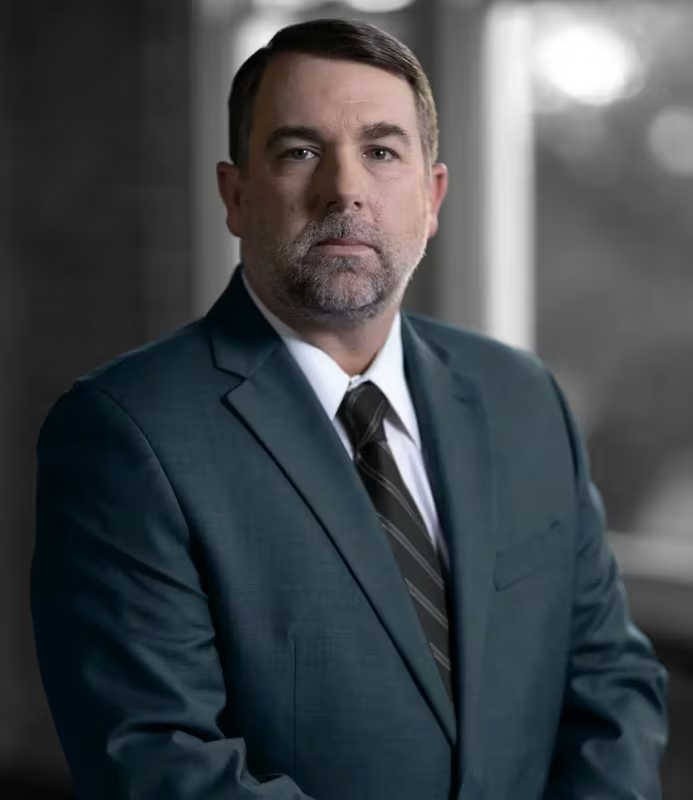
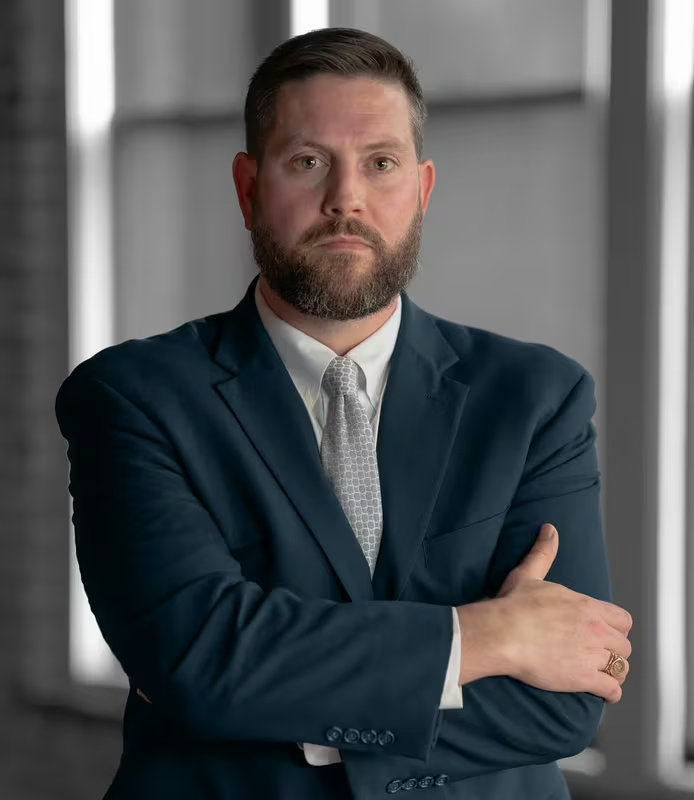
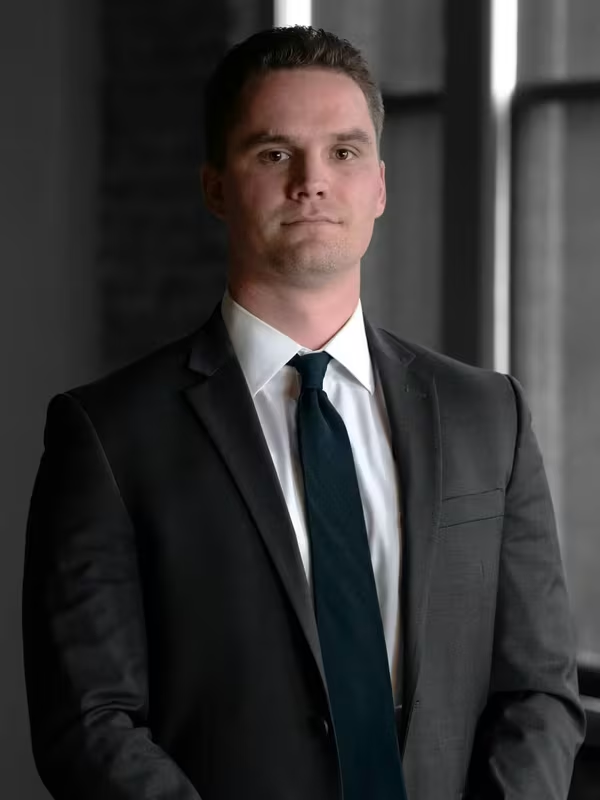
Your Bossier City Trial Team
The lawyers who work your file. Every Bossier City case is handled by the firm's own trial attorneys.





Where Do Most Motorcycle Accidents Happen in Bossier City?
Motorcycle crashes in Bossier City cluster where traffic moves fast, where vehicles turn across travel lanes, and where commuter volume spikes at predictable hours. The highest-risk corridors are the interstate stretches of I-20 and I-220, the busy commercial intersections along Airline Drive, the Benton Road and LA-3 corridor, and the entertainment districts near Barksdale Boulevard. Riders are exposed in these places for the same reasons: high speeds, frequent merging, and drivers scanning for cars rather than two-wheeled vehicles. Where your crash happened matters to the claim because location shapes the available evidence, the likely witnesses, and the road conditions an investigation must document.
Motorcycle Crashes on I-20 and I-220
Interstate 20 runs east and west through Bossier City and carries heavy traffic between here and Shreveport, while I-220 forms the northern loop around the metro area. Both routes combine highway speeds with frequent on-ramps and lane changes, which is where motorcycles are most vulnerable. A car merging at 65 miles per hour that does not register a rider in the next lane produces a sideswipe or rear-end collision with little margin for you to react. Interstate crashes also tend to involve secondary impacts after the initial contact, which makes the medical picture and the physical evidence harder to reconstruct without prompt documentation. Note the nearest exit number and the direction you were traveling.
Airline Drive Intersections
Airline Drive is one of Bossier City’s primary commercial arteries, lined with retail entrances, signal-controlled intersections, and constant turning traffic. The volume of driveways and cross streets along Airline Drive multiplies turning conflicts throughout the day. If your crash happened here, list the businesses on all four corners, because several of them have cameras aimed at the road.
Benton Road and LA-3
Benton Road, which carries Louisiana Highway 3, connects Bossier City to Benton and the communities to the north and sees steady commuter and commercial traffic. The corridor mixes higher posted speeds with signalized intersections and frequent business access points, a combination that produces both intersection collisions and rear-end impacts. A following driver who is not paying attention to a slowing or stopped motorcycle causes a serious rear-end crash. Our office sits on Benton Road, so give us the block and we will know the signal you mean.
Barksdale Boulevard and Entertainment Districts
Barksdale Boulevard and the nearby entertainment and casino districts draw concentrated evening and weekend traffic. Heavy pedestrian activity, frequent parking maneuvers, and congested turning movements add conflict points. Crashes in these districts often happen at night, when reduced visibility compounds a driver’s failure to notice a rider. If yours was after dark, write down which businesses were still open and lit.
Shreveport-Bossier Commuter Traffic
The Red River bridges and the connecting routes between Bossier City and Shreveport carry dense commuter traffic during morning and evening rush hours. Stop-and-go conditions, lane shifts on the bridges, and the constant merging at the river crossings create repeated opportunities for a distracted driver to strike a motorcycle. Commuter congestion also means more vehicles changing lanes in tight spacing, where a rider in a blind spot can be pushed out of a lane or rear-ended. If you commute it, a dashcam or helmet camera earns its cost the first time a driver says you came out of nowhere.
Because each of these locations produces a different evidence trail, identifying exactly where your crash happened is one of the first steps in building a claim. Traffic signals, business surveillance cameras, road geometry, and the responding agency all vary by corridor, and that detail shapes how an investigation proceeds. Write the location down the way you would give it to a dispatcher: road, direction, nearest cross street.