Originally published October 9, 2024. Updated October 10, 2026, with the 2026 school zone law and the fines now in force.
Louisiana bans holding or using a phone while driving unless the vehicle is lawfully stopped (La. R.S. 32:59, enacted in 2025). Senate Bill 98, the 2024 bill this article first covered, failed in the Louisiana House. The next year the Legislature passed House Bill 519, which became Act 288 of 2025 and took effect August 1, 2025. In 2026 the Legislature added a definition of the school zones where the law carries its higher fine.
What the Hands-Free Law Bans
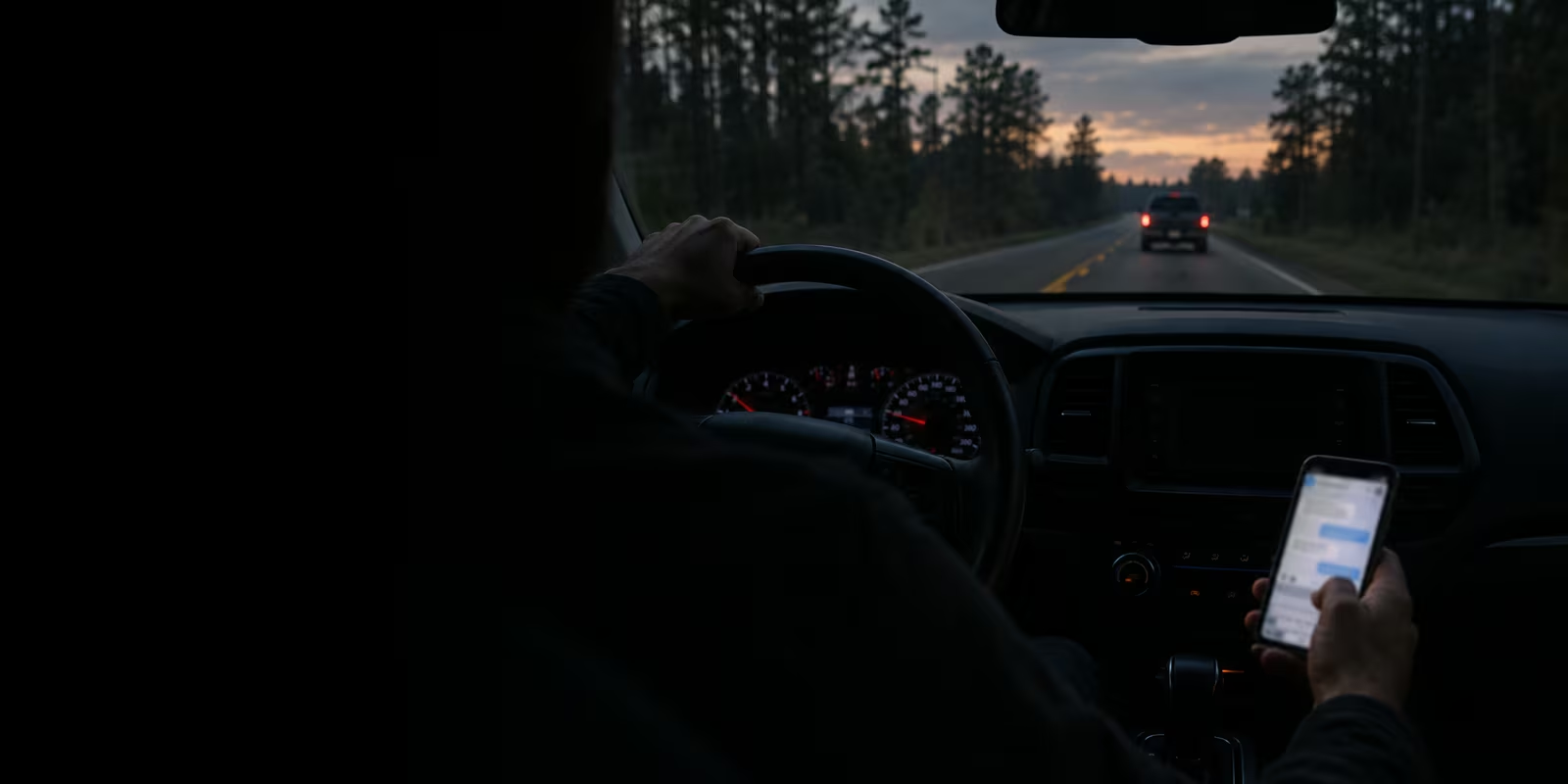
A driver on a public road may not use a phone or similar handheld device unless the vehicle is lawfully stationary. Under the law, that use includes:
- holding or physically supporting a phone in either hand
- talking or listening on a call without a hands-free device, or dialing by hand
- writing, sending or reading texts, messages or email
- reading or posting to social media
- viewing, taking or editing photos and videos
- using any app by typing, tapping or entering commands by hand
A vehicle is lawfully stationary when it is stopped, in park or neutral, or standing in gear and not moving, in a travel lane or on the shoulder. That includes stopping for traffic, a traffic signal or an officer’s directions.
What the Law Still Allows
- Hands-free calls. A driver may talk on a hands-free phone and may use a hand to turn a function on or off or to start one.
- Earpieces and watches. An earpiece, headphones or a device worn on the wrist may be used for a call.
- Navigation. A driver may view navigation on a hands-free GPS.
- Built-in systems. Devices permanently installed in the vehicle are not covered by the ban.
- Emergencies. A driver may use a phone to report a crash, a medical or other emergency, a serious road hazard or a person in danger of serious injury or death, or to dial 911 to report a crime in progress.
- Work and public safety. For-hire drivers, including rideshare drivers, may relay information to their dispatcher on a device mounted in the vehicle, and police, firefighters and EMS may use devices on duty.
Hands-free is legal, but it is not risk-free. Research shows hands-free devices are still a distraction.
Fines and Enforcement
Where the violation happens decides how it is enforced and what it costs:
| Where | How it is enforced | Fine | Fine if the driver is in a crash |
|---|---|---|---|
| School zone or highway construction zone | Primary offense: an officer can stop a driver for it | $250, which a judge may reduce to $100 with up to 15 hours of community service | $500 |
| Anywhere else | Secondary offense: cited only when an officer stops the driver for another violation | $100, which a judge may reduce to $50 with up to 15 hours of community service | $200 |
A few other rules shape enforcement:
- Warnings are over. Officers issued only written warnings for violations before January 1, 2026. Fines apply now.
- Nonmoving violation. Every violation of the law is a nonmoving violation.
- Paying without court. A driver may plead guilty or no contest and pay the fine without appearing in court, unless the violation involved a crash that injured or killed someone.
- Limits on officers. A secondary-offense citation must rest on the officer’s clear and unobstructed view of the phone use. An officer may not search or seize the phone, search the vehicle or the people in it, or make an arrest based only on that violation, other than on an open warrant.
- One statewide rule. State law overrides local phone ordinances, so parishes and cities cannot set their own rules for drivers’ phones.
- Tracking results. From April 1, 2027 through 2032, the Department of Transportation and Development and the State Police must report each year to the Legislature on the law’s effect, including distracted-driving crashes by region.
New for 2026: What Counts as a School Zone
Act 677 of 2026 (House Bill 844), effective August 1, 2026, defines the school zones where phone use is a primary offense with the higher fine. A school zone is a designated area next to a public or private K–12 school, or a college or other postsecondary school, that is marked with official school warning signs or similar traffic signs, and it extends at least 250 feet before the zone begins.
The zone is in effect for 60 minutes before and after school starts, and for 60 minutes before and after school ends.
Distracted Driving in Louisiana: The Numbers
According to the Louisiana Highway Safety Commission, 19 people were killed because of distracted driving in Louisiana in 2025, and 4 more deaths were tied to a handheld cell phone. There were 1,449 suspected serious-injury crashes involving distracted driving or cell phone use. The commission notes that distracted-driving crashes are underreported.
Distracted Driving and an Injury Claim
Phone use can matter after a crash. When a driver is using a phone in violation of the law at the time of a crash, the investigating officer must note the phone use on the crash report.
Fault matters too. For accidents on or after January 1, 2026, a person found 51% or more at fault recovers nothing, and anyone less than 51% at fault has damages reduced by their share (La. C.C. art. 2323). For earlier accidents, fault reduces damages but does not stop a person from recovering them.
More on these crashes is on our distracted driving accident page, along with texting and driving accidents.
How the Law Got Here: Senate Bill 98
Senate Bill 98, by Sen. Patrick McMath, proposed banning handheld phone use while driving in 2024. The Senate passed it 33–6 on April 8, 2024, but the House voted it down 22–71 on May 8, 2024 (bill history).
Supporters, including AAA and families of crash victims, argued that the texting ban then in force was too narrow. AAA said Louisiana drivers were on their phones 30% more than drivers in other states (Fox 8). Sen. McMath said, “This bill is about keeping … all of y’all safe” (KPLC). Opponents, including former Grant Parish District Attorney Ed Tarpley, called it government overreach.
The idea passed the next year. House Bill 519, by Rep. Brian Glorioso, passed the Senate 33–5, the House agreed to the Senate’s changes 94–1, and the governor signed it on June 11, 2025 (bill history). Act 288 also repealed Louisiana’s older texting and school-zone phone laws, La. R.S. 32:300.5 through 32:300.8, and replaced them with the single hands-free rule in La. R.S. 32:59.
Other States
According to the Governors Highway Safety Association, 33 states, Washington, D.C., Puerto Rico, Guam, the Northern Mariana Islands and the U.S. Virgin Islands ban handheld phone use for all drivers, based on state laws reviewed in June 2025. Examples include:
- California’s hands-free law, AB 1785, which prohibits drivers from using handheld electronic devices for any purpose unless the device is in hands-free mode.
- New York’s cell phone law, VTL § 1225-c and § 1225-d, one of the first statewide bans on handheld phones and portable electronic devices while driving.
- Georgia’s Hands-Free Georgia Act, which bars drivers from holding or supporting a phone with any part of their body.
Sources
- Louisiana Legislature, La. R.S. 32:59
- Louisiana Legislature, HB 519 (2025), Act 288
- Louisiana Legislature, HB 844 (2026), Act 677
- Louisiana Legislature, SB 98 (2024) bill history
- Louisiana Highway Safety Commission, Distracted Driving
- Governors Highway Safety Association, Distracted Driving Laws