

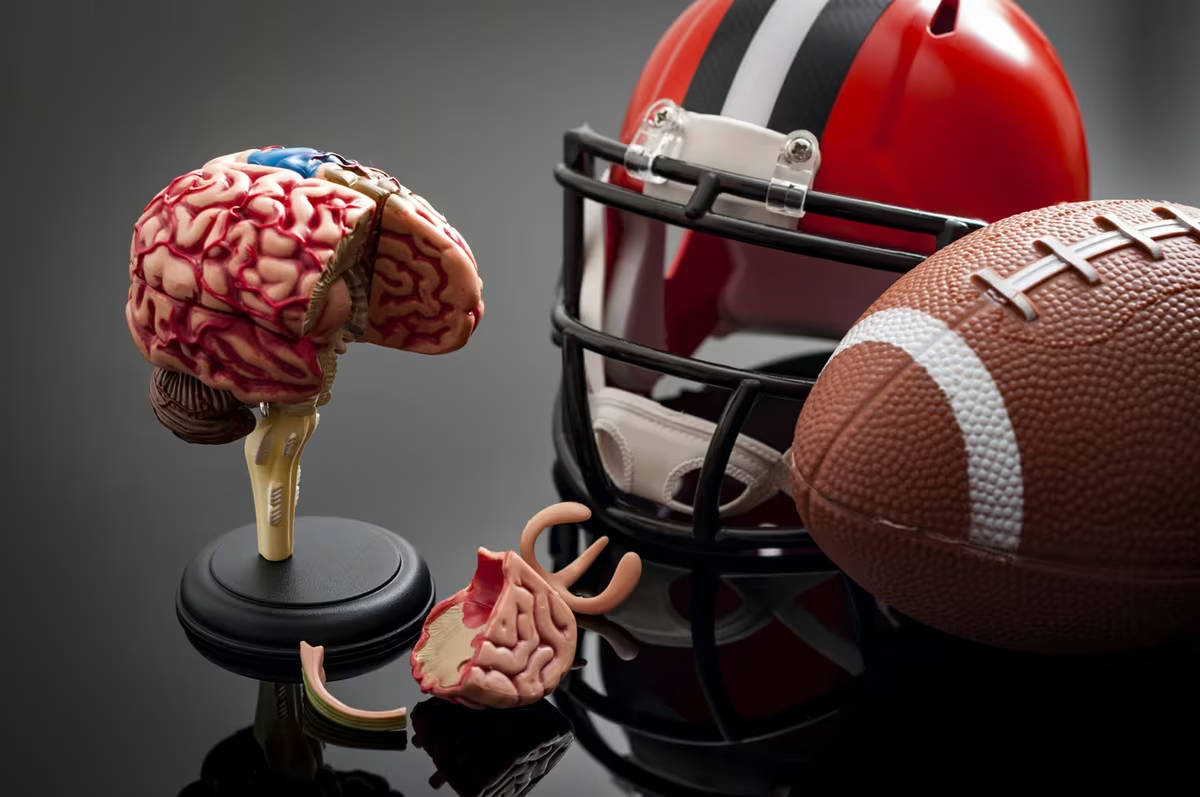
The Centers for Disease Control and Prevention (CDC) reports that American tackle football carries the highest risk of brain injury of any contact sport. The injuries, the players most exposed to them at the high school, college, and NFL levels, and the claims that follow when a league, a school, or an equipment maker fails a player are set out below.
Common Types of Brain Injuries in American Football
Football head injuries happen at every level, from youth leagues to the NFL. Three kinds account for most of them.
Concussions
A concussion is a mild brain injury caused by a blow to the head or body. Players may suffer concussions in football games or practices when tackling, blocking, falling to the ground, or colliding with each other. The sudden jolt causes the brain to move or twist inside the skull, leading to these symptoms:
- Ear ringing
- Headache
- Nausea or vomiting
- Blurred vision
- Drowsiness or dizziness
- Confusion or inability to focus
- Forgetfulness
- Slurred or delayed speech
In more severe cases, there could also be long-term effects of concussions, including post-concussion syndrome. A player who follows the football concussion protocol gives the brain time to heal before the next hit, which is what keeps a single concussion from becoming a lasting one.
Repetitive Head Trauma
Repetitive head trauma in contact sports like football can have serious effects on players that may show up later in life. Neurological damage from football is often connected to repeated head injuries that cause:
- Cognitive difficulties
- Changes in behavior or mood
- Depression
- Impaired memory
- Attention issues
- Sleep problems
Traumatic Brain Injuries
Traumatic brain injury (TBI) in athletes can range from mild to severe, causing different symptoms for different players. On one end, football players may suffer a concussion and only need a few days to recover. However, the other end of the spectrum is a TBI that causes permanent and debilitating neurological effects.
Either way, a player with a suspected TBI needs a doctor the same day, and the frequency of brain damage in football is a known cost of high-impact sports.
Chronic Traumatic Encephalopathy
The long-term risk for football players is chronic traumatic encephalopathy, or CTE, the disease that research has tied to repeated head trauma in former NFL, college, and high school players.
What Is CTE?
CTE is a degenerative brain disease caused by repeated head trauma or injuries that damage the brain’s blood vessels and cells. The disorder is progressive, starting with manageable symptoms and eventually leading to dementia. It can be diagnosed with certainty only at autopsy. The Boston University CTE Center reported in February 2023 that it had found CTE in 345 of the 376 former NFL players whose brains it had studied, 91.7 percent, while cautioning that families donate brains when they already suspect the disease, so the share among all players is lower. A 2026 Boston University study of 33 NFL players with autopsy-confirmed CTE found memory problems in 63 percent of them, and found that many measurably impaired players had not met the NFL concussion settlement’s impairment criteria while alive.
Symptoms of CTE
While symptoms will vary depending on the person and the progression of the disorder, common CTE symptoms include:
- Problems with concentration or focus
- Short-term memory issues
- Changes in behavior, such as angry outbursts
- Depression
- Difficulty speaking clearly
- Problems with balance
- Uncontrollable muscle movements or tremors
CTE typically starts slowly and gets worse with time, making it difficult to catch right away. Individuals with a history of repeated head trauma, such as football players, have a higher risk of developing CTE.
Long-Term Effects of CTE
CTE is a permanent condition that currently does not have a cure. After years or decades with CTE, people may lose the ability to care for themselves, move independently, or speak clearly.
Many people who suffer from CTE also have increasing depression and thoughts of self-harm. Studies have shown that athletes with CTE are more prone to suicidal behavior and ideation.
Risk Factors for Brain Injuries in Football
Although football is associated with head trauma, certain players may be more at risk for serious brain injuries. These factors affect the likelihood of a football player brain injury.
Age and Level of Play
Because children’s and young adults’ brains are still developing, they are more susceptible to head injury damage, and Boston University research ties tackle football at a young age to brain decline later in life. The National Federation of State High School Associations counted 1,032,415 high school players in 11-player football in its 2022-23 participation survey, so most football brain injuries happen in high school and college programs, often with fewer doctors and trainers on the sideline than an NFL team has.
Additionally, playing football more often during youth and adolescence presents more chances for injury. Young players who are involved in tackle competitions or an advanced level of play could suffer more head trauma. In fact, tackle football players experience 15 times more head impacts than youth athletes who play flag football.
Position and Playing Style
The CDC’s HEADS UP data say tackling causes almost two of every three high school football concussions, linebackers take six of ten defensive concussions, and running backs take almost half of the offensive ones. The positions most often hit or tackled carry the most risk:
- Offensive and defensive linemen
- Defensive backs
- Wide receivers
- Quarterbacks
- Tight ends
Playing style also factors into an athlete’s head injury risk. Players who are aggressive or reckless may experience more injuries in general, including concussions and head trauma.
Lack of Proper Safety Gear
If a football player is not wearing the proper helmet or protective gear during practice or a game, they could suffer preventable brain injuries. Likewise, safety gear must be worn correctly and consistently to get the protective benefits of the equipment.
Legal Rights of Injured Players
Injured football players’ rights will depend on several factors, including the circumstances that led to the injury and who was responsible.
Seeking Compensation for Football-Related Brain Injuries
When a football player’s brain injury was caused by negligence, intentional misconduct, or defective equipment, a claim can recover damages for:
- Medical bills
- Cost of future medical care
- Rehabilitation
- Loss of future wages
- Pain and suffering
- Emotional distress
Role of Sports Leagues and Organizations
Football leagues, schools, colleges, and other organizations involved in football should implement policies that require players to follow safety protocols, wear protective gear during games and practices, and use the correct techniques to lower their risk of head injury. Many teams also educate players on the risks involved with the sport and the effects of common football brain injuries.
Louisiana and Texas Concussion Laws for Student Athletes
Both states put the removal and return decisions in writing. The Louisiana Youth Concussion Act, La. R.S. 40:1089.1 through 40:1089.5, covers organized athletics for players seven to eighteen. A coach must immediately remove a youth athlete who reports or shows a sign of concussion, must notify the parent, and may not let the athlete practice or play again until a trained healthcare provider gives written clearance for a full or graduated return. Schools must give coaches, officials, players and parents concussion information before each season and put every coach and official through an annual concussion course under La. R.S. 40:1089.3. The Act creates no liability for a school or league that complied with it, which is why a Louisiana claim against a program starts with whether the coach followed the statute.
Texas sets the same rules for school athletics in Tex. Educ. Code §§ 38.151 to 38.160. Each district needs a concussion oversight team with at least one physician and a written return-to-play protocol; a student who might have a concussion is removed from practice or competition immediately under § 38.156; and under § 38.157 the student returns only after a treating physician’s evaluation, completion of the protocol, and the physician’s written statement that return is safe. A coach may not authorize the return. Section 38.159 shields oversight team members who serve as the law requires, so the Texas claim, like the Louisiana one, turns on a program that skipped a step.
Legal Precedents and High-Profile Cases
Former NFL players and their families have brought the best-known cases. The family of former National Football League linebacker Junior Seau sued the NFL after his 2012 suicide, when an autopsy found CTE, on the claim that the league had not warned players about concussion risks.
Ultimately, the NFL settled the wrongful death lawsuit with Seau’s family and agreed to compensate families of retired players found to have CTE after their deaths.
The larger case is In re National Football League Players’ Concussion Injury Litigation, MDL No. 2323 in the Eastern District of Pennsylvania, a class action for more than 20,000 retired players and their families. In January 2014 the court refused to approve a settlement capped at $675 million; the revised agreement it approved removed the cap and requires the NFL to pay every valid claim for 65 years. A claim pays on a qualifying diagnosis: early or moderate dementia, Alzheimer’s disease, Parkinson’s disease, ALS, or death with CTE. The settlement program reported 20,564 registered class members and 2,226 monetary awards paid as of October 26, 2026.
Preventing Brain Injuries in Football
Although not every injury can be prevented, modern advances in technology and safety protocols can help football players avoid head trauma.
Improved Safety Protocols
Football leagues and organizations are enhancing player safety by implementing new rules and guidelines, such as:
- Wearing protective gear
- Undergoing a seasonal physical or check-up
- Stretching and warming up before games or practice
- Educating players on the rules and restrictions of the game
- Having medical supervision on staff
- Promoting good nutrition and proper hydration
- Raising helmet quality requirements
Advances in Helmet Technology
Football helmet technology continues to evolve, with the NFL allowing players to use Guardian Caps over their helmets. While this padded headgear was typically used during practice and training camps, they were not permitted during games. After seeing the significant reduction in concussions by players wearing Guardian Caps, the NFL agreed to let players decide if they want to wear them during games.
The NFL also introduced 12 new helmet designs for the 2024 season, including eight position-specific helmets for quarterbacks, linemen, and other high-risk positions. For the 2025 regular season the league reported more than 98 percent of players in a top-performing helmet, alongside a record 538 in-game concussion evaluations.
Importance of Early Detection and Treatment
Early detection and treatment of head trauma limit the complications and long-term symptoms. Sideline testing by team doctors and athletic trainers, and a post-concussion protocol that keeps the player out until cleared, are the two pieces that matter.
The brain has to heal before the next hit. A second TBI on top of an unhealed first one is what raises the risk of repetitive injury and, over years, CTE.
What an Injured Player Can Do
Football brain injuries have long-term effects on players and their families, and even a mild concussion can leave neurological damage when it is not treated. A player, or the family of a player with suspected CTE after years of head trauma, can speak with a brain injury lawyer about whether another party’s negligence caused the injury. Trey Morris Injury Lawyers reviews these cases in a free consultation.