










Webster Parish wrecks happen on I-20, on US-371 between Minden and Springhill, and on US-79 and US-80, and the people hurt in them are taken to Minden Medical Center at Medical Plaza or Springhill Medical Center. The Minden Police Department writes the report inside Minden, the Springhill Police Department inside Springhill, the Webster Parish Sheriff’s Office on the parish roads, and Louisiana State Police on I-20 and the U.S. highways. Suits are filed at the Webster Parish Courthouse at 410 Main Street in Minden, where the Webster Parish Clerk of Court also keeps the record. Trey Morris Injury Lawyers is at 415 Main Street, Suite 200, in Minden, and Webster Parish cases are handled from that office. We request the report, send preservation letters for camera footage along US-371 and at the I-20 interchanges, and collect the emergency room records. We send those letters once we have a sound basis for them, because moving as fast as the law permits is what keeps evidence intact and brings more of it to light. The letters also ask that the other vehicle, its event data and the 911 recording be kept, because with the footage they can show the speed, the signal and who had the right of way.
The law that governs the claim is Louisiana law, and it is the same in Webster Parish as in every other parish. If you were hurt in Webster Parish, your claim runs on a two-year clock under La. C.C. Art. 3493.1 when the injury happened after July 1, 2024, and on the one-year period under La. C.C. Art. 3492 when it happened on or before that date. Webster Parish injury suits are filed in the 26th Judicial District Court in Minden.
Results for Louisiana Clients
- $409 MillionWrongful Death
A tragic case where an impaired driver of a commercial vehicle ran a red light, then collided with our client, causing serious bodily injury to the mother and the loss of life of her daughter.
- $49 MillionMotor Vehicle Accident
An impaired driver of a stolen vehicle driving the wrong way collided with our client head-on, resulting in brain injury and multiple broken bones.
- $32,195,000Industrial / Workplace
Failure to maintain proper safety protocols led to an explosion at an industrial plant causing a series of catastrophic injuries from broken bones, burns, spinal injury, and mental anguish.
- $31.5 MillionIndustrial / Workplace
Brain and spinal injuries followed an oil-field company failing to maintain equipment and provide a safe work site.
- $17.25 MillionCommercial Vehicle Accident
Client was struck head-on by a disconnected load of an 18-wheeler that crossed the median causing broken bones and amputation.
- $13 MillionCommercial Vehicle Accident
On the interstate, an 18-wheeler failed to yield right of way then made an unsafe lane change causing the accident which resulted in major bone breaks, damaged organs, and ultimately a leg amputation.
Past results do not guarantee future outcomes; each case is decided on its own facts.
Do You Need a Webster Parish Injury Lawyer After an Accident?
Not every accident in Webster Parish needs a lawyer. A fender-bender with no injuries, full admission of fault, and a cooperative insurer can usually be handled without one. The question becomes serious when injuries are real, fault is contested, or an adjuster is pushing for a quick statement or a quick check.
You are on this page because something happened in or near Minden, Springhill, Sibley, Cotton Valley, Doyline, or somewhere along I-20 or US-371, and you are trying to figure out whether hiring a lawyer is the right call. The honest answer is that it depends on a small number of concrete factors, not on advertising. The sections below walk through those factors so you can decide. This section answers the threshold question: when does an injury claim cross the line from a paperwork exercise into something that needs counsel?
The signal isn’t dramatic. It usually looks like one of these.
- You went to the emergency room, an urgent care, or a follow-up appointment. Medical bills are coming in or your health insurance has started paying and may eventually want reimbursement.
- You missed work, or your ability to do your job has changed.
- The other side’s insurance company is calling, asking for a recorded statement, asking you to sign a medical authorization, or floating an early settlement number.
- Fault is disputed, or more than one vehicle, driver, or property owner is involved.
- A commercial vehicle, an 18-wheeler, a government vehicle, or a business is involved.
- Someone in the accident died.
Any one of those changes the math. Insurance adjusters are trained, salaried professionals whose job is to close files for as little as possible. An unrepresented claimant negotiating against a career adjuster is not a fair conversation, and the numbers reflect that. The adjuster knows what the claim is worth. You usually do not, yet.
Signs You Probably Do Not Need a Lawyer
There are situations where calling a lawyer is overkill. If your vehicle has minor damage, you were not hurt, no one is claiming you caused anything, and the at-fault driver’s insurer is processing the property-damage claim without friction, you can often handle that directly. The same is true for very small medical visits that resolved in a single appointment with no lingering symptoms and no time missed from work. A lawyer’s involvement in those cases usually does not change the outcome.
The distinction is whether the claim is mostly about a car or mostly about a person. Property-damage-only claims are largely a paperwork process. Bodily-injury claims involve medical records, future care, lost income, and pain and suffering, and the value of those is negotiated, not printed on a form.
Signs You Should at Least Talk to One
A consultation is not a commitment. Most personal injury lawyers in Louisiana, including this firm, talk to potential clients for free and only get paid if the case results in a settlement or judgment. The cost of asking is zero. The cost of guessing wrong, signing a release too early, or missing a deadline can be the entire claim.
Talk to a lawyer if any of the following is true. You were taken from the scene by ambulance. You have been diagnosed with a concussion, fracture, herniated disc, or any injury that may need imaging, injections, or surgery. You are being asked to give a recorded statement to the other driver’s insurer. You have been offered a settlement within days or weeks of the accident. You are not sure who was at fault, or law enforcement issued a citation you disagree with. The other party was working at the time, which can pull an employer’s insurance into the claim. Someone in your household was killed.
In each of those situations, what looks like a simple choice today often turns out to have consequences that show up months later, when a back injury that seemed minor needs a procedure, or when a release you signed turns out to bar a much larger claim.
What a Free Consultation Actually Tells You
A real consultation should give you three things: an honest read on whether you have a claim worth pursuing, an explanation of the deadlines that apply to your situation, and a clear answer on what hiring the lawyer would cost you out of pocket. If a consultation does not give you those three things, you have not really had a consultation.
The rest of the sections below address the other inputs to that decision: the kinds of cases handled in Webster Parish, how Louisiana law shapes the claim, what damages can include, and how the process actually works from the day you call to the day a case resolves. Read in order or skip to the section that matches your situation. The goal here is to give you enough to make an informed choice, including the choice not to hire anyone.
Local Coverage. Statewide Record.
- $1 Billion+
Outcomes for Louisiana clients
Verdicts and settlements won across the state by the same trial team that handles Webster Parish cases.
- 11
Trial attorneys, one team
Your case is handled by the firm's own trial attorneys, and we respond in minutes, 24/7.
- 24/7
We come to you
An attorney travels to you in Webster Parish, at home or at the hospital, or meets by video the same day. Free case review, and no fee unless we win.
- 127
Cases resolved over $1 million
Verdicts and settlements of $1 million or more, won by the same trial team that handles Webster Parish cases.
What Types of Injury Cases Does a Webster Parish Lawyer Handle?
A Webster Parish injury lawyer handles claims where someone was hurt because of another party’s negligence or fault. The categories below cover the case types that move through Webster Parish courts and the 26th Judicial District. Each carries its own evidence demands, defendant profile, and procedural quirks. The category your case falls into shapes who gets sued, what records matter, and how the defense will be staffed.
Motor Vehicle Collisions on I-20, US-371, and Local Roads
Car wrecks are the most common injury claim in Webster Parish. Interstate 20 runs east-west through Minden and pulls heavy commercial traffic between Shreveport and Monroe. US-371 and LA-7 carry mixed local and through traffic that often ends in intersection and rear-end collisions. Cases typically involve liability disputes, recorded statements requested by insurers, and medical-causation fights over soft-tissue injuries.
Commercial Truck and 18-Wheeler Cases
Truck cases are not large car cases. They run on federal motor carrier rules, electronic logging device data, driver qualification files, and maintenance records that disappear if not preserved early. Webster Parish sits on a busy I-20 freight corridor, and crashes here often involve out-of-state carriers, multiple insurance layers, and corporate defendants who staff defense counsel within hours. Ask any attorney whether they have sent a spoliation letter to a motor carrier before. The answer tells you whether they have handled these cases or only car cases involving a truck.
Workplace, Industrial, and Oilfield Injuries
Webster Parish has a manufacturing and industrial workforce, including chemical, fabrication, and oil and gas operations. A workplace injury can run on multiple tracks at once: a Louisiana workers’ compensation claim against the employer, and a third-party negligence claim against a contractor, equipment manufacturer, or property owner whose conduct caused the injury. Sorting which claims belong to which defendant is the first job a lawyer does in these matters.
Premises Liability and Slip-and-Fall
Premises cases cover injuries on someone else’s property: a fall at a store, an unsafe condition at an apartment complex, an inadequately maintained parking lot. Louisiana premises law puts specific evidentiary burdens on the injured person, and surveillance footage and incident reports often determine whether a claim survives. These records are routinely overwritten within days, so early preservation requests matter.
Wrongful Death and Catastrophic Injury
When an injury results in death or a permanent, life-altering condition (spinal cord injury, traumatic brain injury, severe burns, amputation), the case changes shape. The damages model expands. The defense investment expands with it. Wrongful death claims are brought under La. C.C. Art. 2315.2, and the related survival action is brought under La. C.C. Art. 2315.1. Who is entitled to bring each claim is addressed separately on this page.
Other Negligence Claims Handled Locally
Webster Parish injury lawyers also handle motorcycle and commercial vehicle wrecks involving local fleets, dog-bite and animal-attack claims, defective-product cases, nursing-home neglect, and rideshare collisions. The common thread across every category above is the same: someone was hurt, another party’s conduct caused or contributed to it, and the records to prove both are time-sensitive.
Webster Parish Practice Areas
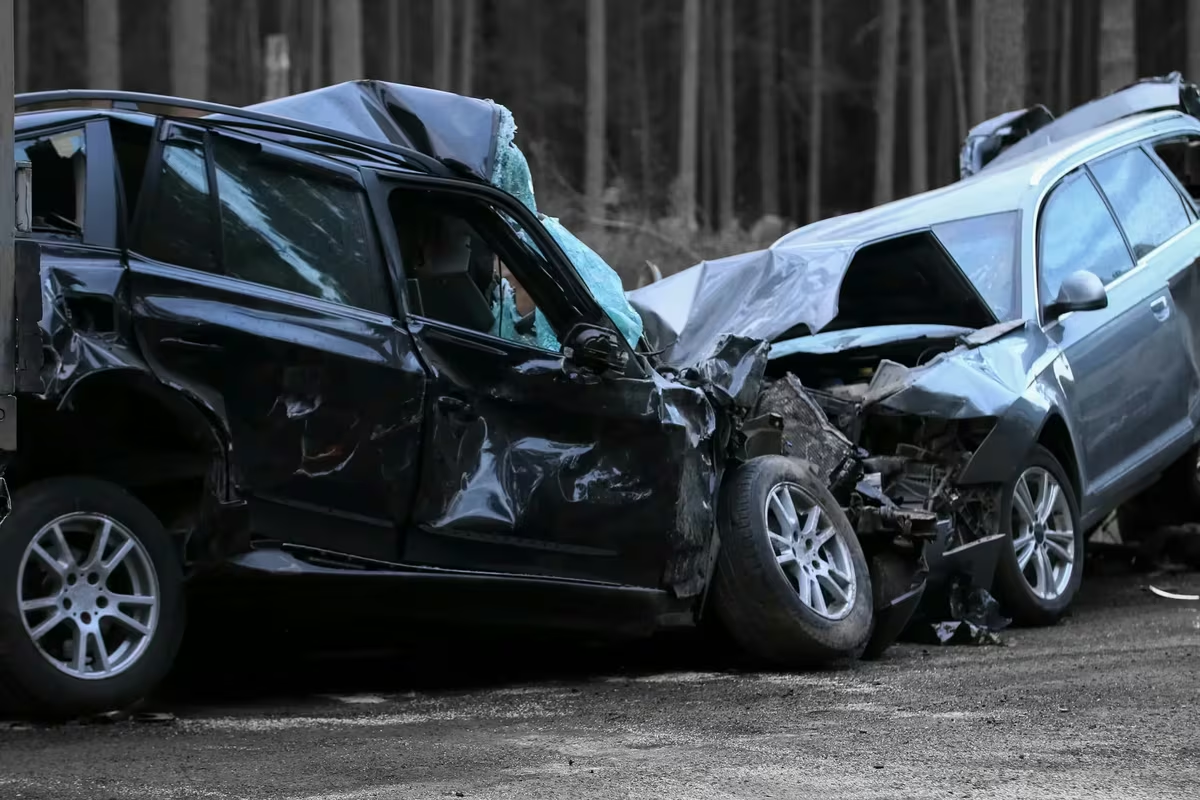 Car AccidentsRear-end, intersection, and highway collisions across Louisiana.
 Truck Accidents18-wheeler and commercial-vehicle wrecks governed by federal trucking rules.
 Catastrophic InjuryBrain, spinal-cord, amputation, and severe-burn injuries that change a life.
 Wrongful DeathClaims brought by families after a fatal accident or act of negligence.
 Premises LiabilitySlip-and-fall and unsafe-property injuries on someone else's premises.
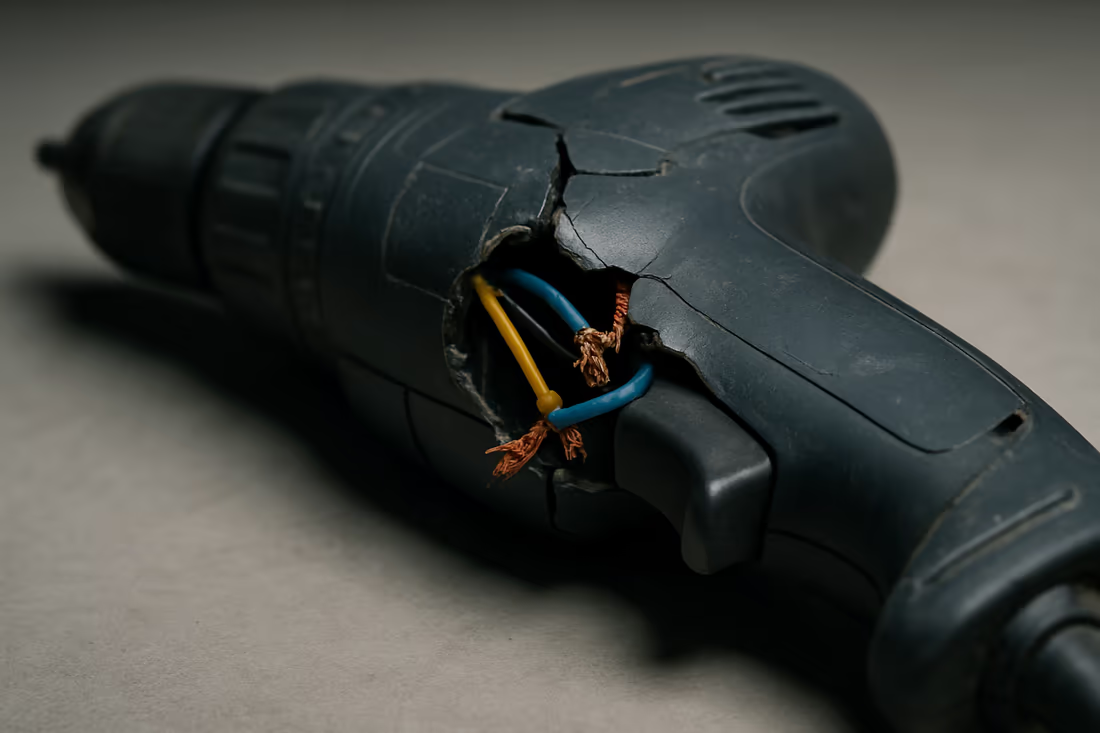 Product LiabilityInjuries caused by defective or unreasonably dangerous products.
 Oilfield AccidentsDrilling, pipeline, and refinery injuries across the energy sector.
 Industrial AccidentsPlant, warehouse, and heavy-equipment injuries in industrial settings.
 Offshore AccidentsRig, platform, and vessel injuries beyond the shoreline.
What Should You Do Immediately After an Accident in Webster Parish?
The hours and days after a crash, fall, or workplace injury set the ceiling on what a claim can later prove. Evidence disappears, witnesses leave, and adjusters start building a file before you do. The steps below are the ones that protect both your health and the documentary record a claim depends on.
Call 911 and Make Sure an Official Report Is Created
From anywhere in Webster Parish, dial 911. The dispatcher routes to the right responding agency: Minden Police inside Minden city limits, the Webster Parish Sheriff’s Office for unincorporated areas and most of the parish, Springhill, Sibley, Cullen, or Doyline police for those municipalities, and Louisiana State Police for crashes on I-20, US-371, US-79, US-80, and LA highways. Ask the responding officer for the report or incident number before they leave the scene. If no officer responds because the crash is minor, drive to the Minden Police Department or the Webster Parish Sheriff’s Office and file a counter report the same day. An unreported accident is the single most common reason an otherwise valid claim gets denied.
Get Medical Attention the Same Day
Go to an emergency room or urgent care even if you think you are not hurt. Soft-tissue injuries, concussions, and internal injuries often do not present symptoms for 24 to 72 hours. The closest options in Webster Parish are Minden Medical Center on Sibley Road in Minden, Springhill Medical Center in the northern part of the parish, and the urgent care clinics in Minden. Tell the intake nurse and the treating provider every body part that hurts, even slightly. Gaps in treatment and undocumented complaints are the two facts insurance adjusters use most often to reduce an offer.
Document the Scene Before You Leave
If you are physically able, use your phone to capture:
- Wide shots of all vehicles, their positions, and the surrounding roadway or property
- Close-ups of damage on every vehicle involved
- Skid marks, debris fields, traffic signals, stop signs, and any obstructions
- License plates, VINs, insurance cards, and driver’s licenses of every party
- Names and phone numbers of every witness, not just the ones the officer interviews
- The other driver’s face and the responding officer’s name and unit number
Weather and lighting matter. A photo at 4:30 p.m. in October on US-371 tells a different story than a verbal description three months later.
Preserve Physical Evidence
Do not repair the vehicle, wash it, or release it to a salvage yard until the damage has been photographed, measured, and documented by someone working for you. The same applies to torn clothing, broken equipment, damaged footwear from a fall, or any product that caused the injury. Keep it. Bag it. Label it with the date. Once a vehicle is crushed or a defective product is thrown out, the case loses proof it cannot replace.
Report the Crash to Your Own Insurer, Carefully
Most Louisiana auto policies require prompt notice of a loss. Call your own carrier and report that an accident occurred. Give the date, time, location, and the other driver’s information. Do not give a recorded statement, do not speculate about fault, and do not estimate your injuries. “I was hurt and I am still being evaluated” is a complete and accurate answer.
Do Not Talk to the Other Driver’s Insurance Company
The adjuster for the at-fault driver will call quickly, often within 24 to 48 hours. You are not required to give them a statement, sign a medical authorization, or accept a quick settlement. Decline politely and route the call to your attorney once you have one.
Start a Paper Trail That Same Week
Open a folder, physical or digital, and put everything in it: the police report number, ER discharge papers, prescription receipts, mileage to and from appointments, missed-work documentation from your employer, repair estimates, and a short daily note about pain levels and limitations. Claims are won on documentation generated in the first 30 days, not on memory reconstructed later.
Know the Clock Has Already Started
Louisiana sets a strict deadline for filing an injury lawsuit, and that deadline begins running the day of the accident, not the day you decide to act. The specific rule, the recent change to it, and how it applies to a Webster Parish claim are covered in the statute-of-limitations section below. The practical point for the first week is simple: every day spent without medical records, photos, and a report is a day the claim gets harder to prove.
What Does a Webster Parish Injury Lawyer Actually Do for You?
A personal injury lawyer is part investigator, part records clerk, part negotiator, and, when the case demands it, a trial lawyer in the 26th Judicial District Court in Minden. The work starts long before any settlement conversation. It starts with proving what happened, documenting how it changed your life, and putting that case in a form an insurance adjuster or a jury can act on. Most of that work happens out of view of the client, which is why people often hire counsel without a clear sense of what they are paying for.
The sections below break the job into the parts a Webster Parish injury client actually receives. Read this with one question in mind: when you interview an attorney, can they describe doing each of these tasks on cases like yours?
Investigating the Accident and Preserving Evidence
The first job is to lock down what happened. Skid marks fade. Surveillance footage from a gas station on U.S. 79 or a warehouse off I-20 typically loops over within days or weeks. Witnesses move and forget. Vehicles get repaired or sent to salvage.
A lawyer working a Webster Parish case will request the official crash report from the investigating agency, whether that is the Webster Parish Sheriff’s Office, Minden Police Department, Springhill Police Department, or Louisiana State Police Troop G out of Bossier City. They will identify and contact witnesses, photograph the scene, and send written preservation letters to anyone holding evidence. On a commercial-vehicle case, that means demanding the driver’s logs, the electronic logging device data, dispatch records, and the truck itself. On a premises case, it means demanding the surveillance video and any incident reports.
When you interview an attorney, ask what preservation letters they would send and to whom. The answer tells you whether they have actually built these cases.
Building the Liability Case
Proving the other side was at fault is not the same as believing they were. Liability has to be supported with evidence a defense lawyer cannot easily attack. That means matching the physical evidence (vehicle damage, scene photos, road conditions) to the witness statements and the official report, and identifying the gaps where an expert is needed.
In a serious wreck, an accident reconstructionist may be retained to analyze speeds, angles, and points of impact. In a workplace or industrial injury, a safety expert may be needed to explain which standards applied and which were ignored. In a premises case, the investigation looks at maintenance logs, prior incidents at the same location, and what the property owner knew or should have known.
This is also the stage where every potentially responsible party is identified. A wreck involving a delivery driver is not just a claim against the driver. It is a claim against the employer, the company that owned the trailer, and sometimes a maintenance contractor. Missing a defendant means leaving compensation on the table.
Handling the Insurance Companies So You Don’t Have To
From the moment a claim is open, the at-fault carrier (and sometimes your own) will call, send forms, ask for recorded statements, and request broad medical authorizations. Adjusters are trained, scripted, and measured on how much they pay out. An unrepresented claimant is talking to a professional whose job is to reduce the value of the claim.
Once a lawyer is in the case, that contact stops coming to you. All communication routes through the firm. Recorded statements, if given at all, are given on terms the lawyer controls. Medical authorizations are narrowed so the carrier gets the records that relate to the injury, not a full life history to mine for prior complaints.
When you interview an attorney, ask who at the firm will handle adjuster calls, how quickly those calls are returned, and how they decide whether to give a recorded statement.
Coordinating Medical Treatment and Documentation
A lawyer does not direct your medical care, and a competent one will not pretend to. What a lawyer does is make sure the treatment you receive is documented in a way that connects each diagnosis, each restriction, and each cost back to the accident. That means getting complete records and bills from every provider, requesting narrative reports when imaging or specialist opinions are critical, and tracking out-of-pocket expenses.
If treatment is stalling because of insurance issues, the lawyer can often help identify providers willing to treat under a medical lien until the case resolves. That keeps the medical record building while the claim is pending.
Calculating and Proving Damages
The value of an injury claim is built, not guessed. A lawyer compiles the medical bills, the lost-wage documentation from your employer, the future medical needs supported by a treating physician or life-care planner, and the non-economic harm shown through your own testimony and the testimony of people who know you. Property damage, mileage to and from appointments, prescription costs, and household services you can no longer perform all belong in the file.
The goal is a damages presentation an adjuster cannot dismiss and, if it comes to it, a jury in Minden can follow line by line.
Negotiating the Settlement
Most personal injury claims resolve without a trial. The negotiation is not a single phone call. It is a structured exchange that usually begins with a demand package: a written presentation of liability, medical treatment, damages, and the legal authority that supports the claim, with supporting exhibits. The carrier responds. Counter-offers move in both directions. Sometimes mediation is used to break a deadlock.
A lawyer’s job in negotiation is to know what the case is worth, know what comparable cases have resolved for, and know when an offer is the best the carrier will pay without litigation. Settling too early leaves money on the table. Refusing reasonable offers out of pride costs the client time and risk. The judgment call is the work.
Filing Suit and Litigating When Necessary
If the carrier will not pay fair value, the case is filed. For most Webster Parish injuries, that means a petition in the 26th Judicial District Court, which sits in Minden and also serves Bossier Parish. Some cases, particularly those involving out-of-state defendants or federal claims, are filed in or removed to the United States District Court for the Western District of Louisiana, Shreveport Division.
Once suit is filed, the work shifts to written discovery, depositions, expert reports, motion practice, and trial preparation. Many cases settle during this period, often after a key deposition or a ruling that changes the risk calculus. The cases that do not settle are tried.
Ask any attorney how many cases they have actually tried to verdict, not just filed. The answer matters, because carriers know which firms try cases and which firms fold at the courthouse steps. That reputation affects every offer that comes in before trial.
Managing Liens, Subrogation, and the Final Payout
The last job is one clients rarely think about until it surprises them. Health insurers, Medicare, Medicaid, ERISA plans, and workers’ compensation carriers often have a right to be reimbursed out of any settlement for what they paid toward accident-related care. Unresolved liens can eat into the client’s share or, worse, create personal liability after the case closes.
A lawyer’s job at the end of the case is to identify every lien, negotiate them down where the law allows, and account for every dollar on a written settlement statement before any funds are disbursed. The client should leave the closing with a clear, itemized record of where the money went and why.
That is the work. Not all of it is visible, and almost none of it is glamorous. But it is the difference between a claim that is processed and a claim that is built.
Why Hire a Local Webster Parish Injury Lawyer Instead of an Out-of-Town Firm?
The attorney you hire after a Webster Parish accident is going to spend the next year or two working inside a specific courthouse, in front of specific judges, opposite specific defense lawyers and adjusters. Familiarity with that environment is a working condition that affects scheduling, motion practice, jury selection, and how quickly a case moves toward resolution. A firm that drives in from a metro area for the first hearing is learning what a local lawyer already knows.
That does not mean every local lawyer is the right lawyer. Local is one factor among several, and it is worth understanding what it actually buys you and what it does not.
What Local Familiarity Actually Means
Webster Parish civil cases are filed at the 26th Judicial District Court in Minden. The judges who hear those cases set their own scheduling preferences, motion practice habits, and trial calendars. A lawyer who has tried cases in that courthouse knows how a particular judge handles discovery disputes, what the local jury pool tends to credit, and which defense firms appear in the parish on insurance-defense files. That knowledge is learned by showing up.
Ask any attorney you interview how many cases they have taken to trial or through significant motion practice in the 26th JDC. The answer is a fact. If they have never appeared in Minden, they are not disqualified, but they are starting from zero on courthouse logistics while opposing counsel may not be.
Practical Access for the Client
An injury case generates documents, decisions, and meetings over many months. Medical records arrive. Adjusters call. Depositions get scheduled. A lawyer with an office near Webster Parish is easier to meet in person, easier to reach during business hours, and easier to bring to a site visit if the accident location matters to the claim.
Distance is not a fatal flaw. Plenty of cases are handled competently by firms two or three hours away, especially when the firm has tried cases in the parish before and associates local counsel when needed. The right question to ask is straightforward: who will be your point of contact, where do they sit, and how often will you hear from them. A firm that cannot answer that directly is telling you something useful.
What Local Does Not Mean
Local does not mean small. The lawyer down the street is not automatically the best fit for a serious injury case, especially one involving commercial vehicles, industrial incidents, or complex medical issues that require expert witnesses and significant case investment. A small local practice that does not have the resources to advance costs on a contested case is not doing the client a favor by taking it.
The practical test is whether the firm you are considering combines two things: working familiarity with Webster Parish courts and the staffing and financial capacity to handle the kind of case you have. Those are separate questions. Ask both.
How to Evaluate the Tradeoff
When you interview firms, ask each one the same set of questions. How many cases have they handled in the 26th JDC. Who in the firm will actually work the file day to day. How do they staff a case that goes into deeper litigation. Whether they associate local counsel when they take cases outside their home parish, and how that affects fees. The answers tell you whether the firm has thought about the case as your case or as a file on a stack.
A Webster Parish injury claim is not won by geography. It is won by preparation, evidence, and the willingness to try the case if the offer is not fair. Local presence helps when it comes with that work ethic behind it. It does not substitute for it.
How Does a Webster Parish Personal Injury Claim Work, Step by Step?
A personal injury claim is a sequence, not an event. From the day of the accident to the day a check clears, the file moves through predictable stages.
The steps below describe what happens after you have already hired counsel and started medical treatment. The two preceding pieces (what to do immediately after the wreck and what the lawyer’s job looks like day to day) are covered in their own sections on this page.
-
Investigation and Evidence Preservation
The first phase is fact-gathering. Your lawyer orders the crash report from the Webster Parish Sheriff’s Office, Minden Police, Springhill Police, or Louisiana State Police Troop G, depending on where the wreck happened. The file pulls 911 audio, dispatch logs, photographs taken at the scene, and any body-cam or dash-cam footage that exists.
-
Medical Treatment and Documentation
The claim cannot be valued until the medical picture is clear. Gaps in treatment are the single most common reason an otherwise solid case loses value at the negotiating table.
-
Reaching Maximum Medical Improvement
Maximum medical improvement, or MMI, is the point at which a treating physician determines your condition has stabilized. Settling before MMI is risky because future medical costs and permanent impairment are still unknown.
-
The Demand Package
Once MMI is reached, the lawyer assembles a demand package and sends it to the at-fault driver’s insurance carrier. A response typically follows in thirty to sixty days.
-
Negotiation
Negotiation is a series of offers and counter-offers, usually conducted in writing or by phone between the lawyer and the adjuster. Many cases settle in this phase.
-
Filing Suit in Webster Parish
If negotiation stalls or the prescription deadline is approaching, the petition for damages is filed. Webster Parish civil cases are filed in the 26th Judicial District Court at the courthouse in Minden. Filing the petition interrupts prescription and moves the case from the insurance-claim track to the litigation track.
-
Discovery
Discovery is the formal exchange of information between the parties. Discovery is often the longest phase of a litigated case and can run six months to more than a year.
-
Mediation
Before most cases reach a courtroom, the parties attend mediation. Mediation is not binding, but it resolves a large share of cases that did not settle pre-suit.
-
Trial
A Webster Parish civil jury trial is held at the 26th JDC courthouse in Minden. Most personal injury cases never see a jury. The credible threat of trial, backed by a file that is ready for trial, is what produces serious settlement offers earlier in the process.
-
Resolution and Disbursement
The settlement check or judgment proceeds are deposited into the firm’s trust account. From there, the attorney’s fee and case costs are paid, outstanding medical liens and health insurance subrogation claims are negotiated and satisfied, and the net amount is disbursed to you.
What Compensation Can You Recover in a Webster Parish Injury Claim?
Louisiana injury claims compensate the injured person through two broad categories of damages: economic losses you can document with paperwork, and non-economic losses that account for the human cost of the injury. A Webster Parish claim follows the same Louisiana damages framework as a claim filed anywhere else in the state.
Economic Damages: The Bills and the Paychecks
Economic damages cover measurable financial losses tied to the injury. These are the line items an adjuster or jury can add up from records. Economic damages live or die on documentation. Bills, records, wage statements, and expert reports are the building blocks.
Non-Economic Damages: The Human Cost
Non-economic damages account for losses that do not arrive with an invoice. Louisiana law allows the injured person to be compensated for these even though no receipt exists.
Damages in Cases Involving Egregious Conduct
Louisiana does not award punitive damages in ordinary negligence cases. The legislature has authorized them in specific, narrow categories defined by statute. Whether any such category applies to a given Webster Parish case is a legal analysis tied to the specific facts and the specific statute, and it should be evaluated by counsel reviewing the file. The default expectation in a typical injury claim is that damages will be economic and non-economic, not punitive.
How Much Is a Webster Parish Injury Case Worth?
There is no average that tells you what your case is worth. Value comes from the specific damages you can prove, the strength of liability, and the practical limits on what can be collected. Below is how those pieces actually drive a number.
The Inputs That Drive Case Value
Four categories of facts move the number up or down. First, the medical picture: the type of injury, the treatment required, whether surgery was recommended or performed, and the expected long-term prognosis. Second, the economic loss: actual medical bills incurred, future medical care reasonably expected, wages lost during treatment, and any reduction in future earning capacity. Third, the human loss: pain, physical limitation, scarring, and the effect on daily life. Fourth, liability strength: clear fault on the other side increases value; disputed fault decreases it.
Why Two Similar-Sounding Cases Settle for Very Different Amounts
Two people can be rear-ended at the same Minden intersection on the same day and end up with cases worth very different amounts. Case value tracks damages, not the dramatic facts of the impact.
The Practical Ceiling: Available Insurance and Collectability
A case is only worth what can actually be collected. In most Webster Parish auto cases, that means the at-fault driver’s liability policy plus any uninsured or underinsured motorist coverage on your side. A claim can be worth more than the available coverage in theory and still settle at the policy limit in practice if the defendant has no collectable assets.
What Reduces Case Value
Gaps in treatment reduce value. So do prior injuries to the same body part that are not clearly distinguished from the new injury. So do social-media posts that contradict the claimed limitations. So does any percentage of fault assigned to the injured person, because Louisiana reduces the award by that percentage.
Honest Ranges, Not Guarantees
After records are gathered and liability is clear, an experienced lawyer can usually give a realistic range, not a single number. The range narrows as discovery progresses.
How Does Louisiana Comparative Fault Affect Your Webster Parish Injury Case?
Louisiana applies a comparative fault system to personal injury claims. The fault percentage assigned to each party, including the injured person, becomes one of the most consequential numbers in a Webster Parish case. It directly reduces what an injured person can collect, and it shapes every settlement negotiation from the first adjuster call through trial.
A partly-at-fault claimant still has a claim. The math changes, not the right to pursue damages.
What Comparative Fault Means in Practice
Under Louisiana’s comparative fault framework, a jury or judge assigns a percentage of fault to each party who contributed to causing the accident. The injured person’s damages award is then reduced by the percentage of fault attributable to that person. If total damages are calculated at $100,000 and 20% of the fault rests with the claimant, the award is reduced by $20,000.
Fault can be split among multiple parties. In a Webster Parish intersection collision, for example, fault might be divided between two drivers, or between a driver and a third party whose vehicle, conduct, or property contributed to the crash. Each percentage attaches to a specific defendant for the portion of damages that party owes.
How Insurers Use Comparative Fault Against an Injured Claimant
Adjusters do not assign fault neutrally. The percentage an insurer proposes early in a claim is a negotiating position, not a finding. Every percentage point matters.
How Fault Is Actually Investigated and Proved
Fault is built from evidence, not assumptions. The investigation that supports a comparative fault argument in a Webster Parish case typically includes the crash report from the responding agency, scene photographs, vehicle damage analysis, witness statements, available video from nearby businesses or traffic cameras, cell phone records when distraction is alleged, and medical records that document the mechanism of injury.
Why the Assigned Percentage Is Worth Contesting
In settlement negotiations, fault percentage is the lever the defense pulls hardest. A case with strong damages but a contested fault picture settles for far less than a case where liability is clean. The evidence that drives fault percentages down has a short shelf life, which is why the first weeks after a Webster Parish accident are the weeks that decide what a case is worth at the end.
What Is the Statute of Limitations for Injury Claims in Louisiana — and How Does It Apply in Webster Parish?
Louisiana sets strict deadlines for filing personal injury lawsuits. Miss the deadline, and the courthouse door closes. This deadline applies the same way in Webster Parish as it does anywhere else in the state, because it is set by Louisiana law, not by local rule.
What deadline applies to personal injury claims in Louisiana?
Louisiana calls its filing deadline a prescriptive period. For causes of action arising after July 1, 2024, the prescriptive period for delictual (tort) actions is two years (La. C.C. Art. 3493.1). If you were hurt on or before July 1, 2024, the one-year period under La. C.C. Art. 3492 still governs your claim. Product liability claims run on the same two-year deadline; there is no separate shorter period for them.
When does the clock start running?
The clock generally starts on the date of the injury. For a Webster Parish car wreck on I-20, that is the date of the collision. For a slip and fall at a Minden business, that is the date of the fall. The discovery rule (contra non valentem) can delay the start of the clock when an injury or its cause could not reasonably have been known at the time.
How does this deadline apply when you file in Webster Parish?
Webster Parish civil cases are filed in the 26th Judicial District Court in Minden. What can change locally is where the case must be filed (venue) and the court’s scheduling practices. The deadline is the lawsuit filing date, not the date you hired a lawyer, not the date you sent a demand letter, and not the date the insurance company stopped returning calls.
Do different types of claims have different deadlines?
Yes. Other claim types run on their own schedules. Wrongful death claims under La. C.C. Art. 2315.2 and survival actions under La. C.C. Art. 2315.1 must be filed within the longer of one year from the death or two years from the injury. Medical malpractice claims and claims involving minors have their own timing rules. Claims against a Louisiana government entity require no pre-suit notice of claim, but service of citation must be requested within 90 days of filing under La. R.S. 13:5107(D), and missing that step can end the case. If your case involves a government vehicle, a public road defect, a hospital, or a child, get it evaluated quickly.
What if settlement talks are ongoing as the deadline approaches?
Insurance adjusters are not obligated to remind you that prescription is about to run, and friendly settlement conversations do not stop the clock. If the deadline is approaching and the claim is not resolved, the lawsuit has to be filed to preserve the claim.
How Much Does It Cost to Hire a Webster Parish Injury Lawyer?
Personal injury representation in Webster Parish is handled on a contingency fee. You pay no hourly rate, no retainer, and no out-of-pocket legal fee to get started. The attorney is paid a percentage of the money collected from the at-fault party or their insurer. If nothing is collected, you owe no attorney fee. That is the core economic structure, and it shapes every other question about cost.
What Does “Contingency Fee” Actually Mean?
A contingency fee is a written agreement that ties the lawyer’s payment to the outcome of the case. The fee is a stated percentage of the gross or net settlement or judgment, defined in the engagement contract you sign at the start. Because the firm gets paid only when the client gets paid, the lawyer and the client share the same financial interest in the outcome.
The percentage is disclosed in writing before the representation begins. Read it. Ask what the percentage is, whether it changes if the case goes into suit or trial, and whether it is calculated before or after case costs are deducted. Those three answers tell you what the fee structure really looks like.
Case Costs Are Separate From Attorney Fees
Attorney fees and case costs are two different categories. Case costs are the hard expenses needed to build the file: medical record charges, police report fees, court filing fees, deposition transcripts, expert witness fees, accident reconstruction, and mailing or service costs. On a contingency engagement, the firm typically advances these costs while the case is pending and is reimbursed from the settlement at the end.
Ask every attorney you interview the same two questions. Who advances case costs while the file is open? And if the case does not result in a settlement, am I responsible for repaying those costs? The answers vary by firm, and they belong in the written engagement agreement, not in a verbal promise.
The Free Consultation
The initial consultation is free. A Webster Parish resident can sit down with an injury lawyer, describe what happened, hand over the police report and the medical paperwork, and get a straight read on whether there is a case worth pursuing. No fee is charged for that meeting, and no obligation to hire follows from it.
Use the consultation to evaluate the attorney as much as the case. Ask how often they have handled similar matters, who in the office will be the day-to-day contact, and how communication is handled. A consultation that only sells you on signing a contract is a consultation that did not respect your time.
What You Should See in Writing Before You Sign
The contingency percentage. Whether the percentage changes at any stage of the case. How case costs are advanced and reimbursed. What happens to costs if there is no settlement. How medical liens, health insurance subrogation, and other third-party claims are handled out of the settlement. The right to terminate the representation and what that means for fees and costs already incurred.
If any of those terms is not in the engagement letter, ask for it to be added before you sign. A firm that resists putting fee terms in writing is telling you something useful about how the rest of the case will be handled.
Wrongful Death Claims in Webster Parish: Who Can File and What Is Recoverable?
When a Webster Parish resident dies because of someone else’s negligence, Louisiana law creates two distinct claims that the family can bring. The questions below are the ones families in Minden, Springhill, Cotton Valley, and Sarepta ask first.
Who Has the Right to File a Wrongful Death Claim in Louisiana?
Louisiana does not let just any relative file. The Civil Code sets a strict order of who can bring a wrongful death claim under La. C.C. Art. 2315.2, and the next category only opens if no one in the prior category exists.
The order is: surviving spouse and children first.
What Is the Difference Between a Wrongful Death Claim and a Survival Action?
These are two separate claims, and Louisiana families often file both at the same time. They compensate different losses.
A wrongful death claim under La. C.C. Art. 2315.2 compensates the surviving family for what the death took from them. A survival action under La. C.C. Art. 2315.1 compensates the deceased’s estate for what the deceased experienced between the moment of injury and the moment of death. The same accident produces both claims.
What Damages Can Webster Parish Families Recover in a Wrongful Death Claim?
Wrongful death damages compensate the family’s losses. The categories include loss of love, affection, and companionship; loss of services the deceased provided to the household; loss of financial support and earnings the deceased would have contributed; funeral and burial expenses; and the family members’ own mental anguish and grief.
Survival action damages compensate what the deceased went through.
How Long Do Webster Parish Families Have to File a Wrongful Death Claim?
Wrongful death claims under La. C.C. Art. 2315.2 and survival actions under La. C.C. Art. 2315.1 run on their own prescriptive period. The period is the longer of one year from the death or two years from the injury (La. C.C. Art. 2315.2, as amended in 2025); before that amendment, it was one year from the death.
The consequence of missing the deadline is total. A family that walks into a lawyer’s office one day late is told the claim no longer exists. Settlement value goes to zero. There is no extension for grief, for funeral logistics, or for the time it takes to discover that negligence caused the death. The deadlines apply.
What Should a Webster Parish Family Look for in a Wrongful Death Attorney?
Wrongful death cases are not high-volume work. The evidence is different. The damages analysis is different. The client relationship is different because the client is a grieving family, not an injured person who can describe what happened.
Ask how many wrongful death cases the attorney has handled in the last five years. Ask whether they retain an economist to calculate lost financial support, and at what stage of the case. Ask how they document loss of love, affection, and companionship for a jury. Ask whether they file the survival action and the wrongful death claim together or separately. Ask how they handle disputes among eligible family members about settlement.
The answers to those questions reveal whether the attorney has actually tried wrongful death cases or is treating it as another personal injury file with a different label. The two are not the same.
What Our Clients Say
- Crystal M.
You guys are simply the best.I will definitely recommend you all to everyone I know. The entire staff is awesome ! Thank you for your patience and understanding throughout the entire process and handling my case with such care.
- Marda D.
Another great experience with Trey Morris Attorney!Professional, helpful, and made the whole process easy. Highly recommend!!
- Paige S.
Kat and Meghan made a stressful situation so much easier.They got to work quickly and stayed in touch often so I never had to question what was going on. They fought hard for the best possible outcome. Thank you so much for all your hard work!
- Katerrica C.
I hired [Trey Morris Injury Lawyers] to represent me with my case.Mr. Lane Robinson, Jessica, and Yadira has been with me every step of the way, making sure I received the proper care I needed to get well. They always called emailed and text to make sure I was doing OK. I would recommend the firm to anyone. They have an amazing team. I couldn’t have made a better choice. Thank you all for everything you have done for me and my family.
- Marlena W.
I can’t thank [my attorney] and Lizzie enough for taking care of me after my car accident.I highly recommend using [Trey Morris Injury Lawyers]! They both made everything easy and stress free for me!! Thank you all so much!
- ELvia G.
We are very grateful to [Trey Morris Injury Lawyers] for all their help and support during our car accident case.Ms. Hancock and Ms. Mena were always very kind, professional, and attentive throughout the entire process. Excellent team.
- Sarah S.
First time being injured and needing a lawyer they where very helpful.They answered my questions Id have very well. Highly recommend them.
- Arzelia K.
I was well taken care of as a client of [Trey Morris Injury Lawyers].My questions and concerns were answered promptly, and they made sure I received whatever help I needed. I am grateful to have had them as my lawyers.
- Tj C.
Big people in a little town making a huge difference !Coleman and star were a burst of great performances
- Ximena K.
Best law firm in LA.Professional attorneys, very helpful paralegals, and great communication. Highly recommend.
- Destiny D.
I HIGHLY recommend [Trey Morris Injury Lawyers]!Mr.Odom and Star were amazing! I can’t speak enough good things about Star! She kept me updated through the whole process, went above and beyond and answered all my questions/concerns I had at all times. They took care of everything for me and made this stressful situation a breeze!!
- Brit H.
Thank you for providing outstanding service from start to finish.They were professional, responsive, and truly cared about my case. I felt informed and supported every step of the way. Highly recommend their team. Austin Townsend and Lizzie are simply the best!
Testimonials do not constitute a guarantee, warranty, or prediction regarding the outcome of your legal matter. Past results do not guarantee future outcomes.
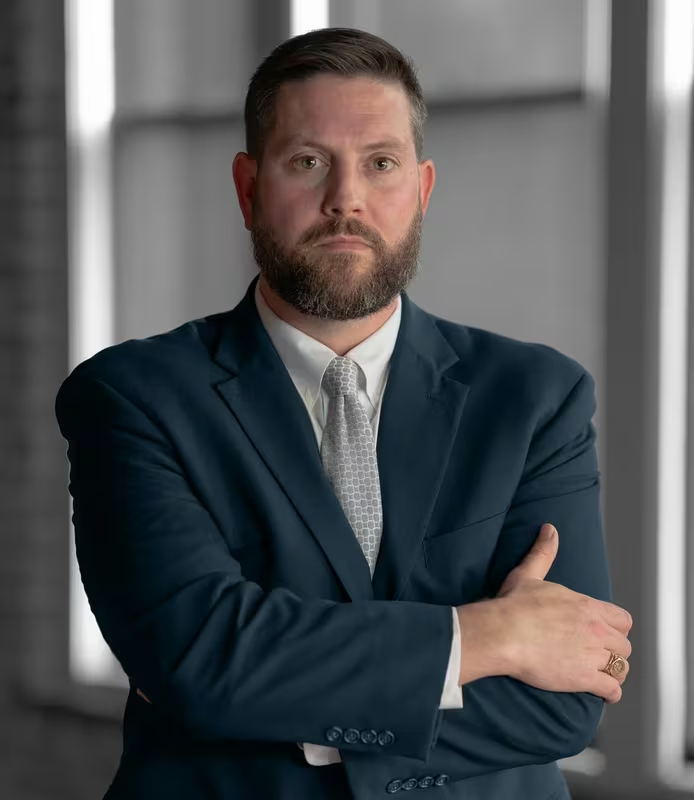
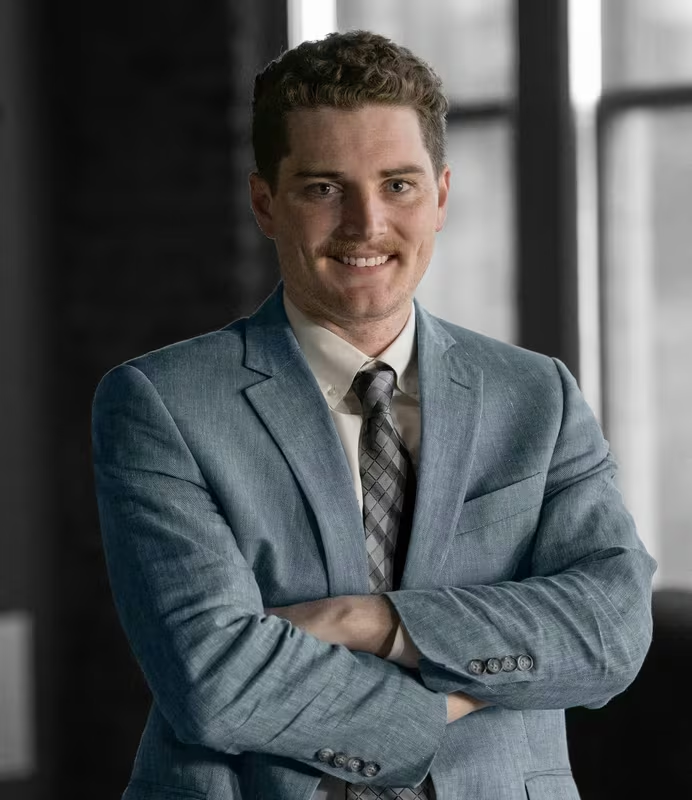
Your Webster Parish Trial Team
The lawyers who work your file. Every Webster Parish case is handled by the firm's own trial attorneys.








Contact a Webster Parish Injury Lawyer for a Free Consultation
If you were injured in Webster Parish and want a straight answer about whether you have a case, a consultation with Trey Morris Injury Lawyers costs nothing and creates no obligation. You can use it to ask questions, get a read on the claim, and decide whether to move forward. No pressure to sign anything that day.
What Happens When You Call
The first conversation is a fact-gathering call. Expect questions about when and where the incident occurred, the injuries involved, whether you have spoken to an insurance adjuster, and what medical treatment you have received so far. The goal is to understand the situation well enough to tell you honestly whether a claim is worth pursuing. If the answer is no, you will hear that. If the answer is yes, the next steps are explained in plain language.
Bring what you have. A police report number, photos from the scene, the name of the other driver’s insurer, medical bills, and any correspondence from an adjuster all help. If you do not have any of that yet, the call still works. Documents can come later.
What the Consultation Does Not Do
A consultation is a conversation, not representation. An attorney-client relationship begins only when a written representation agreement is signed by both sides. Until that signature happens, nothing said during the call binds you to the firm or the firm to you. You are free to talk to other firms, take time to think, and make the choice that fits your situation.
How to Reach the Firm
Trey Morris Injury Lawyers serves Webster Parish residents from its Minden office and from offices in Shreveport, Covington, Ruston, and Lake Charles. Calls, in-person meetings, and video meetings are all available. If travel is hard because of injuries, a lawyer can come to you or handle the intake by phone.
You have done the research. You have read the page. The next step is a conversation. When you are ready, reach out.