










Tangipahoa Parish wrecks happen on I-12 and I-55, along U.S. 190 and U.S. 51, and on La. 22, and the people hurt in them are taken to North Oaks Medical Center on Paul Vega MD Drive in Hammond, the parish’s trauma center, or to Lallie Kemp in Independence. The Hammond Police Department writes the report inside Hammond and the Tangipahoa Parish Sheriff’s Office writes it in the rest of the parish. Suits are filed at the Tangipahoa Parish Courthouse on North Bay Street in Amite. Trey Morris Injury Lawyers handles Tangipahoa cases from our Covington office on River Highland Boulevard. We request the report and send preservation letters for surveillance video along U.S. 190, La. 22, and the I-12 and I-55 corridors, where that footage is overwritten in days. We aim to send those letters once the facts give us an honest basis for them, because moving as fast as the law permits is how evidence gets kept and found. Along with the video, we ask the other driver and their insurer to keep the vehicle and its event data, because together with the video they show speed, braking, and who had the right of way.
The law that governs the claim is Louisiana law and it does not change from parish to parish. If you were hurt in Tangipahoa Parish, your case is filed in the 21st Judicial District Court in Amite, and your deadline is two years under La. C.C. Art. 3493.1 for injuries after July 1, 2024, or one year under La. C.C. Art. 3492 for injuries on or before that date. For wrecks on or after January 1, 2026, a 51% fault finding under La. C.C. Art. 2323 ends the case, which is why the fault evidence matters so much.
Results for Louisiana Clients
- $409 MillionWrongful Death
A tragic case where an impaired driver of a commercial vehicle ran a red light, then collided with our client, causing serious bodily injury to the mother and the loss of life of her daughter.
- $49 MillionMotor Vehicle Accident
An impaired driver of a stolen vehicle driving the wrong way collided with our client head-on, resulting in brain injury and multiple broken bones.
- $32,195,000Industrial / Workplace
Failure to maintain proper safety protocols led to an explosion at an industrial plant causing a series of catastrophic injuries from broken bones, burns, spinal injury, and mental anguish.
- $31.5 MillionIndustrial / Workplace
Brain and spinal injuries followed an oil-field company failing to maintain equipment and provide a safe work site.
- $17.25 MillionCommercial Vehicle Accident
Client was struck head-on by a disconnected load of an 18-wheeler that crossed the median causing broken bones and amputation.
- $13 MillionCommercial Vehicle Accident
On the interstate, an 18-wheeler failed to yield right of way then made an unsafe lane change causing the accident which resulted in major bone breaks, damaged organs, and ultimately a leg amputation.
Past results do not guarantee future outcomes; each case is decided on its own facts.
What Does a Tangipahoa Parish Injury Lawyer Handle?
A Tangipahoa Parish injury lawyer represents people who were hurt because someone else was careless. The work is part investigation, part negotiation, and part litigation in the 21st Judicial District Court in Amite. The job is to figure out who is responsible, prove the harm with documents and testimony, and pursue damages through an insurance claim or a lawsuit.
Most of that work happens before a courtroom is ever involved. A lawyer in this role gathers the police report, medical records, employment records, and witness statements. They identify every party who may share fault and every insurance policy that may apply. They send a preservation letter to keep video, dashcam footage, and electronic data from being deleted. They retain accident reconstructionists, treating physicians, life-care planners, and economists when the case calls for it.
Day-to-day, the lawyer handles communication with the at-fault driver’s insurer, the client’s own uninsured and underinsured motorist carrier, and any health insurer or Medicare lien holder. They negotiate medical bills, track future treatment, and document lost income. When the file is mature, they draft a demand package and negotiate a settlement. When the insurer will not pay fair value, they file suit, conduct discovery, take depositions, and try the case to a judge or jury.
A useful evaluator question for any attorney you interview: who in the office will actually handle my file, and how often will I hear from them? In Louisiana injury cases, the answer separates lawyers who personally work the file from offices that warehouse cases. Ask how many cases the lawyer is currently carrying, who returns phone calls within 24 hours, and how decisions about settlement versus trial get made. The answers tell you what representation will look like across the eighteen months to three years many of these matters take.
Local Coverage. Statewide Record.
- $1 Billion+
Outcomes for Louisiana clients
Verdicts and settlements won across the state by the same trial team that handles Tangipahoa Parish cases.
- 11
Trial attorneys, one team
Your case is handled by the firm's own trial attorneys, and we respond in minutes, 24/7.
- 24/7
We come to you
An attorney travels to you in Tangipahoa Parish, at home or at the hospital, or meets by video the same day. Free case review, and no fee unless we win.
- 127
Cases resolved over $1 million
Verdicts and settlements of $1 million or more, won by the same trial team that handles Tangipahoa Parish cases.
What Types of Injury Cases Do Tangipahoa Parish Personal Injury Lawyers Handle?
Personal injury practice in Tangipahoa Parish covers the full range of cases where one party’s conduct causes physical harm to another. The case types below are the categories most often handled by injury lawyers serving Hammond, Ponchatoula, Amite City, and the surrounding communities. Each category has its own evidence problems, its own defendants, and its own questions you should ask any attorney you interview.
Motor Vehicle Collisions
Car wrecks remain the most common injury case. The work involves crash reconstruction, traffic-citation review, vehicle damage analysis, and medical causation. Rear-end collisions, intersection crashes, head-on impacts, and single-vehicle wrecks involving a defective road condition or another driver who left the scene all fall in this bucket. Ask the attorney how they handle uninsured and underinsured motorist coverage when the at-fault driver carries minimum limits or no coverage at all.
Commercial Vehicle and 18-Wheeler Wrecks
Tractor-trailer cases are not large car wrecks. Federal Motor Carrier Safety Administration regulations govern driver hours, vehicle maintenance, drug testing, and cargo securement. Evidence in these cases includes the electronic logging device, the driver qualification file, the post-crash drug and alcohol tests, dispatch records, and the carrier’s safety history. Ask whether the attorney sends a litigation hold letter to preserve that data on the carrier’s servers.
Motorcycle, Bicycle, and Pedestrian Cases
Riders and pedestrians take the full force of an impact. These cases carry a defense narrative problem because insurers often try to push fault onto the rider or walker. Visibility, lane position, helmet status, and crosswalk geometry all matter. The medical record in these cases tends to be heavier on orthopedic injuries, traumatic brain injuries, and road-rash documentation.
Premises Liability
Slip and fall, trip and fall, and inadequate-security claims arise on store floors, parking lots, apartment complexes, and private property. The owner or operator owes a duty that depends on the visitor’s status and the hazard’s foreseeability. Surveillance video, incident reports, sweep logs, and prior-similar-incident records are the evidence that wins or loses these cases, and they get overwritten or discarded fast.
Workplace and Industrial Injuries
Workers in Tangipahoa Parish work in construction, warehousing, transportation, manufacturing, and agriculture. A workplace injury can trigger a workers’ compensation claim against the employer and, separately, a third-party liability claim against a contractor, equipment manufacturer, or property owner whose negligence caused the harm. Investigation focuses on equipment maintenance records, training documentation, and the chain of subcontractors on the site.
Product Liability
Defective products, including auto parts, medical devices, industrial equipment, and consumer goods, can support claims against manufacturers, distributors, and sellers. These cases turn on preservation of the product, expert engineering analysis, and the design or warning history of the product line.
Wrongful Death and Survival Claims
When a person dies as a result of another party’s conduct, Louisiana law allows certain family members to bring a wrongful death claim under La. C.C. Art. 2315.2, and it allows the estate to bring a survival action under La. C.C. Art. 2315.1 for the harm the decedent suffered before death. The case categories above can all become wrongful death cases when injuries are fatal.
Catastrophic Injuries Across Categories
Spinal cord injuries, traumatic brain injuries, severe burns, amputations, and multiple-trauma cases cut across every category above. They require life-care planners, vocational economists, and treating-physician coordination. Ask the attorney how often they retain those experts and whether they have tried catastrophic cases to verdict.
Tangipahoa Parish Practice Areas
 Car AccidentsRear-end, intersection, and highway collisions across Louisiana.
 Truck Accidents18-wheeler and commercial-vehicle wrecks governed by federal trucking rules.
 Catastrophic InjuryBrain, spinal-cord, amputation, and severe-burn injuries that change a life.
 Wrongful DeathClaims brought by families after a fatal accident or act of negligence.
 Premises LiabilitySlip-and-fall and unsafe-property injuries on someone else's premises.
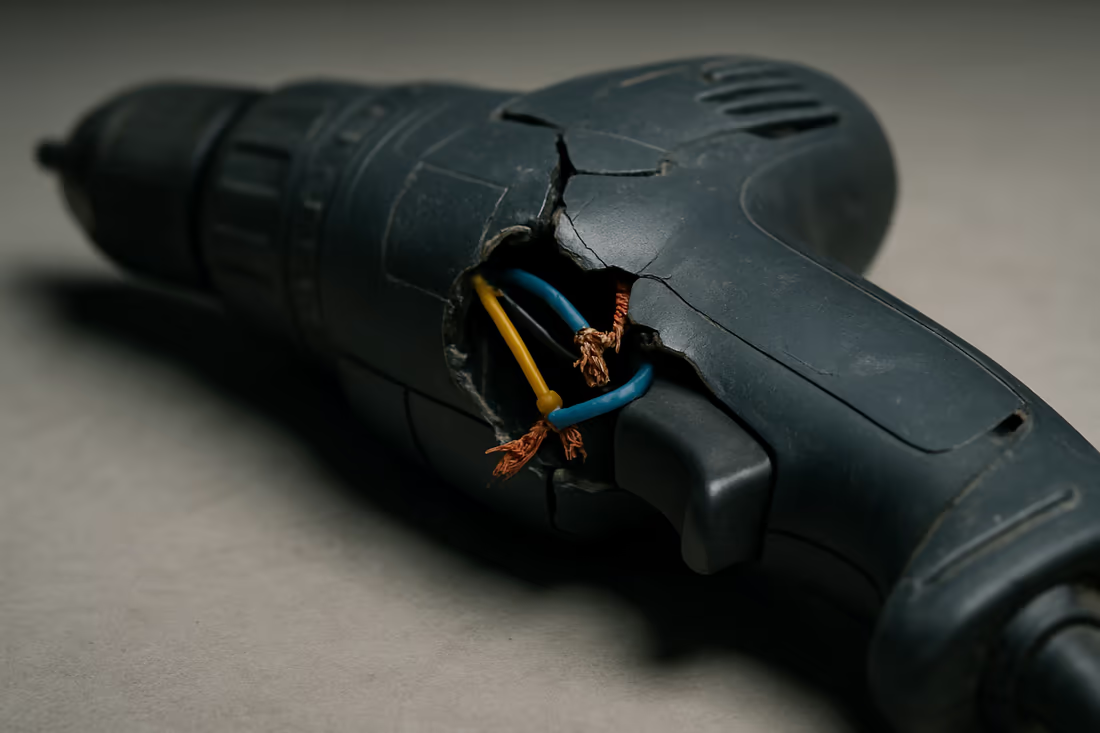 Product LiabilityInjuries caused by defective or unreasonably dangerous products.
 Oilfield AccidentsDrilling, pipeline, and refinery injuries across the energy sector.
 Industrial AccidentsPlant, warehouse, and heavy-equipment injuries in industrial settings.
 Offshore AccidentsRig, platform, and vessel injuries beyond the shoreline.
Where Do Serious Accidents Happen in Tangipahoa Parish — I-12, I-55, and Beyond?
Serious crashes in Tangipahoa Parish cluster on the two interstates that cross the parish, on the U.S. and state highways that feed them, and at the railroad and pedestrian corridors running through Hammond and Ponchatoula. Geography matters for an injury claim because crash location drives which agency investigated, what evidence exists, and which defendants may be involved.
I-12 Across the Northern Parish
I-12 runs east to west across the upper half of Tangipahoa Parish, connecting Baton Rouge traffic to the Northshore and the Mississippi state line. The Hammond interchange at I-12 and I-55 is one of the busiest in the parish and mixes long-haul commercial trucks with local commuter traffic. Rear-end collisions in stop-and-go congestion, lane-change crashes at the interchange, and high-speed wrecks during rain are the patterns most often reported on this corridor. Louisiana State Police Troop L generally handles crash investigation on I-12 in the parish.
I-55 From Manchac to Kentwood
I-55 runs north to south the full length of the parish, passing through Ponchatoula, Hammond, Independence, Amite City, Roseland, and Kentwood. Long elevated stretches over the Manchac swamp on the southern end and rural stretches north of Amite City both create distinct risks: fog and reduced visibility on the swamp segments, and high-speed single-vehicle and commercial-truck wrecks on the rural straightaways. The volume of through-trucking between New Orleans and Jackson means tractor-trailers are a recurring factor in serious I-55 crashes.
U.S. 51, U.S. 190, and State Highways
Not every serious wreck happens on the interstate. U.S. 51 parallels I-55 and runs through the heart of every town along the corridor, with traffic signals, business driveways, and pedestrians. U.S. 190 crosses the parish east to west through Hammond and intersects both interstates. State highways such as LA 22, LA 442, LA 16, and LA 1054 carry rural traffic with two-lane shoulders, agricultural equipment, and limited lighting. Intersection crashes, left-turn collisions, and run-off-road wrecks dominate these roads.
Hammond, Ponchatoula, and In-Town Streets
Inside Hammond and Ponchatoula, the mix shifts to lower-speed urban patterns: intersection crashes, parking lot collisions, pedestrian and bicycle strikes near Southeastern Louisiana University and the downtown districts, and rear-end wrecks at signalized intersections. Local police departments handle these investigations rather than State Police, which changes how the crash report is obtained and what supplemental evidence may be available.
Rail Corridors and Grade Crossings
The Canadian National rail line runs north to south through Tangipahoa Parish alongside U.S. 51, with grade crossings in Ponchatoula, Hammond, Independence, Amite City, and Kentwood. Train-versus-vehicle collisions, near-miss incidents at crossings, and pedestrian strikes along the tracks are a recognized category of serious-injury and fatal events in the parish. These cases involve federal railroad regulations and corporate rail defendants in addition to standard motor-vehicle issues.
Why Location Drives the Investigation
Where a crash happened controls who investigated, what video or telematics may exist, and which parties can be named. Interstate wrecks generate State Police reports, commercial-vehicle logbooks, and sometimes federal regulatory data. City crashes generate municipal police reports and may involve traffic-camera or business-surveillance footage. Rural state-highway wrecks may have only a sheriff’s deputy report and witness statements. A core job in any Tangipahoa Parish injury case is identifying every source of evidence tied to that specific location.
What Should You Do Immediately After an Accident in Tangipahoa Parish?
The first hour after a crash or injury shapes the rest of your claim. The steps below are practical groundwork, and they apply whether the wreck happened on a parish road, a Hammond street, or a stretch of interstate.
Call 911 and Get a Police Report
Call 911 from the scene. In Tangipahoa Parish, that brings Louisiana State Police, the Tangipahoa Parish Sheriff’s Office, or municipal police from Hammond, Ponchatoula, or Amite, depending on where the crash happened.
Preserve Evidence Before It Disappears
Surveillance video at gas stations, intersections, and businesses along U.S. 190, La. 22, and the I-12 and I-55 corridors is typically overwritten in days or weeks. Keep your damaged vehicle available for inspection.
Why Do You Need a Tangipahoa Parish Injury Lawyer After an Accident?
After a serious wreck on I-12, I-55, or a back road outside Hammond, the other side starts building its file before the injured person leaves the emergency room. An adjuster opens a claim within hours. A recorded statement gets requested. A settlement number lands in an inbox before a diagnosis is finalized. A lawyer evens the table. Treatment stays with the patient. The file, the deadlines, and the people whose job is to pay less than the case is worth get handled by counsel.
There are plenty of qualified attorneys in Tangipahoa Parish. The point of this section is to name the specific work that gets done on the claimant’s behalf, so any lawyer interviewed can be asked whether they actually do it.
The adjuster is not a neutral party
The insurance company assigns a claims professional within hours of a reported wreck. That person is trained, supervised, and measured on closing files cheaply.
When counsel is retained, the adjuster talks to the lawyer, not to the claimant.
Evidence disappears quickly
Skid marks fade. Surveillance footage at gas stations and warehouses along Highway 51 and U.S. 190 typically overwrites in seven to thirty days. Vehicle event data recorders can be wiped when a truck or car is repaired or sold at auction. Witness memories blur. A lawyer sends preservation letters to trucking companies, retail businesses, and parish agencies to protect that data. Crash reports are pulled from Louisiana State Police Troop L or the Tangipahoa Parish Sheriff’s Office. Scene photographs, 911 audio, and dash camera footage get requested in writing, with dates and case numbers.
Questions worth asking any attorney: which parties does the firm send spoliation letters to, and who on the team handles it. A vague answer is itself an answer.
Liability and damages take separate work
Proving who caused the wreck is one investigation. Proving what the wreck did to a body, an income, and a life is another. Both have to be built. Treating physicians need to connect the injury to the crash in writing. Wage records, tax returns, and employer statements document lost income. For permanent injuries, a life care planner or vocational expert may be retained to project future medical costs and lost earning capacity. None of that happens without someone driving the file.
The headline deadline is not the only clock
Louisiana extended the prescriptive period for most personal injury claims to two years for causes of action arising after July 1, 2024 (La. C.C. Art. 3493.1). Injuries that happened on or before that date remain under the one-year deadline in La. C.C. Art. 3492. That split is covered in a separate section on this page. Other clocks matter too. Claims against governmental entities, such as a parish road defect or a vehicle owned by a public agency, do not require a pre-suit notice of claim, but service of citation must be requested within 90 days of filing under La. R.S. 13:5107(D). Uninsured motorist claims have contract deadlines tied to the policy. A lawyer tracks every clock, not just the headline one.
What representation actually changes
The claimant stops being the file’s project manager. Medical providers bill the claim instead of the household mailbox. Property damage gets handled separately from the bodily injury claim so a quick car repair check does not get used to release the injury case. Health insurance liens, Medicare conditional payments, and Medicaid reimbursement claims get identified and negotiated, so the net number that reaches the client reflects the work. When an offer is fair, the case settles. When it is not, suit gets filed in the 21st Judicial District Court in Amite or the appropriate venue, and the case moves toward trial. That credibility, the willingness to actually try the case, is what moves settlement numbers. A direct question for any attorney interview: when did the firm last try a personal injury case to verdict. The answer is one of the few things that separates firms in this work.
What Is the Injury Claim Process in Tangipahoa Parish, Step by Step?
A Tangipahoa Parish injury claim is a sequence, not an event. Each step builds the record that determines what the case is worth and who pays.
-
Investigation and Evidence Preservation
The attorney sends preservation letters to anyone holding evidence. Photographs of the scene get taken to document its conditions. In Tangipahoa Parish, that often means scene work along I-12, I-55, U.S. 51, or a parish road to record debris and skid marks.
-
The Demand Package
When treatment reaches a stable point, the attorney assembles a demand package and sends it to the insurance carrier.
-
Filing Suit and Discovery
If the claim does not settle, the attorney files a petition. In Tangipahoa Parish, most injury suits are filed in the 21st Judicial District Court in Amite, the parish seat. Some cases belong in federal court in the Eastern District of Louisiana.
-
Mediation, Trial Prep, and Resolution
Most cases settle before trial, often at mediation, where a neutral third party works with both sides to find a number. Cases that do not settle go to trial.
How Long Do You Have to File a Personal Injury Claim in Louisiana?
Louisiana changed its filing deadline for personal injury claims in 2024. For injuries occurring after July 1, 2024, the deadline is two years from the date of the injury under La. C.C. Art. 3493.1. For injuries that occurred on or before July 1, 2024, the one-year deadline under La. C.C. Art. 3492 still applies. Product liability claims follow the same two deadlines, with no separate carve-out. The date the injury happened, not the date you discovered it or hired a lawyer, controls which rule governs your case.
A claim filed even one day late can be dismissed regardless of how serious the injuries are, how clear the other side’s fault is, or how much insurance coverage exists.
Which Deadline Applies to Your Case
The controlling date is when the injury was sustained. A Tangipahoa Parish crash on the morning of July 1, 2024, falls under the two-year rule in La. C.C. Art. 3493.1. A crash the night before falls under the one-year rule in La. C.C. Art. 3492. For ongoing or repeated exposure injuries, the analysis is more involved and depends on when the damage became apparent.
Shorter Deadlines That Catch People Off Guard
The two-year prescriptive period under La. C.C. Art. 3493.1, which applies to injuries after July 1, 2024, is the outer limit for filing a lawsuit. Several shorter deadlines can affect a claim well before that:
- Claims against the State of Louisiana, a parish, a municipality, or a public entity (including parish hospitals, sheriff’s deputies acting in their official capacity, and public school boards) follow procedures under the Louisiana Governmental Claims Act, La. R.S. 13:5101 et seq. There is no pre-suit notice, but service must be requested within 90 days of filing suit, and some damages are capped at $500,000.
- Uninsured and underinsured motorist (UM/UIM) claims have notice requirements tied to the auto policy itself. Insurance contracts often require prompt notice of a loss and cooperation with the carrier’s investigation.
- Workers’ compensation claims arising from on-the-job injuries run on a separate timetable under the Louisiana Workers’ Compensation Act, not the tort prescriptive period.
- Medical malpractice claims are governed by their own statute, with a panel review process that must be initiated before a lawsuit is filed.
Exceptions and Tolling
Louisiana law recognizes limited circumstances that can interrupt or suspend prescription. These include certain rules for minors, for incapacitated persons, and for situations where the responsible party concealed key facts.
Can You Still Recover Compensation If You Were Partly at Fault in Louisiana?
That depends on when the accident happened. For causes of action arising on or after January 1, 2026, Louisiana applies a modified comparative fault system under La. C.C. Art. 2323 as amended by Act 15 of the 2025 Regular Session (HB 431). If you are found 51% or more at fault, you collect nothing. If you are 50% or less at fault, your damages are reduced by your share. For accidents before January 1, 2026, the older pure comparative fault rule still governs, and a partially at-fault person can pursue a reduced award even when that share is large.
The practical effect is simple math. If a Hammond driver is found 30 percent at fault for a rear-end chain reaction on I-12 and the total damages come out to $200,000, the award is reduced by 30 percent and the driver collects $140,000 from the other at-fault parties. The same logic applies whether the share is 10 percent or 70 percent. Louisiana does not use the 51 percent bar that Texas and many other states apply.
Fault is assigned by the trier of fact (a judge or jury) by looking at the conduct of every person whose actions contributed to the incident, including parties who were never sued. Under La. C.C. Art. 2323, this allocation considers each party’s relative responsibility. A driver who was speeding, a trucking company that ignored a maintenance defect, a property owner whose lighting was inadequate, and the injured person whose seat belt was unbuckled can all end up with percentages on the verdict form. Each at-fault party owes only its own share, not the full judgment. For causes of action arising on or after January 1, 2026, that percentage also decides whether you recover at all, because a finding of 51% or more against you ends the case.
One narrow exception is worth knowing. Under La. R.S. 32:295.1, evidence that an occupant failed to wear a seat belt cannot be used to reduce damages in a civil case.
How Much Is Your Tangipahoa Parish Injury Case Worth?
The honest answer is that no one can tell you what your case is worth from a website. Value comes from documented losses, the strength of liability evidence, and the long-term medical picture.
What Categories of Damages Make Up an Injury Claim?
Louisiana injury claims compensate two broad kinds of losses. Economic damages are the bills and lost income you can add up on paper: medical treatment to date, future medical care, lost wages, lost earning capacity, property damage, and out-of-pocket costs tied to the injury. Non-economic damages cover the human side: physical pain, mental anguish, loss of enjoyment of life, scarring, and disability.
In some cases there is a third category. When a defendant’s conduct involves intoxicated driving or other narrowly defined misconduct, Louisiana law permits an additional, punishment-focused award on top of compensatory damages. That is a narrow door, not a general feature of every claim, and any attorney who tells you otherwise is selling something.
What Facts Move Case Value Up or Down?
The same diagnosis can support very different claim values depending on the surrounding facts. The variables a serious attorney works through include:
- Severity and permanence of the injury. A soft-tissue strain that resolves in six weeks is not a herniated disc that requires fusion surgery. Imaging, surgical records, and treating-physician opinions on permanent impairment drive this.
- Available coverage and defendants. A claim is only worth what can actually be collected. The number of potentially responsible parties and the policies behind them set a practical ceiling on the case.
- Venue and jury pool. Cases in Tangipahoa Parish district court are evaluated against what local juries have historically done with comparable facts, not against verdicts from another state.
How Do Wrongful Death Claims Work in Louisiana?
When a person dies because of someone else’s negligence, Louisiana law lets certain family members bring two separate claims. A wrongful death claim under La. C.C. Art. 2315.2 is the family’s own claim for the losses they suffered when their loved one died. A survival action under La. C.C. Art. 2315.1 is a separate claim for what the deceased person went through between the moment of injury and the moment of death.
Deadlines on these claims are short. Both the wrongful death claim under La. C.C. Art. 2315.2 and the survival action under La. C.C. Art. 2315.1 must be filed within the longer of one year from the death or two years from the injury. Missing the deadline ends the claim regardless of how strong the underlying facts are.
How Is a Survival Action Different from a Wrongful Death Claim?
A survival action under La. C.C. Art. 2315.1 belongs to the deceased person’s estate. It compensates what the deceased experienced personally before dying: conscious pain and suffering, fear and mental anguish in the moments before death, medical expenses for the final injury, and any lost earnings between injury and death. A wrongful death claim under La. C.C. Art. 2315.2, by contrast, belongs to the surviving family and compensates their losses going forward.
How Much Does a Tangipahoa Parish Injury Lawyer Cost?
Nothing up front. Personal injury lawyers in Tangipahoa Parish work on a contingency fee. You pay the firm a percentage of the compensation it secures for you. If there is no compensation, you owe no attorney’s fee. The fee structure, the case expenses, and the way medical bills get handled at the end of the case are the three things to understand before you sign a representation agreement.
What Is a Contingency Fee?
A contingency fee means the lawyer’s pay is contingent on the outcome. The firm advances the work, takes the risk, and gets paid out of the settlement or judgment when the case resolves. The fee is a percentage, agreed in writing at the start of representation, and disclosed line by line on the settlement statement at the end.
The practical effect: a hospital worker in Hammond and a retiree in Ponchatoula get the same access to counsel. Hourly billing is not part of the arrangement. You do not get an invoice in the mail while the case is pending.
How Are Case Expenses Handled?
Attorney fees and case expenses are two different categories. Expenses are the hard costs of building the claim: medical record requests, accident reconstruction, expert witness retainers, deposition transcripts, court filing fees, mediation fees, and investigator costs. A serious commercial-vehicle case on I-12 or I-55 can require expert work that runs into the tens of thousands of dollars in expenses alone.
The firm advances those expenses while the case is pending. At resolution, the expenses are reimbursed from the gross compensation, separate from the attorney fee. The representation agreement should spell out which side fronts expenses, how reimbursement works if the case does not resolve favorably, and whether expenses are deducted before or after the fee is calculated. The order of those deductions changes the net number, so it is worth reading.
What About Medical Bills, Health Insurance Liens, and Medicare?
The net amount you take home depends on more than the fee and the expenses. Outstanding medical bills, health insurance subrogation claims, Medicare or Medicaid liens, and ERISA plan reimbursement claims all get resolved out of the settlement before funds are disbursed. A capable Tangipahoa Parish injury firm negotiates those liens down where the law allows, which protects the client’s net.
Ask any lawyer you interview how they handle lien negotiation. Ask whether the settlement statement breaks out the gross compensation, the fee, the case expenses, each lien resolution, and the final net to the client. A clear settlement statement is not a courtesy. It is the document that shows you exactly where every dollar went.
What Should You Look for in the Representation Agreement?
Read the agreement before signing. Five things to confirm in writing:
- The contingency fee percentage, and whether the percentage changes if the case is filed in suit or proceeds to trial.
- Who advances case expenses, and how those expenses are reimbursed at the end of the case.
- Whether the fee is calculated on the gross compensation or on the amount after expenses are deducted.
- How medical bills and liens are handled, and who negotiates them.
- What happens if you decide to end the representation, and what happens if the case does not produce compensation.
A firm that cannot answer these questions plainly, in writing, is a firm worth crossing off the list. The point of the consultation is to understand the economics of the relationship before you commit to it. The consultation itself is free.
Which Communities in Tangipahoa Parish Does Our Injury Law Firm Serve?
We represent injured people across every community in Tangipahoa Parish. The parish stretches from the Mississippi state line down to Lake Pontchartrain, and we handle cases from the rural northern parish through the I-12 corridor and into the southern lakeshore towns. Where the wreck happened, where you live, and where you receive medical care all matter to how the case develops.
Hammond and the I-12 Corridor
Hammond is the parish’s largest city and the commercial hub of the region. It sits at the intersection of I-12 and I-55, which is one of the busiest interchanges in southeast Louisiana. Cases out of Hammond often involve interstate collisions, university-area traffic near Southeastern Louisiana University, and crashes along US-190 and the SE Morrison Boulevard commercial strip. We handle matters that originate in Hammond and the surrounding unincorporated areas of Ward 6.
Amite City and the Parish Seat
Amite City is the parish seat. The Tangipahoa Parish Courthouse and the Clerk of Court are located here, which is where civil filings for the 21st Judicial District Court are made. Our practice covers Amite City, Independence, and the surrounding farming communities along US-51 north of Hammond. These are areas where rural two-lane highways and agricultural traffic create their own pattern of serious collisions.
Ponchatoula and the Southern Parish
Ponchatoula sits just south of Hammond along I-55 and US-51. Cases here often involve the strawberry-country stretch of US-51, the I-55 approach to the Manchac swamp crossing, and local traffic through downtown. We also serve clients in Robert and the unincorporated communities between Ponchatoula and the lake.
Northern Parish: Kentwood, Roseland, Tickfaw, and Loranger
The northern half of the parish includes Kentwood near the Mississippi line, Roseland, Tickfaw, Loranger, and the smaller communities along LA-10, LA-16, and LA-1054. Distances are longer up here, EMS response can take more time, and crash scenes on rural highways often involve different evidence questions than urban wrecks. We handle cases throughout this part of the parish.
How Location Affects Your Case
Where the incident happened controls which court hears the case, which sheriff’s office or police department holds the crash report, and which hospital records will document your injuries. Tangipahoa Parish matters generally go through the 21st Judicial District Court in Amite City. If you were treated at North Oaks in Hammond, at Lallie Kemp in Independence, or transferred to a New Orleans trauma center, those records become part of the file. You do not need to come to us. We meet clients at their home, at the hospital, or anywhere in the parish that works for you.
What Our Clients Say
- Victoria M.
Very professional and very easy to work with throughout the whole case!Lane and Men helped make the whole process go smonthly with no stress
- Sarah S.
First time being injured and needing a lawyer they where very helpful.They answered my questions Id have very well. Highly recommend them.
- Dawn H.
Very professional, informed me of every step that was taken with the case and was always letting me know the status.Very nice people and was very respectful. Thanks a whole lot for the service Erin, Chelsea, and Morgan!!!
- Yamileth L.
Jessica has been great helping throughout our whole process at [Trey Morris Injury Lawyers]!She has been great with communication and making everything so easy!
- Sarah S.
Awesome people, they truly care about their clients.Give them a call today if you want to be taken care of the way you deserve to be.
- Kim K.
I have nothing but positive things to say about [Trey Morris Injury Lawyers].This firm went above and beyond to help me and I couldn’t have asked for a better outcome!!!
- Debra L.
They were extremely courteous, helpful and informative all along the process of our wrongful death suit.I recommend you talk to them if you need lawyer
- Nathan Y.
[Trey Morris Injury Lawyers] helped my wife receive compensation after an auto accident.They got the auto insurance companies to fully compensate for all her expenses. Things couldn’t have been easier and their rates were reasonable. Would recommend!
- Phat T.
I’m very happy with [Trey Morris Injury Lawyers].Thank you for taking care of me like we’re family. I will recommend anybody if you had an accident you need to call [Trey Morris Injury Lawyers]. They’re very Professional and they’ll take good care you like you’re their family. Thank again [Trey Morris Injury Lawyers].
- Jordyn L.
Hired them for an automobile accident and absolutely loved them.Very professional and reliable. Highly recommend!
- Jillian E.
[Trey Morris Injury Lawyers] are the best personal injury lawyers!They helped me with my car accident and were professional from beginning to end.
- Connie B.
Great lawyers when you need someone you can count on!!They always make you feel like you're their TOP priority, they listen to every details and explain what's next to do. Thanks for your help.
Testimonials do not constitute a guarantee, warranty, or prediction regarding the outcome of your legal matter. Past results do not guarantee future outcomes.
Your Tangipahoa Parish Trial Team
The lawyers who work your file. Every Tangipahoa Parish case is handled by the firm's own trial attorneys.











How Can You Talk to a Tangipahoa Parish Injury Lawyer for a Free Consultation?
A free consultation is a conversation. You describe what happened. An attorney listens, asks questions, and gives you a read on whether you have a claim worth pursuing. No fee. No obligation to hire anyone. If you decide the firm is not the right fit, you walk away with information you did not have before.
Trey Morris Injury Lawyers offers free consultations to people injured in Tangipahoa Parish. The conversation can happen by phone, by video, or in person. Bring what you have. If you have nothing yet, bring your memory of what happened and the names of anyone else involved.
What Happens During the Consultation?
The attorney will want to understand a few things. How the injury happened. Who else was involved. What medical treatment you have had so far. Whether anyone from an insurance company has already contacted you. Whether a police report or incident report exists.
From there, the attorney can tell you whether the facts look like a viable claim, what the deadlines are, and what the next steps would be if you decide to move forward. You will also get a clear explanation of how the fee arrangement works before any paperwork is signed.
What Should You Bring or Have Ready?
Useful items, if you have them:
- The police report or incident report number
- Photos from the scene or of your injuries
- Names and contact information for witnesses
- Medical records, discharge papers, or a list of providers you have seen
- Insurance information for everyone involved, including your own policy
- Any letters or emails from insurance adjusters
- A written timeline of what happened, while it is still fresh
If you do not have any of this, do not wait. Call first, gather later. The consultation can still happen with just your account of events.
How Do You Schedule the Consultation?
Reach out by phone or through the website contact form. The intake conversation is short. Someone will collect basic information about what happened and connect you with an attorney for the substantive discussion. If you are still in the hospital or cannot travel, arrangements can be made to come to you or to handle the conversation remotely.
There is no cost to talk. There is no pressure to sign anything during the call. Take the information you receive, compare it against what other firms tell you, and make the decision that fits your situation.