










St. Tammany Parish wrecks happen on I-12, on US-190 through Mandeville and Covington, on Highway 59, and in downtown Slidell, and the people hurt in them are taken to St. Tammany Health System on South Tyler Street in Covington, Slidell Memorial, or Lakeview Regional. The St. Tammany Parish Sheriff’s Office writes the report on the parish roads, and the Covington Police Department writes it inside Covington city limits. Suits are filed at the St. Tammany Parish Courthouse on North Columbia Street in Covington. Trey Morris Injury Lawyers handles St. Tammany cases from our Covington office on River Highland Boulevard. We order the crash report, send preservation letters for any camera footage along the corridor where the wreck happened, and collect the emergency room records so the injury is documented from the first day. We send those letters once the facts give us an honest basis for them, and we move as fast as the rules permit, because evidence that is kept is evidence we can use. The letter also asks the at-fault driver and the insurer to keep the vehicle and its event data, which, with the footage, show speed, braking, and who had the right of way.
The law that governs the claim is Louisiana law, and it does not change from one parish to the next. We investigate the crash, document the medical treatment and lost income, and file suit in the 22nd Judicial District Court, which serves St. Tammany and Washington Parishes. For injuries after July 1, 2024, the filing deadline is two years under La. C.C. Art. 3493.1.
Results for Louisiana Clients
- $409 MillionWrongful Death
A tragic case where an impaired driver of a commercial vehicle ran a red light, then collided with our client, causing serious bodily injury to the mother and the loss of life of her daughter.
- $49 MillionMotor Vehicle Accident
An impaired driver of a stolen vehicle driving the wrong way collided with our client head-on, resulting in brain injury and multiple broken bones.
- $32,195,000Industrial / Workplace
Failure to maintain proper safety protocols led to an explosion at an industrial plant causing a series of catastrophic injuries from broken bones, burns, spinal injury, and mental anguish.
- $31.5 MillionIndustrial / Workplace
Brain and spinal injuries followed an oil-field company failing to maintain equipment and provide a safe work site.
- $17.25 MillionCommercial Vehicle Accident
Client was struck head-on by a disconnected load of an 18-wheeler that crossed the median causing broken bones and amputation.
- $13 MillionCommercial Vehicle Accident
On the interstate, an 18-wheeler failed to yield right of way then made an unsafe lane change causing the accident which resulted in major bone breaks, damaged organs, and ultimately a leg amputation.
Past results do not guarantee future outcomes; each case is decided on its own facts.
What Does a St. Tammany Parish Injury Lawyer Handle?
A St. Tammany Parish injury lawyer represents people who were hurt because of someone else’s negligence and pursues civil claims for the money it takes to put them back where they started. The work is concrete: investigating what happened, identifying every party who shares fault, documenting medical treatment and lost income, dealing with insurance adjusters, and filing suit in the 22nd Judicial District Court when the insurer will not pay a fair number. The lawyer carries the case. The client treats and heals.
Most of the day-to-day work happens before a lawsuit is ever filed. A St. Tammany injury lawyer pulls the crash report from the Louisiana State Police or the sheriff’s office, locks down witness statements, obtains 911 audio and dispatch logs, and sends preservation letters so that surveillance video, dashcam footage, and trucking records are not overwritten or destroyed. The lawyer also handles the paperwork side: medical authorizations, wage-loss verifications, property-damage claims, rental-vehicle disputes, and the running fight with the at-fault driver’s insurer over what the case is actually worth.
The scope is broader than the car wreck on I-12 or Highway 190 that brought the client to the firm. A St. Tammany Parish injury lawyer handles motor-vehicle collisions, commercial truck crashes, motorcycle wrecks, pedestrian and bicycle injuries, premises liability (slip-and-fall, negligent security, unsafe conditions on someone else’s property), dog bites, defective products, nursing-home neglect, and wrongful death claims brought by surviving family members. The unifying thread is the same: someone was hurt, someone else is legally responsible, and a civil claim is the mechanism for shifting the cost off the injured person.
A useful way to evaluate any lawyer you talk to is to ask what they actually do on a case in the first thirty days. The honest answer involves evidence preservation, identifying insurance coverage on every potentially liable party (not just the obvious one), getting the client into appropriate medical care, and opening the claim with the carrier. If the answer is vague, that tells you something. If the answer is specific, that tells you something too.
Local Coverage. Statewide Record.
- $1 Billion+
Outcomes for Louisiana clients
Verdicts and settlements won across the state by the same trial team that handles St. Tammany Parish cases.
- 11
Trial attorneys, one team
Your case is handled by the firm's own trial attorneys, and we respond in minutes, 24/7.
- 24/7
We come to you
An attorney travels to you in St. Tammany Parish, at home or at the hospital, or meets by video the same day. Free case review, and no fee unless we win.
- 127
Cases resolved over $1 million
Verdicts and settlements of $1 million or more, won by the same trial team that handles St. Tammany Parish cases.
Why Should You Hire a Local St. Tammany Parish Injury Lawyer?
A local injury lawyer is an attorney who regularly practices in the 22nd Judicial District Court in Covington and knows how St. Tammany Parish cases actually move. That familiarity shapes filing strategy, settlement posture, and trial preparation in ways an out-of-parish lawyer has to learn on your time. The question is not whether a Baton Rouge or New Orleans firm can handle a St. Tammany case. The question is who already knows the courtroom, the jury pool, and the roads where the wreck happened.
Familiarity With the 22nd Judicial District Court
Personal injury suits in St. Tammany Parish are filed at the 22nd JDC courthouse in Covington. Local counsel knows the judges’ scheduling preferences, the clerk’s filing practices, and how motion days run. That knowledge affects when a case gets a trial date, how discovery disputes are resolved, and how quickly a stalled file moves. Ask any attorney how often they appear in the 22nd JDC. The answer tells you whether they will be learning the court or working it.
Knowledge of the Local Jury Pool and Community
Jury verdicts in St. Tammany Parish reflect the parish, not the state. The communities along the Northshore, Slidell, Covington, Mandeville, and the rural areas north of I-12 each bring different attitudes toward damages, defendants, and credibility. A lawyer who has tried cases here understands what a St. Tammany jury responds to and what it does not. That understanding informs case valuation, settlement negotiation, and trial themes. A firm that tries everything in Orleans or Jefferson is not the same as a firm that tries cases on the Northshore.
Practical Access for You and the Evidence
Local practice means local logistics. Witness interviews, scene inspections on highways like US 190, I-12, and LA 21, medical record collection from Northshore providers, and meetings with you happen without a two-hour drive each way. When a defense expert needs to be deposed or a crash site needs to be photographed before conditions change, proximity matters. Ask a prospective attorney how they handle scene investigation and local witness work. The answer separates a lawyer running a case from a parish away from one who can be on the ground.
St. Tammany Parish Practice Areas
 Car AccidentsRear-end, intersection, and highway collisions across Louisiana.
 Truck Accidents18-wheeler and commercial-vehicle wrecks governed by federal trucking rules.
 Catastrophic InjuryBrain, spinal-cord, amputation, and severe-burn injuries that change a life.
 Wrongful DeathClaims brought by families after a fatal accident or act of negligence.
 Premises LiabilitySlip-and-fall and unsafe-property injuries on someone else's premises.
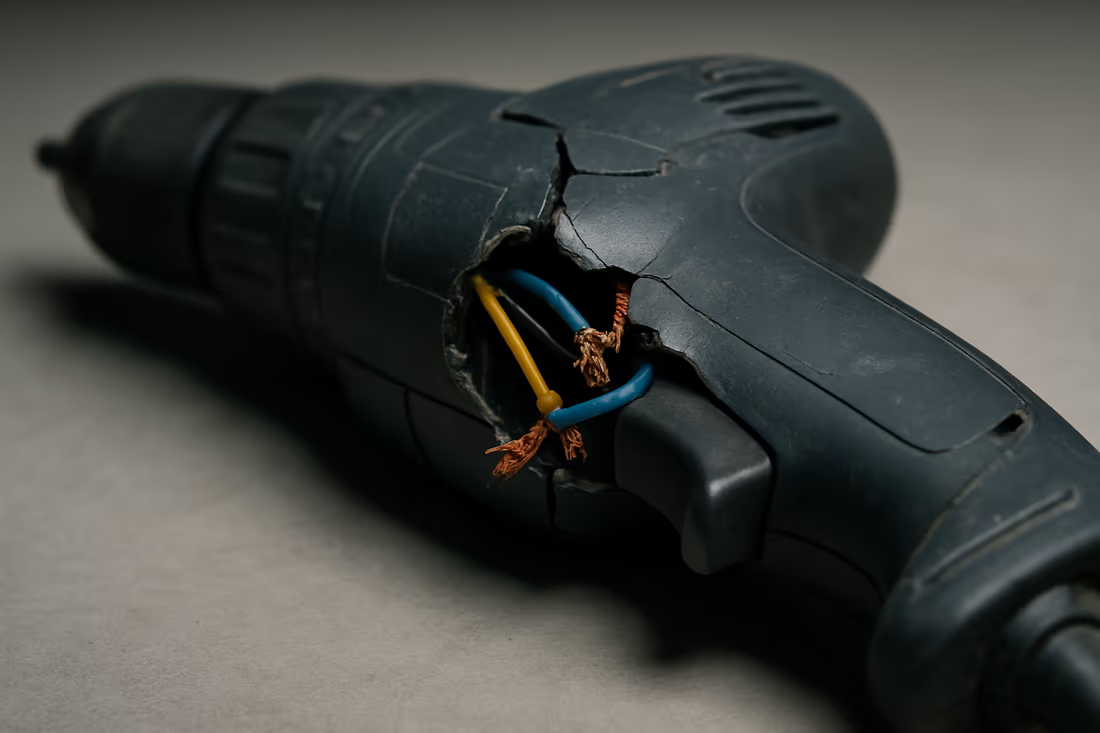 Product LiabilityInjuries caused by defective or unreasonably dangerous products.
 Oilfield AccidentsDrilling, pipeline, and refinery injuries across the energy sector.
 Industrial AccidentsPlant, warehouse, and heavy-equipment injuries in industrial settings.
 Offshore AccidentsRig, platform, and vessel injuries beyond the shoreline.
What Types of Injury Cases Do St. Tammany Parish Lawyers Handle?
Personal injury practice in St. Tammany Parish tracks the fact patterns that produce serious harm on the Northshore. The categories below describe the case types a local injury lawyer commonly works on. Each category has its own evidence demands, defendant profiles, and investigation priorities.
Car and Truck Collisions
Motor vehicle crashes are the most common injury cases in the parish. The traffic load on Interstate 12, Interstate 10, the Lake Pontchartrain Causeway, and U.S. 190 produces high-speed wrecks involving passenger vehicles, commercial trucks, and delivery vans. Commercial truck cases pull in additional defendants such as motor carriers, brokers, and maintenance contractors, and they require early preservation of electronic control module data, driver logs, and dashcam footage before that evidence is overwritten.
Motorcycle, Bicycle, and Pedestrian Injuries
Riders and pedestrians absorb the full force of a collision. Cases on Highway 190 corridors through Mandeville and Covington, on Highway 59, and in downtown Slidell often involve disputed visibility, intersection sightlines, and lane-change facts. Investigation focuses on roadway geometry, signal timing, and witness statements.
Premises Liability
Slip and falls, trip and falls, and inadequate-security cases arise at retail stores, restaurants, hotels, apartment complexes, and parking lots across the parish. The investigation centers on the condition that caused the fall, how long it existed, prior incident history at the property, and any surveillance footage the property owner controls.
Workplace and Construction Injuries
St. Tammany Parish supports construction, marine services, healthcare, and skilled trades. A workplace injury can involve a workers compensation claim against the employer and a separate third-party liability claim against a contractor, equipment manufacturer, or property owner whose conduct contributed to the harm. Sorting those tracks early protects both sources of compensation.
Maritime and Offshore Cases
Proximity to Lake Pontchartrain, the Gulf, and the inland waterways means injury lawyers in the parish see Jones Act seaman claims, Longshore and Harbor Workers Compensation Act claims, and recreational boating cases. These claims run on different rules than ordinary tort cases and require lawyers who know which framework applies to which worker.
Wrongful Death and Catastrophic Injury
Catastrophic injury cases involve traumatic brain injury, spinal cord injury, severe burns, amputations, and other harm that changes a person’s life permanently. Wrongful death cases follow when a person does not survive. Both require life-care planners, vocational economists, and medical experts to document future medical needs and lost earning capacity.
Product Liability and Defective Equipment
Defective vehicle components, industrial equipment failures, and unsafe consumer products produce injury cases against manufacturers, distributors, and sellers. These cases turn on engineering analysis, product testing, and recall and incident history, and they typically involve out-of-state corporate defendants.
Medical Negligence
Claims against healthcare providers in Louisiana run through the Medical Review Panel process before suit, which is a different procedural track than an ordinary tort claim. Cases involve hospitals, physician groups, and nursing facilities serving the Mandeville, Covington, and Slidell areas, with damages governed by the Louisiana Medical Malpractice Act.
Insurance Disputes Tied to Injury Claims
Uninsured and underinsured motorist disputes, first-party medical payments coverage, and bad-faith claim handling questions frequently sit alongside the underlying injury case. A St. Tammany Parish injury lawyer commonly handles both the liability claim against the at-fault party and the coverage claim against the client’s own carrier when policy limits or denials are in dispute.
What Should You Do Immediately After an Accident in St. Tammany Parish?
The hours and days right after a crash, fall, or workplace incident shape the case far more than most people realize. The steps below apply whether the incident happened on I-12 near Covington, on a job site in Slidell, or in a parking lot in Mandeville.
Get Medical Attention, Even If You Feel Fine
Call 911 if anyone is hurt. If you can move safely, get to St. Tammany Health System, Slidell Memorial, Lakeview Regional, or the nearest emergency room.
Report the Incident and Get a Written Record
For a vehicle crash, call the responding agency. That will be the Louisiana State Police on the interstates, the St. Tammany Parish Sheriff’s Office in unincorporated areas, or the local police in Covington, Slidell, Mandeville, or Madisonville.
Exchange Information, but Do Not Give a Recorded Statement
Exchange names, contact details, driver’s license numbers, license plates, insurer names, and policy numbers. You are not required to give a recorded statement to the other party’s insurer, and doing so before you have spoken to a lawyer is one of the easiest ways to damage a claim.
When to Call a Lawyer
There is no rule that you must hire counsel, but the practical answer is: sooner helps more than later. Evidence preservation letters, scene inspections, black-box downloads on commercial trucks, and witness interviews all secure evidence that can be repaired, overwritten, or forgotten. An initial consultation with a Louisiana injury lawyer is typically free, and the conversation itself does not commit you to anything.
How Does the St. Tammany Parish Injury Claim Process Work?
A St. Tammany Parish injury claim moves through a predictable sequence of stages, even when the facts and injuries differ from case to case. The process starts with investigation and medical documentation, moves through a demand and negotiation phase with the at-fault party’s insurer, and, if the insurer will not pay fair value, proceeds into a lawsuit filed in district court.
What Compensation Can You Recover After an Injury in St. Tammany Parish?
Louisiana injury claims compensate two broad categories of loss: economic damages and non-economic damages. Economic damages are the out-of-pocket costs a person can document on paper. Non-economic damages are the human costs that don’t show up on a receipt.
Punitive Damages
Louisiana does not allow punitive damages in most personal injury cases. They are available only in narrow categories authorized by statute, such as injuries caused by a drunk driver under La. C.C. art. 2315.4. When they apply, punitive damages are meant to punish the wrongdoer’s conduct rather than compensate the victim. Most car-accident, slip-and-fall, and ordinary-negligence cases do not involve them.
What Drives the Final Number
Three variables move the final compensation figure more than anything else:
- Liability strength. Clear fault on the other side produces a stronger demand than a contested-fault claim. For causes of action arising on or after January 1, 2026, Louisiana applies a modified comparative fault system under La. C.C. Art. 2323 as amended by Act 15 of the 2025 Regular Session (HB 431): a plaintiff found 51% or more at fault collects nothing, and at 50% or less the damages are reduced by the plaintiff’s share. Accidents before January 1, 2026 remain under pure comparative fault, where any percentage of fault assigned to the injured person reduces the award by that percentage.
- Medical documentation. Consistent treatment, clear causation between the incident and the injuries, and credible provider records build the spine of the damages claim. Gaps in treatment and unrelated prior injuries are the two issues defense adjusters press hardest.
- Available coverage. The defendant’s liability limits, any applicable umbrella policy, and the injured person’s own uninsured/underinsured motorist coverage set the practical ceiling. A serious injury against a minimum-limits driver with no UM coverage is a very different conversation than the same injury against a commercial policy.
A careful evaluation looks at all three before any number gets put on the table. Anyone quoting a settlement range in the first phone call, before reviewing records and policies, is guessing.
How Long Do You Have to File a Personal Injury Claim in Louisiana?
Louisiana law sets a filing deadline for personal injury claims. If the lawsuit is not filed in a court of proper venue before the deadline runs, the claim is barred regardless of how strong the underlying facts are.
The filing clock generally begins on the date the injury occurred. In some situations, the start date depends on when the injured person knew, or reasonably should have known, that an injury connected to someone else’s conduct had occurred.
What the deadline applies to
The deadline applies to filing a lawsuit in court. Sending a demand letter to the insurance company, opening a claim with an adjuster, or negotiating a settlement does not stop the clock.
The deadline also applies to every defendant who needs to be in the case. If a second responsible party is identified late, that party still has to be added before the deadline runs as to them. Late discovery of an additional defendant is not, by itself, a reason the deadline extends.
Where Are Personal Injury Lawsuits Filed in St. Tammany Parish?
Personal injury lawsuits arising from incidents in St. Tammany Parish are generally filed in the 22nd Judicial District Court, the state district court with territorial jurisdiction over both St. Tammany and Washington parishes. The 22nd JDC sits in Covington at the parish courthouse, and that is where the clerk of court accepts the petition that starts a civil case. Some smaller claims fit in Justice of the Peace or City Court instead, and certain cases belong in federal court at the U.S. District Court for the Eastern District of Louisiana in New Orleans. Where a case is filed shapes the judge assigned, the local rules that apply, and how jury selection is drawn.
The 22nd Judicial District Court in Covington
The St. Tammany Parish Courthouse is located in Covington and houses the 22nd Judicial District Court. Civil petitions, including personal injury suits, are filed with the Clerk of Court for St. Tammany Parish. Filings include the petition for damages, a request for service on each defendant, and the filing fee or a pauper application. Once filed, the case is allotted to a division and a district judge is assigned to manage it through trial.
City Court and Justice of the Peace courts
Smaller civil disputes that fall under the jurisdictional limits of the Slidell City Court or a parish Justice of the Peace court can be filed there instead of the district court. These courts handle lower-dollar claims and follow simpler procedures. Most serious injury cases, including those involving significant medical treatment or contested liability, are filed in district court because the damages sought exceed the limits of the lower courts.
Federal court for diversity and federal-question cases
A personal injury case can land in federal court when the parties are citizens of different states and the amount in controversy exceeds the federal threshold, or when the claim arises under federal law. St. Tammany Parish sits within the U.S. District Court for the Eastern District of Louisiana, headquartered in New Orleans. A defendant served in state district court can also remove a qualifying case to federal court within the time set by federal removal rules. Federal court applies its own procedural rules and jury pool, which is one reason filing decisions and removal decisions matter early in a case.
Venue, jurisdiction, and why the choice matters
Louisiana venue rules generally allow suit where the accident happened, where the defendant is domiciled, or where the defendant does business. For an accident in St. Tammany Parish, the parish courthouse in Covington is usually the most natural venue. The court selected affects which judges hear the case, which local rules govern scheduling and motion practice, and the geographic area the jury is drawn from. Ask any attorney how they decide between state and federal court for a given case. The answer should turn on the parties involved, the claims pleaded, and the strategic implications, not on convenience.
How Much Does a St. Tammany Parish Injury Lawyer Cost?
Most St. Tammany Parish personal injury lawyers work on a contingency fee. You pay nothing up front. The lawyer is paid a percentage of the settlement or judgment, and only if money is actually collected for you. If the case produces nothing, you owe no attorney fee.
This is the standard fee structure for plaintiff-side injury work in Louisiana. It exists for a reason. Injury clients usually cannot pay hourly rates, especially when they are out of work after a wreck or industrial incident. The contingency model shifts the financial risk of the case onto the law firm. The firm only gets paid if it produces a result.
The rest of this section breaks down what to expect when you read a contingency fee agreement, what “costs” means separate from the fee, what the free consultation actually is, and the questions worth asking before you sign with any firm.
What Is a Contingency Fee?
A contingency fee is a percentage of the gross or net compensation the lawyer obtains for you. The percentage is fixed in a written agreement signed before the representation begins. Common ranges in Louisiana injury work fall between roughly one-third and forty percent, with the higher tier often tied to cases that proceed past filing suit or into trial.
A few features define the contingency arrangement:
- The fee is owed only if money is collected for the client. No money, no fee.
- The percentage is set in writing. It does not move based on how long the case takes.
- The agreement should state whether the percentage is calculated before or after case costs are deducted. That matters.
- The agreement should state whether the percentage changes if the case is filed in court, set for trial, or appealed.
Ask any attorney you interview to walk you through their fee agreement line by line. A lawyer who cannot explain their own fee structure in plain language is a warning sign. A lawyer who will not give you the agreement to read before you sign is a bigger one.
How Are Case Costs Different From the Attorney Fee?
Attorney fees and case costs are two separate things. The fee pays the lawyer for legal work. Costs are the out-of-pocket expenses the firm spends to develop your case.
Typical case costs in a St. Tammany Parish injury matter include:
- Medical record and billing retrieval charges
- Police and crash report fees
- Court filing fees with the 22nd Judicial District Court Clerk
- Service of process and subpoena fees
- Deposition transcripts and court reporter charges
- Expert witness fees (accident reconstruction, treating physicians, life-care planners, economists)
- Investigator fees
- Mediation fees
Most contingency firms advance these costs during the case. You do not write checks as the case moves. At the end, costs are reimbursed to the firm out of the settlement or judgment, typically before or after the attorney fee depending on the agreement.
The order of math matters. A fee calculated on the gross amount before costs produces a different net to the client than a fee calculated after costs are deducted. Ask which method the agreement uses and ask for an example with real numbers. Any honest firm will show you the math.
Also ask what happens to advanced costs if the case is lost or dropped. Many Louisiana plaintiff firms absorb costs in a losing case, but the agreement controls. Read it.
Is the Initial Consultation Free?
The initial consultation with a personal injury lawyer in St. Tammany Parish is typically free. That is the industry norm for plaintiff-side injury work. You can sit down with a lawyer, describe what happened, hand over the police report and any medical records, and get a candid read on whether you have a case, without paying anything.
A useful consultation should give you four things:
- An honest assessment of liability and the strengths and weaknesses of the claim.
- An outline of the process from here, including the next 30 to 90 days.
- A clear explanation of the fee, the costs, and how money flows at the end of the case.
- A direct answer to whether the firm wants to take the case and why or why not.
If you leave a consultation without a clear picture of cost, fee, and process, you did not get enough information. Schedule a second consultation with a different firm.
Questions to Ask Before You Sign a Fee Agreement
Before you sign with any St. Tammany Parish injury lawyer, ask the following and listen for direct answers:
- What is the contingency percentage, and does it change if suit is filed or the case goes to trial?
- Is the fee calculated on the gross compensation or after costs are deducted?
- Who advances the case costs, and what happens to those costs if no money is collected?
- Will I receive a written settlement statement at the end of the case showing every deduction?
- Who at the firm will be my primary point of contact, and how often will I get case updates?
- Are there any other charges, administrative fees, or markups beyond the contingency fee and documented costs?
A firm that answers these questions clearly, in writing, and without hedging is a firm worth considering. A firm that gets uncomfortable with the questions has told you what you need to know.
How Much Is My St. Tammany Parish Injury Case Worth?
There is no average case value, and any attorney who quotes one in the first phone call is guessing. Case value is a calculation built from documented losses, the strength of liability evidence, the insurance and assets available on the defense side, and how a St. Tammany Parish jury is likely to receive the facts.
Value is the sum of economic damages (the bills and lost income you can prove on paper), non-economic damages (pain, physical impairment, mental anguish, loss of enjoyment of life), and, in narrow circumstances, exemplary damages.
What Reduces Case Value?
Comparative fault assigned to the injured person reduces the award by that percentage, and for accidents on or after January 1, 2026 a finding of 51% or more fault on the injured person ends the case under La. C.C. Art. 2323 as amended by Act 15 of the 2025 Regular Session (HB 431); accidents before that date remain under pure comparative fault. Gaps in treatment let the defense argue the injury was not serious or not related. Limited insurance coverage on the at-fault side can cap a practical compensation amount even when the legal damages are higher, which is why uninsured and underinsured motorist coverage on your own policy matters.
How Long Does a Personal Injury Case Take in St. Tammany Parish?
Most personal injury cases in St. Tammany Parish resolve in a range that runs from a few months to a few years. The two factors that drive that range are the seriousness of the injury and whether the case settles before suit, settles after suit is filed, or goes to trial.
Litigation in St. Tammany Parish
From filing to trial, a contested case in this venue commonly takes a year or longer; complex cases with multiple defendants or significant expert disputes can run longer still. A realistic answer for most St. Tammany Parish injury cases: a few months if the case settles pre-suit on a clean liability picture, roughly one to two years if suit is filed and the case settles during litigation, and longer when the case is tried or has unusual complexity.
How Do You Choose the Right St. Tammany Parish Injury Lawyer?
The right lawyer for a St. Tammany Parish injury case is the one who can prove three things at the first meeting: relevant experience with your type of claim, familiarity with the 22nd Judicial District Court in Covington, and a clear plan for moving your file forward. Everything else is marketing. Use the meeting to ask questions you can verify, and measure the answers against what you read on this page.
Verify Credentials and Standing
Start with the basics that take five minutes online. Confirm the lawyer is licensed and in good standing with the Louisiana State Bar Association. Check whether the firm has Louisiana offices, not just a referral arrangement with an out-of-state intake operation. Ask how long the lawyer has been admitted to practice in Louisiana and whether the lawyer personally handles cases in the 22nd Judicial District Court, which sits in Covington.
Soft expertise language is normal. A firm that says it focuses on personal injury, or that its practice handles truck collisions and catastrophic injury, is describing its work. Be cautious of claims of bar-approved specialty certification unless the lawyer can name the accrediting board.
Ask Case-Specific Experience Questions
General injury experience is not the same as experience with your facts. A premises case at a Slidell retailer involves different proof than a head-on collision on US-190 or a wrongful death claim arising from an industrial site. Ask the lawyer to describe the last three cases the firm handled that match the mechanism of your injury. Ask who at the firm will be assigned to your file, and whether that lawyer or a paralegal will be your day-to-day contact.
A useful follow-up: ask how the firm decides when a case should settle and when it should be filed as a lawsuit. The answer tells you whether the firm treats litigation as a real option or only as a threat.
Test Communication and Process
The first call is a sample of how the firm communicates for the next year or two. Note how quickly the firm responded, who you spoke with, and whether the lawyer answered your questions or talked over them. Ask how often you should expect updates, what events trigger a call from the firm, and how to reach your lawyer if something changes with your treatment or your employment.
Ask the lawyer to walk through the first ninety days of your case. A firm that can describe the early steps without hedging has handled cases like yours before. A firm that gives a generic answer is telling you something useful.
Confirm Fee Terms in Writing
Before you sign anything, read the contingency fee agreement. Confirm the percentage, how case expenses are advanced and repaid, and what happens if you change lawyers or the case does not produce a result. Ask whether medical liens, health insurance subrogation, and Medicare or Medicaid claims will be negotiated, and who handles that work. The fee agreement is the document that governs the relationship, so treat the conversation about it as part of the hiring decision.
Compare and Decide
There are qualified personal injury attorneys across St. Tammany Parish and the broader Northshore. Meet with more than one if you can. Bring the same questions to each meeting and compare the answers. The right lawyer is the one whose answers were specific, whose process was clear, and whose fee terms you understood when you walked out. Take the time the decision deserves.
What Our Clients Say
- Victoria M.
Very professional and very easy to work with throughout the whole case!Lane and Men helped make the whole process go smonthly with no stress
- Sarah S.
First time being injured and needing a lawyer they where very helpful.They answered my questions Id have very well. Highly recommend them.
- Dawn H.
Very professional, informed me of every step that was taken with the case and was always letting me know the status.Very nice people and was very respectful. Thanks a whole lot for the service Erin, Chelsea, and Morgan!!!
- Yamileth L.
Jessica has been great helping throughout our whole process at [Trey Morris Injury Lawyers]!She has been great with communication and making everything so easy!
- Sarah S.
Awesome people, they truly care about their clients.Give them a call today if you want to be taken care of the way you deserve to be.
- Kim K.
I have nothing but positive things to say about [Trey Morris Injury Lawyers].This firm went above and beyond to help me and I couldn’t have asked for a better outcome!!!
- Debra L.
They were extremely courteous, helpful and informative all along the process of our wrongful death suit.I recommend you talk to them if you need lawyer
- Nathan Y.
[Trey Morris Injury Lawyers] helped my wife receive compensation after an auto accident.They got the auto insurance companies to fully compensate for all her expenses. Things couldn’t have been easier and their rates were reasonable. Would recommend!
- Phat T.
I’m very happy with [Trey Morris Injury Lawyers].Thank you for taking care of me like we’re family. I will recommend anybody if you had an accident you need to call [Trey Morris Injury Lawyers]. They’re very Professional and they’ll take good care you like you’re their family. Thank again [Trey Morris Injury Lawyers].
- Jordyn L.
Hired them for an automobile accident and absolutely loved them.Very professional and reliable. Highly recommend!
- Jillian E.
[Trey Morris Injury Lawyers] are the best personal injury lawyers!They helped me with my car accident and were professional from beginning to end.
- Connie B.
Great lawyers when you need someone you can count on!!They always make you feel like you're their TOP priority, they listen to every details and explain what's next to do. Thanks for your help.
Testimonials do not constitute a guarantee, warranty, or prediction regarding the outcome of your legal matter. Past results do not guarantee future outcomes.
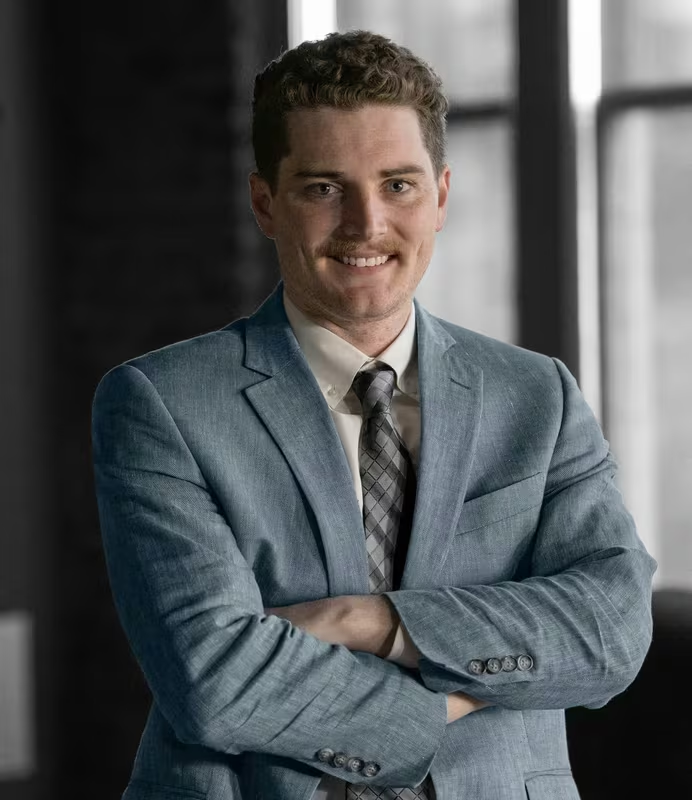
Your St. Tammany Parish Trial Team
The lawyers who work your file. Every St. Tammany Parish case is handled by the firm's own trial attorneys.








How Are Wrongful Death Claims Handled in St. Tammany Parish?
A wrongful death claim is a civil action brought by surviving family members when a person dies because of someone else’s fault. In St. Tammany Parish, these claims are filed in state court and proceed under Louisiana civil law.
Louisiana recognizes two distinct claims that often arise from the same death. The wrongful death claim under La. C.C. Art. 2315.2 compensates surviving family members for their own losses, such as loss of love, affection, companionship, and financial support. A survival action under La. C.C. Art. 2315.1, by contrast, belongs to the estate and covers what the deceased person experienced between the injury and death, including pain, suffering, and medical expenses incurred during that period.
Where the Case Is Investigated and Filed
When the underlying incident occurred in St. Tammany Parish, the case is investigated locally and the civil suit is generally filed in the 22nd Judicial District Court, which serves St. Tammany and Washington Parishes. Local investigation often involves the coroner’s office, the agency that responded to the scene, and any state or federal regulator with jurisdiction over the activity that caused the death. The wrongful death and survival claims are typically filed together in the same petition so the court can address both in one proceeding.