








Richland Parish wrecks happen on I-20 where the trucks run through Rayville and Delhi, on U.S. 425 and Highway 15, and on the two-lane parish highways where cars share the road with farm equipment. The injured are taken to Richardson Medical Center on Highway 3048 in Rayville. Louisiana State Police Troop F writes the report on the interstate, the Richland Parish Sheriff’s Office writes it on the parish roads, and the Rayville Police Department writes it inside town. A suit is filed at the Richland Parish Courthouse on Julia Street in Rayville, where the Fifth Judicial District Court sits. Trey Morris Injury Lawyers orders that report, sends preservation letters for the truck’s electronic data and camera footage, and gathers the Rayville hospital records. We aim to send those letters once there is an honest basis for asking, because moving as fast as the rules permit is what keeps the proof intact and helps turn up more of it. The truck’s data can show its speed and braking leading into the crash, and the camera footage can show who had the right of way.
The law is Louisiana law and it does not change from parish to parish. The deadline is two years for injuries after July 1, 2024 under La. C.C. Art. 3493.1 and one year for injuries on or before that date under La. C.C. Art. 3492. For accidents on or after January 1, 2026, a finding that you were 51 percent at fault under La. C.C. Art. 2323 ends the claim, so we document fault on Interstate 20 truck wrecks and two-lane highway crashes involving farm equipment.
Results for Louisiana Clients
- $409 MillionWrongful Death
A tragic case where an impaired driver of a commercial vehicle ran a red light, then collided with our client, causing serious bodily injury to the mother and the loss of life of her daughter.
- $49 MillionMotor Vehicle Accident
An impaired driver of a stolen vehicle driving the wrong way collided with our client head-on, resulting in brain injury and multiple broken bones.
- $32,195,000Industrial / Workplace
Failure to maintain proper safety protocols led to an explosion at an industrial plant causing a series of catastrophic injuries from broken bones, burns, spinal injury, and mental anguish.
- $31.5 MillionIndustrial / Workplace
Brain and spinal injuries followed an oil-field company failing to maintain equipment and provide a safe work site.
- $17.25 MillionCommercial Vehicle Accident
Client was struck head-on by a disconnected load of an 18-wheeler that crossed the median causing broken bones and amputation.
- $13 MillionCommercial Vehicle Accident
On the interstate, an 18-wheeler failed to yield right of way then made an unsafe lane change causing the accident which resulted in major bone breaks, damaged organs, and ultimately a leg amputation.
Past results do not guarantee future outcomes; each case is decided on its own facts.
What Is a Richland Parish Injury Lawyer and Who Do We Represent?
A Richland Parish injury lawyer is an attorney who represents people hurt by someone else’s negligence in cases filed in the Fifth Judicial District Court in Rayville or in other courts with jurisdiction over claims arising in this parish. The work is civil, not criminal. The goal is compensation for the harm done, not punishment of the at-fault party. We represent the injured person and, when an injury proves fatal, the family members Louisiana law recognizes as proper claimants.
Richland Parish is a rural parish in northeast Louisiana with Rayville as the parish seat and Delhi, Mangham, and Start among its other communities. Interstate 20 runs east-west through the parish, U.S. Highway 425 runs north-south, and state highways connect farms, timber operations, and small downtowns. The mix of long-haul truck traffic, agricultural equipment on public roads, and two-lane rural highways shapes the kinds of injury cases that come out of this parish.
Who we represent
Our clients are people who were not at the wheel of the at-fault vehicle, not the property owner who failed to fix the hazard, and not the employer who cut a safety corner. They include:
- Drivers, passengers, and pedestrians injured in collisions on I-20, U.S. 425, La. Highway 15, and parish roads
- People hit by 18-wheelers and other commercial vehicles moving freight through northeast Louisiana
- Customers and visitors hurt by unsafe conditions on someone else’s property
- Workers injured by third parties on a job site, separate from any workers’ compensation claim against the direct employer
- Surviving spouses, children, and parents bringing wrongful death and survival claims under Louisiana Civil Code articles 2315.1 and 2315.2
Who we do not represent
We do not represent insurance companies, trucking carriers, or property owners defending injury claims. We do not handle criminal defense, divorce, or routine business disputes. Keeping the practice on the plaintiff’s side of injury cases is a deliberate choice. It avoids conflicts and keeps the focus on one job: building the strongest possible claim for the person who was hurt.
What “Richland Parish injury lawyer” actually means in practice
The phrase is geographic shorthand. A lawyer does not have to live in Rayville to handle a Richland Parish case well. What matters is admission to the Louisiana State Bar, familiarity with the Fifth Judicial District Court and its procedures, working knowledge of the State Police Troop F coverage area and the local sheriff’s office crash-reporting practices, and the experience to evaluate medical care available in the parish and the surrounding region. We bring that combination to claims arising in Richland Parish while serving clients from offices elsewhere in Louisiana.
Local Coverage. Statewide Record.
- $1 Billion+
Outcomes for Louisiana clients
Verdicts and settlements won across the state by the same trial team that handles Richland Parish cases.
- 11
Trial attorneys, one team
Your case is handled by the firm's own trial attorneys, and we respond in minutes, 24/7.
- 24/7
We come to you
An attorney travels to you in Richland Parish, at home or at the hospital, or meets by video the same day. Free case review, and no fee unless we win.
- 127
Cases resolved over $1 million
Verdicts and settlements of $1 million or more, won by the same trial team that handles Richland Parish cases.
What Does a Richland Parish Injury Lawyer Do After an Accident?
An injury lawyer’s work after a Richland Parish accident is mostly investigation, preservation, and pressure. The lawyer locks down the proof, builds the demand around documented losses, and handles every conversation with the insurance carrier so the claimant is not negotiating against an adjuster trained to minimize the file. None of that requires the client to do anything beyond getting medical care and keeping records. The work below is what the reader should expect any competent Louisiana injury attorney to do, and what they should ask about when comparing firms.
Investigation and Evidence Preservation
The first job is freezing the facts. Crash scenes on I-20, US-425, and the parish’s rural two-lane highways change within hours. Skid marks fade. Debris gets cleared. Surveillance video from gas stations, truck stops, and roadside businesses is often overwritten on a 7 to 30 day loop. A preservation letter asks whoever holds that footage and those records to keep them.
The investigation typically includes locating the Louisiana State Police or Richland Parish Sheriff’s Office crash report, identifying every witness named in it, photographing the scene, and sending spoliation letters to any trucking company, business, or property owner who controls relevant footage or records. When a commercial vehicle is involved, that letter also targets the electronic control module, driver logs, and dispatch data.
Ask a prospective attorney which preservation letters they send and who on the team actually goes to the scene. The answer tells you whether they are running the case or waiting on a settlement offer.
Medical Documentation and Treatment Coordination
The lawyer does not direct medical care, but the file lives or dies on the medical record. Part of the job is making sure treatment is documented in a way that connects each diagnosis and limitation back to the accident, with no gaps the defense can use to argue the injury came from somewhere else.
That means gathering records from every provider, from the emergency department through orthopedics, imaging, physical therapy, and any specialist referrals. It means tracking out-of-pocket costs, mileage to appointments, and prescription expenses. When a client lacks health insurance, the lawyer often coordinates treatment on a medical lien so care is not delayed because of cost. The medical narrative the lawyer assembles becomes the spine of the demand package.
Identifying Every Liable Party and Insurance Source
A Richland Parish accident often has more than one source of compensation, and identifying all of them is part of the lawyer’s job. A rear-end collision on I-20 may involve a personal driver, an employer if the driver was working, a separate trailer owner, a maintenance contractor, and multiple layers of liability and umbrella coverage. A premises injury may involve a tenant, a property owner, and a maintenance company under separate policies. The lawyer’s job is to map every potential defendant and every applicable policy, then pursue them in the order that matches the evidence.
This is also where uninsured and underinsured motorist coverage on the client’s own auto policy gets reviewed. Many Louisiana drivers do not realize their own UM coverage applies when the at-fault driver has minimum limits that will not cover the harm.
Handling the Insurance Carriers
Once representation is established, the lawyer becomes the only point of contact for the adjusters. Recorded statements stop. Lowball offers stop landing in the client’s voicemail. Requests for blanket medical authorizations, which let carriers go fishing through years of unrelated records, are answered with narrow, accident-specific releases instead.
The demand package the lawyer eventually sends is built from the medical record, the wage-loss documentation, and the liability evidence assembled during the investigation. Negotiation runs from that package. If the carrier will not pay a number that matches the documented harm, the lawyer files suit in the appropriate court, which for Richland Parish state-court cases is the Fifth Judicial District Court in Rayville.
Litigation, Discovery, and Trial Preparation
Most injury cases settle, but the ones that settle for fair numbers are the ones the defense believes will actually be tried. Filing suit triggers formal discovery: written interrogatories, requests for production, depositions of the parties, treating physicians, and any expert witnesses. The lawyer prepares the client for deposition, takes the depositions of the defendants and their witnesses, and works up the case as if it is going to a jury, because the leverage to settle well comes from being ready to try it.
When comparing attorneys, ask how many cases the firm has actually taken to verdict in Louisiana courts in the last several years. A firm that settles everything has a different negotiating posture than one the defense knows will pick a jury.
What the Client Is Expected to Do
The short version: follow medical advice, keep appointments, save every bill and receipt, and route all accident-related calls to the lawyer’s office. The investigation, the demand, the negotiation, and the litigation are the lawyer’s job. The client’s job is to heal and to tell the truth.
Richland Parish Practice Areas
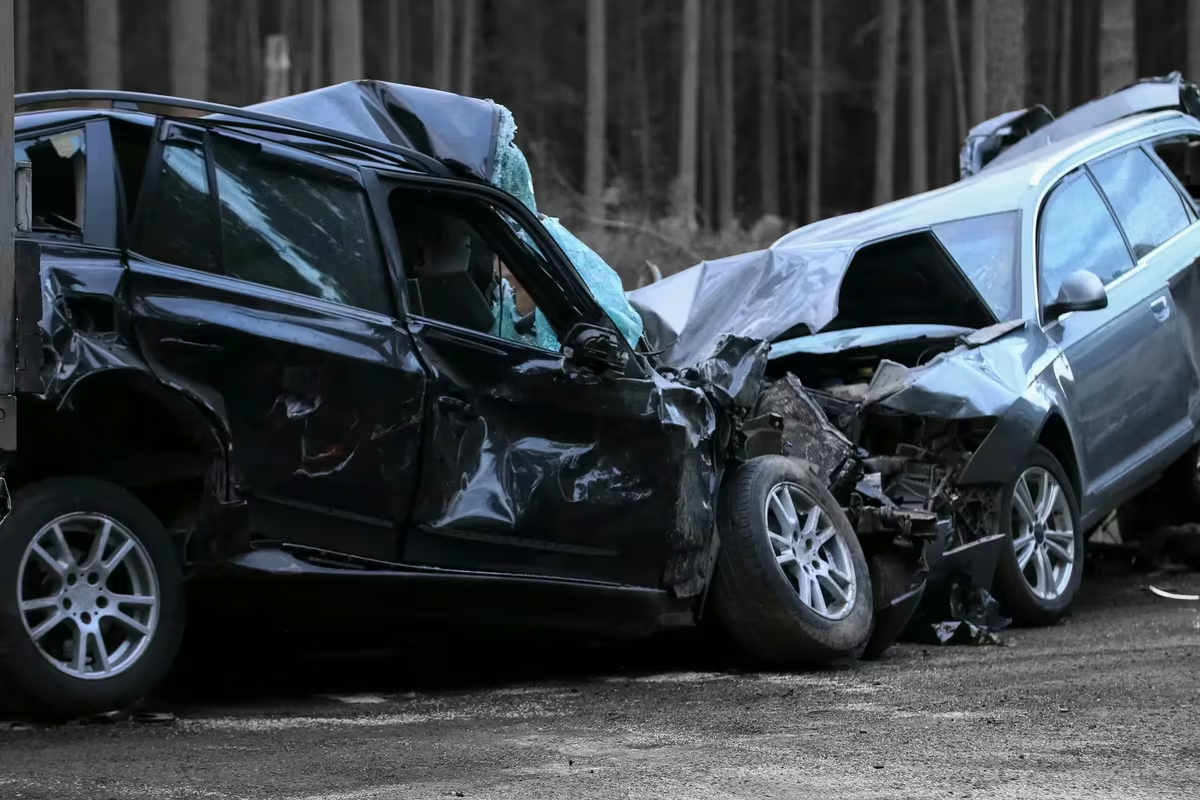 Car AccidentsRear-end, intersection, and highway collisions across Louisiana.
 Truck Accidents18-wheeler and commercial-vehicle wrecks governed by federal trucking rules.
 Catastrophic InjuryBrain, spinal-cord, amputation, and severe-burn injuries that change a life.
 Wrongful DeathClaims brought by families after a fatal accident or act of negligence.
 Premises LiabilitySlip-and-fall and unsafe-property injuries on someone else's premises.
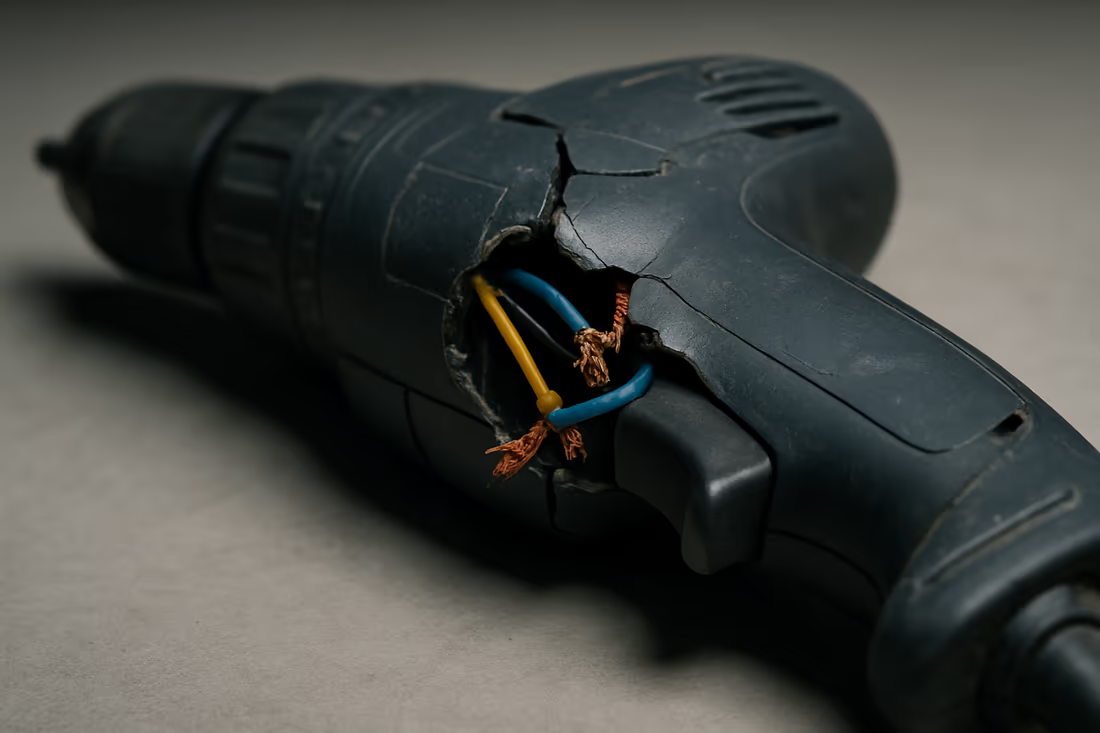 Product LiabilityInjuries caused by defective or unreasonably dangerous products.
 Oilfield AccidentsDrilling, pipeline, and refinery injuries across the energy sector.
 Industrial AccidentsPlant, warehouse, and heavy-equipment injuries in industrial settings.
 Offshore AccidentsRig, platform, and vessel injuries beyond the shoreline.
What Types of Injury Cases Do Richland Parish Injury Lawyers Handle?
Richland Parish injury lawyers handle the full range of civil claims that arise when one person’s negligence injures another. These include motor-vehicle collisions on Interstate 20 and U.S. Highway 425, commercial trucking wrecks, motorcycle crashes, pedestrian and bicycle injuries, premises-liability claims, workplace and industrial injuries, product-defect claims, and wrongful-death actions. The common thread is a duty owed, a breach of that duty, and resulting harm that a Louisiana civil court can address.
Motor-Vehicle and Trucking Collisions
Car, truck, and motorcycle wrecks make up the largest share of injury caseloads in rural North Louisiana parishes. I-20 runs east-west through the parish, carrying heavy interstate freight traffic between Monroe and Vicksburg. Cases involving 18-wheelers, delivery vans, and other commercial vehicles often pull in additional parties such as the motor carrier, the trailer owner, the broker, and a commercial liability insurer. Passenger-vehicle collisions, rear-end crashes, and intersection wrecks on state and parish roads round out this category.
Premises Liability and Slip-and-Fall
Premises claims arise when a property owner or merchant fails to keep the property in a reasonably safe condition and a visitor is injured. Typical fact patterns include falls inside grocery stores and gas stations along U.S. 425 and La. Highway 15, unsafe parking lots, unmarked hazards, and inadequate security. Liability analysis is fact-specific and turns on what the property owner knew or should have known before the injury occurred.
Workplace, Industrial, and Agricultural Injuries
Richland Parish has a working economy built around agriculture, timber, oilfield services, and trucking. Workers injured on the job may have a workers’ compensation claim against the employer and, separately, a third-party tort claim against a non-employer whose negligence contributed to the injury. Equipment failures, contractor-on-contractor incidents at industrial sites, and farm-equipment injuries are recurring scenarios.
Catastrophic Injury, Wrongful Death, and Product Liability
Catastrophic cases involve traumatic brain injury, spinal-cord injury, severe burns, amputations, and other harms that change a person’s life and earning capacity. When an injury results in death, Louisiana law recognizes separate wrongful-death and survival actions brought by defined family members. Product-liability claims target manufacturers and sellers when a defective vehicle component, machine guard, tire, or consumer product causes injury.
How the Case Type Shapes the Investigation
The case category drives what evidence matters. A trucking wreck calls for driver logs, electronic control module data, dispatch records, and federal motor-carrier compliance files. A premises case calls for incident reports, surveillance video, sweep logs, and inspection histories. A product case calls for the product itself, recall data, and engineering analysis. When you talk to any attorney about a Richland Parish injury, a useful question is what evidence they will move to preserve and how they will preserve it.
What Should You Do Immediately After an Accident in Richland Parish?
The first hour after a Richland Parish accident sets the floor for everything that comes after. Police reports get written, scene evidence disappears, and statements you make on the side of I-20 or in a Rayville emergency room can show up later in an insurance file.
Call 911 and Get a Law Enforcement Response
Call 911 from the scene, even if the crash looks minor. In Richland Parish, the responding agency will usually be the Louisiana State Police (for I-20 and U.S. 425), the Richland Parish Sheriff’s Office on parish roads, or the Rayville, Delhi, or Mangham police inside town limits. The official crash report becomes a primary document in any later claim, and 911 dispatch also routes EMS to your location.
Get Medical Care, Even If You Think You Are Fine
Accept EMS evaluation at the scene. If you decline transport, get seen the same day at Richland Parish Hospital in Delhi, at an urgent care, or at your primary care clinic.
Exchange Information, But Do Not Give a Recorded Statement
Exchange names, addresses, driver’s license numbers, license plates, and insurance information with every driver. That is required by Louisiana law.
When the other driver’s insurance company calls, often within 24 to 48 hours, they will ask for a recorded statement. You are not obligated to give one.
Talk to a Lawyer Before You Talk to the Other Side
A consultation costs nothing and locks in your timeline. An attorney can send preservation letters to trucking companies, request 911 audio and dash-cam footage from the responding agency, and put the at-fault insurer on notice. Those letters ask each party holding the original record to keep it.
How Long Do You Have to File an Injury Claim in Richland Parish, Louisiana?
The filing deadline is the single fact every injury claimant needs to know before anything else. Miss it and the claim is gone, regardless of how clear the liability or how severe the injuries. Louisiana calls this deadline a prescriptive period, and the legislature changed it for injuries occurring after July 1, 2024.
What Is the Filing Deadline for Injuries in Richland Parish?
For injuries after July 1, 2024, Louisiana gives an injured person two years from the date of the accident to file suit (La. C.C. Art. 3493.1). For injuries on or before July 1, 2024, the older one-year prescriptive period under La. C.C. Art. 3492 still controls. Richland Parish follows the same statewide rule.
Why the Deadline Matters Even If You Are Still Treating
Prescription does not pause because you are still treating. Filing suit is the act that stops prescription. Settlement discussions, recorded statements, and medical bills sent to the carrier do not stop it.
Wrongful Death and Survival Claims Have Their Own Clock
When an accident causes a death, Louisiana law creates two separate claims: a survival action under La. C.C. Art. 2315.1 for what the deceased person suffered before death, and a wrongful death action under La. C.C. Art. 2315.2 for what the surviving family lost. Both must be filed within the longer of one year from the death or two years from the injury (La. C.C. Art. 2315.2, as amended in 2025); before that amendment, the period was one year from the death. The clock for the wrongful death claim runs from the date of death, which may be later than the date of the accident if the person survived for a period before passing.
Claims Against Public Entities and Special Notice Rules
If a claim involves a Louisiana public entity, such as a parish, a municipality, a state agency, or a public hospital, the procedure differs from a claim against a private party. Louisiana does not require a pre-suit notice of claim, but service of citation must be requested within 90 days of filing under La. R.S. 13:5107(D). The prescriptive deadline still controls when suit must be filed, and the service rule controls what has to happen right after filing. Accidents on parish roads, in public buildings, or involving government vehicles in Richland Parish fall into this category. Ask any attorney how they screen for public-entity defendants, because the right entity has to be identified in time to file and serve correctly.
Can You Still Recover Compensation If You Were Partly at Fault in Louisiana?
Yes, and the rule that applies depends on the date of the accident. For causes of action arising on or after January 1, 2026, Louisiana applies modified comparative fault under La. C.C. Art. 2323 as amended by Act 15 of the 2025 Regular Session (HB 431): a plaintiff found 51 percent or more at fault collects nothing, and a plaintiff found 50 percent or less at fault has damages reduced by that share. Accidents before January 1, 2026 remain under pure comparative fault, where fault reduces the award but never bars it outright.
How comparative fault works in practice
A jury or judge assigns a percentage of fault to every party whose conduct contributed to the harm. That includes the plaintiff, the named defendants, and sometimes non-parties whose conduct was at issue. The plaintiff’s gross damages are then reduced by the plaintiff’s own percentage.
Why fault percentages are worth fighting over
Fault allocation is often the most contested issue in an injury case, and small shifts in percentages move real money. Insurance adjusters routinely open negotiations by asserting that the injured person bears a large share of fault. They point to following distance in a rear-end case, speed in an intersection collision, footwear in a slip and fall, or seatbelt use in a crash.
What this means for a Richland Parish claim
A Richland Parish injury claim is rarely a clean story where one party is 100 percent at fault and the other is blameless. Rural highways, agricultural traffic on local roads, weather, and shared roadway use all create fact patterns where multiple parties may have contributed. Comparative fault gives an injured person a path forward in those mixed-fault situations, but for accidents on or after January 1, 2026 that path closes once a plaintiff’s share reaches 51 percent under La. C.C. Art. 2323. That is why fault percentages, not just liability in the abstract, drive how these cases are investigated and tried.
What Compensation Can an Injury Victim Recover in Richland Parish?
A Richland Parish injury claim under Louisiana law allows two principal categories of compensatory damages: economic damages, which reimburse documented financial losses, and non-economic damages, which compensate for the human cost of an injury. Punitive damages exist only when a specific statute authorizes them.
Economic Damages
Economic damages cover financial losses that can be documented with bills, receipts, pay records, and expert reports. They include past and future medical expenses, such as emergency care, hospitalization, surgery, physical therapy, prescription medication, assistive devices, and long-term rehabilitation. They also include past and future lost wages and lost earning capacity when an injury keeps a person out of work or limits the kind of work they can do afterward.
Non-Economic Damages
Non-economic damages compensate for losses that are real but harder to put a price on. These include physical pain and suffering, mental anguish, emotional distress, scarring and disfigurement, loss of enjoyment of life, and inconvenience tied to medical treatment and limitations on daily activity. Close family members, starting with a spouse and children, may have their own claim for loss of consortium, which covers the loss of companionship, affection, and services.
Wrongful Death and Survival Damages
When an accident causes death, Louisiana law recognizes two separate claims. A survival claim under La. C.C. Art. 2315.1 compensates for the harm the decedent suffered between the moment of injury and the moment of death, including conscious pain and medical expenses incurred before death. A wrongful death claim under La. C.C. Art. 2315.2 compensates eligible family members for their own losses, including loss of love and affection, loss of support, loss of services, and funeral and burial expenses.
Punitive Damages
Louisiana does not allow punitive damages in most personal injury cases. They are available only when a specific statute authorizes them. The most common example is La. C.C. art. 2315.4, which permits exemplary damages against a driver whose intoxication caused the injury. Outside of narrow statutory windows, a Louisiana claim is limited to compensatory damages. Any attorney who promises punitive damages without identifying the specific statute that authorizes them is overstating the law.
What Affects the Categories Available
Not every category applies to every case. The applicable insurance, the identity of the defendant, and the type of incident also shape what can be pursued.
How Much Is a Richland Parish Injury Case Worth?
No honest lawyer can tell you a number on the first call. Case value is the sum of your specific economic losses, the severity and duration of your injuries, the strength of the liability evidence, and the insurance and assets available to pay a judgment. Two crashes that look identical from the outside can settle for very different amounts because those four inputs are never the same.
How Do Wrongful Death Claims Work in Richland Parish?
A wrongful death claim under La. C.C. Art. 2315.2 is a civil action brought by surviving family members when someone dies because of another party’s negligence or wrongful conduct. In Richland Parish, these cases are filed in Louisiana state court under Louisiana law, and they sit alongside (not inside) the survival claim under La. C.C. Art. 2315.1 for what the decedent suffered before death.
Who Can File a Wrongful Death Claim in Louisiana
The right to file follows a strict order set by La. C.C. Art. 2315.2. The surviving spouse and children come first. If there are none, the right passes to surviving parents. If there are no surviving parents, it passes to surviving siblings. If none of those exist, it passes to surviving grandparents.
Wrongful Death Claims vs. Survival Actions
Louisiana recognizes two separate claims when someone dies from another party’s fault. The wrongful death claim under La. C.C. Art. 2315.2 compensates the family for their own losses after the death. The survival action under La. C.C. Art. 2315.1 compensates the estate for what the decedent suffered between the injury and the moment of death.
Proving Fault and Damages
A wrongful death case still requires proof that the defendant’s negligence or wrongful conduct caused the death. Economic damages include the decedent’s expected future earnings, household services they would have provided, and the value of benefits the family lost. Non-economic damages include the loss of relationship between the decedent and each surviving family member, which is evaluated individually for the spouse, each child, and each parent.
How the Case Moves Forward
A wrongful death case in Richland Parish typically begins with an investigation phase while the family handles the funeral and immediate aftermath. After investigation, the attorney files the lawsuit in the proper Louisiana court, conducts discovery, takes depositions, works with experts, and prepares for either mediation or trial. Most cases resolve before trial, but the case has to be built as if it will be tried.
Who Can Be Held Liable for Slip-and-Fall and Premises Liability Injuries in Richland Parish?
Premises liability cases in Richland Parish turn on who controlled the property when the injury happened and whether that person knew, or should have known, about the hazard. Liability does not automatically attach to a property owner just because someone got hurt on the property. The injured person has to show that a specific party had a duty to address the hazard, failed to address it, and that failure caused the injury. Several different parties can carry that duty, sometimes more than one at the same time.
Store Owners and Commercial Tenants
Grocery stores, gas stations, restaurants, big-box retailers, and other businesses owe a duty to keep aisles, entrances, restrooms, and parking lots reasonably safe for customers. A spill in a produce aisle, a leaking cooler, an unmarked wet floor after mopping, ice cream tracked across tile near the freezer section. Those are the recurring fact patterns. The store is typically the operator the customer interacts with, and it is usually the first defendant identified. When the store leases the building, the lease often shifts maintenance duties between landlord and tenant, which is one of the first documents to obtain in the investigation.
Property Owners and Landlords
The owner of the underlying real estate can be liable even when a tenant runs the business. Owners are responsible for structural conditions: roof leaks that create slick floors, broken stair treads, failed handrails, defective parking lot surfaces, inadequate exterior lighting. In rural Richland Parish, where a single owner may hold buildings in Rayville, Delhi, and Mangham, the owner often handles structural repairs while the tenant handles day-to-day cleanup. Both can end up named as defendants while the maintenance responsibility gets sorted out.
Homeowners and Residential Hosts
Residential premises liability is real, though it operates differently from commercial cases. A homeowner who knows about a rotted porch step, a loose handrail, or an aggressive dog and invites guests onto the property anyway can be liable when someone gets hurt. Most residential claims are handled through the homeowner’s liability insurance rather than out of personal assets. Trespasser claims exist but are narrow, and the duty owed to a trespasser is far lower than the duty owed to an invited guest or business customer.
Government Entities and Public Property
Falls on sidewalks, courthouse steps, parish-owned buildings, school grounds, or public parks raise an additional layer of complexity. Claims against the Richland Parish Police Jury, the Town of Rayville, the Town of Delhi, the Village of Mangham, the school board, or the State of Louisiana run through different procedural rules than claims against private parties. Louisiana does not require a pre-suit notice of claim, but service of citation must be requested within 90 days of filing under La. R.S. 13:5107(D). Sovereign-immunity defenses and the framework in La. R.S. 9:2800 governing public-entity liability for things in the public’s custody also come into play. These cases require an investigation focused on identifying the correct public entity and preserving evidence of the defect.
Contractors, Cleaning Crews, and Third-Party Vendors
The party that created the hazard is not always the same party that owns or operates the premises. A janitorial contractor who mopped without placing warning cones, a flooring company that left a transition strip raised, a vendor restocking shelves who spilled product and walked away. These third parties can be named as defendants alongside the property owner and the business operator. Identifying them usually requires incident reports, video footage, vendor logs, and witness statements.
How Louisiana Premises Liability Actually Works
Louisiana premises liability is governed primarily by La. C.C. art. 2317.1 and, for merchants specifically, by La. R.S. 9:2800.6. Against a merchant, the injured person must prove the condition presented an unreasonable risk of harm, the merchant either created the condition or had actual or constructive notice of it before the fall, and the merchant failed to exercise reasonable care. Constructive notice is the battleground in most slip-and-fall cases. It requires showing the condition existed for some period of time before the fall such that the merchant should have discovered it. Time-stamped video, sweep logs, employee testimony, and the physical characteristics of the spill (dried edges, footprints through it, dirt tracked across it) are how that element gets proven or disproven.
When more than one party shares responsibility, Louisiana’s comparative fault system allocates a percentage to each, including potentially to the injured person. Identifying every viable defendant matters because it preserves the full set of parties whose conduct contributed to the fall, which directly affects what can be collected at the end of the case.
How Much Does It Cost to Hire a Richland Parish Injury Lawyer?
Nothing up front. We handle Richland Parish injury cases on a contingency fee, which means you pay no attorney fee unless we obtain compensation for you. The fee is a percentage of the settlement or judgment, agreed in writing at the start of the case. If there is no compensation, there is no attorney fee.
That arrangement matters in a rural parish like Richland. Hiring a lawyer should not require pulling money out of a household already absorbing medical bills, missed paychecks, and a damaged vehicle. Contingency representation moves the financial risk of pursuing the claim from the injured person to the law firm.
What a Contingency Fee Covers
The attorney fee is the percentage paid for legal work: investigation, demand preparation, negotiation, filing suit if needed, discovery, depositions, motion practice, mediation, and trial. The exact percentage is disclosed in the written contract before you sign. Ask any lawyer you interview for the percentage, whether it changes if the case is filed in court, and what happens if the case settles within the first 30 days.
A clear written fee agreement is required. You should leave the first meeting with a copy in hand and time to read it. If a lawyer cannot answer fee questions in plain numbers during the consultation, that is information about how they will communicate later in the case.
Case Costs Versus Attorney Fees
Case costs are separate from the attorney fee. Costs are the out-of-pocket expenses needed to build the case: medical record retrieval, police and crash reports, expert witness fees, court filing fees, deposition transcripts, accident reconstruction, mileage to records custodians, and trial exhibits. In a serious Richland Parish injury claim, costs can be substantial because experts and records do not come cheap.
We advance these costs. You do not write checks for depositions or expert reports while the case is pending. At resolution, costs are reimbursed from the settlement or judgment, and the math is shown on a written settlement statement before any money is disbursed. Ask any attorney you interview two questions: who fronts the case costs, and are costs deducted before or after the attorney fee is calculated. The answers materially change what reaches your pocket.
The Free Consultation
The initial consultation is free and carries no obligation. You can describe what happened, hear an honest read on the claim, and decide whether to hire the firm. Meeting with a lawyer is not the same as hiring one. If the case is not one we should take, we will tell you that during the meeting rather than after you sign paperwork.
For injured people in Rayville, Delhi, Mangham, Start, and the rest of Richland Parish, the practical answer is this: the cost of asking is zero, the cost of hiring is zero unless we obtain compensation, and every dollar that moves through the case is documented in writing.
Why Do Richland Parish Injury Victims Choose Our Firm?
Residents of Rayville, Delhi, Mangham, and the rest of Richland Parish have a long list of attorneys to consider when something serious happens. This section explains what to look for in injury counsel and how Trey Morris Injury Lawyers approaches the work. Read it, compare it to what other firms tell you, and make the call that fits your situation.
Trial experience that shapes settlement value
Insurance carriers track which firms try cases and which firms do not. A file marked for settlement only is worth less than a file marked for trial. Trey Morris Injury Lawyers has handled personal injury, commercial vehicle, catastrophic injury, and wrongful death matters in Louisiana state courts for more than two decades. That history is verifiable. Ask any firm you interview how many jury trials its lead attorneys have completed in the last five years. The answer tells you whether the carrier on the other side has a reason to pay full value.
Investigation built for rural Louisiana cases
Richland Parish injury claims often turn on evidence that disappears quickly. Skid marks fade. Truck electronic control module data overwrites itself. Property owners repair the hazard before anyone photographs it. Witnesses move. The firm sends investigators to the scene, preserves vehicle data, secures surveillance from nearby businesses along I-20 and U.S. 425, and identifies every potentially responsible party. Ask a prospective attorney what they do to preserve evidence in a serious case. If the answer is “we wait for the police report,” keep looking.
Direct attorney contact, not a call center handoff
Clients reach their attorney, not a rotating roster of case managers. Phone calls and emails are returned. Updates are explained in plain language. The reader can verify this by reading the firm’s published client reviews and by asking, during any consultation, who specifically will handle the case and who will be reachable when questions come up at month four or month nine.
Verifiable third-party recognition
Trey Morris Injury Lawyers attorneys hold recognition from independent rating organizations including Super Lawyers, Best Lawyers, and Martindale-Hubbell AV Preeminent ratings. These are peer- and methodology-based ratings, not paid placements. They are one input among several. Combine them with attorney bios, published case results, and the conversation you have during the free consultation.
What to compare us against
When evaluating any Richland Parish injury lawyer, ask the same questions of every firm: How many cases like mine have you tried to verdict? Who answers my call on a Tuesday afternoon? How do you investigate? What is the fee, and what costs come out of any compensation? The firm that gives you specific, verifiable answers, including this one, is the firm worth hiring.
What Our Clients Say
- Dakota R.
Where should I start!?Trey Morris Injury Law Firm was a great fit for me! During this wild time of getting into a car wreck, dealing with insurance, and other third parties, Mrs. Brooke and Mrs. Nerren were extremely helpful! They were there for me through the whole process and never once did I doubt their professionalism. They will fight tooth and nail for you and get you what you deserve. I would recommend them to anyone.
- Janet C.
Best personal injury lawyers ever!!!They did everything they said they would do, and never left me wondering what was going on with my case!
- Michael C.
Lane Robinson and his team were great.When he took the accident case for my wife he was very concerned, friendly, and professional. He never gave up but pushed until she was fully compensated for her injuries. We couldn’t be anymore grateful with the outstanding outcome. Thanks Lane
- Ahmillyah T.
I would like to thank Attorney Coleman Nerren for handling my case.I can honestly say he is the best Attorney I’ve ever had. He is caring and straightforward. I spoke with him on and off with throughout my case and received nothing but the highest respect. They will go above and beyond to satisfy their clients. 10/10 will definitely use again and will highly definitely recommend.
- Denise
Handling my case with care and made a stressful situation much easier.Communication was always clear and timely, and I felt like they genuinely had my best interest in mind. I would recommend them to anyone needing legal help.
- Patty P.
Thanks to Kaden for answering all my questions.He was knowledgeable and very polite. Joe and Jamie were also very helpful.
- Meredith F.
Jaime and the Ruston team were fantastic.They were super knowledgeable and answered all my questions!
- Naasia C.
Jaime is very professional!She is very awesome answer all of questions accurately & professionally. I would recommend this place.
- Willie W.
I would like to share this review to the consumer protection group that took my case thank you very much for helping on my case I knew something could be done about the situation but I did not know how to go about it I really appreciate the service that you rendered to me and I will be glad to recommend you guys to anyone and everyone who needs help again thank you very much and you have a great great day.Sincerely Willie [W.] Jr
- Gracyn J.
I was pretty nervous about everything at first, but Attorney Shavers and my case manager Leanna made the whole process a breeze.They were patient, kept me updated, and explained things in a way that made sense. Really glad I chose them!
- Karessa L.
⭐️⭐️⭐️⭐️⭐️ From start to finish, [Trey Morris Injury Lawyers] exceeded all expectations.Everyone from the front desk to the legal team was professional, kind, and truly helpful. They made a stressful situation so much easier to manage and always kept me informed throughout the process. I felt supported every step of the way. Highly recommend this firm to anyone needing injury law representation
- Maram Z.
I just want to express how pleased I am with [Trey Morris Injury Lawyers].Their caring team made a huge difference in my experience. From the moment I reached out, they were attentive and supportive, guiding me through every step of the process. They truly took the time to listen to my concerns and made me feel valued as a client. I highly recommend their services to anyone in need of a compassionate and dedicated legal team!
Testimonials do not constitute a guarantee, warranty, or prediction regarding the outcome of your legal matter. Past results do not guarantee future outcomes.
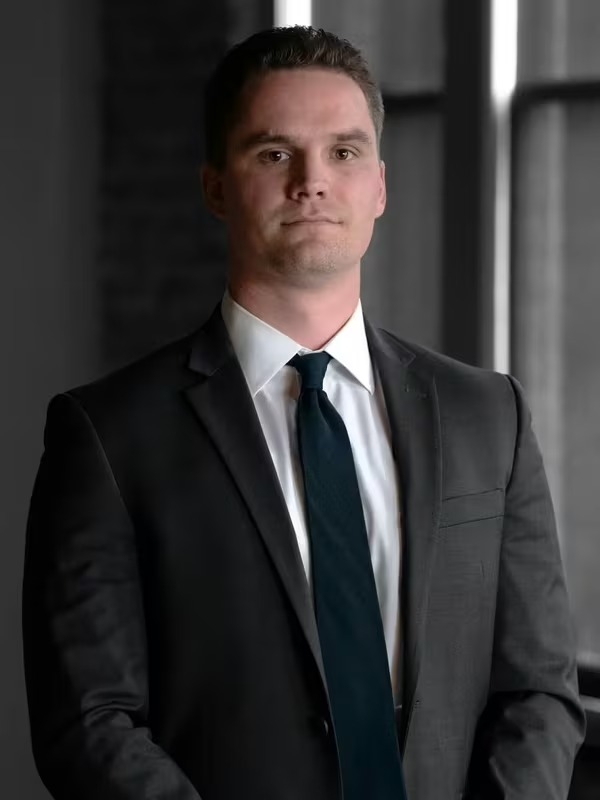
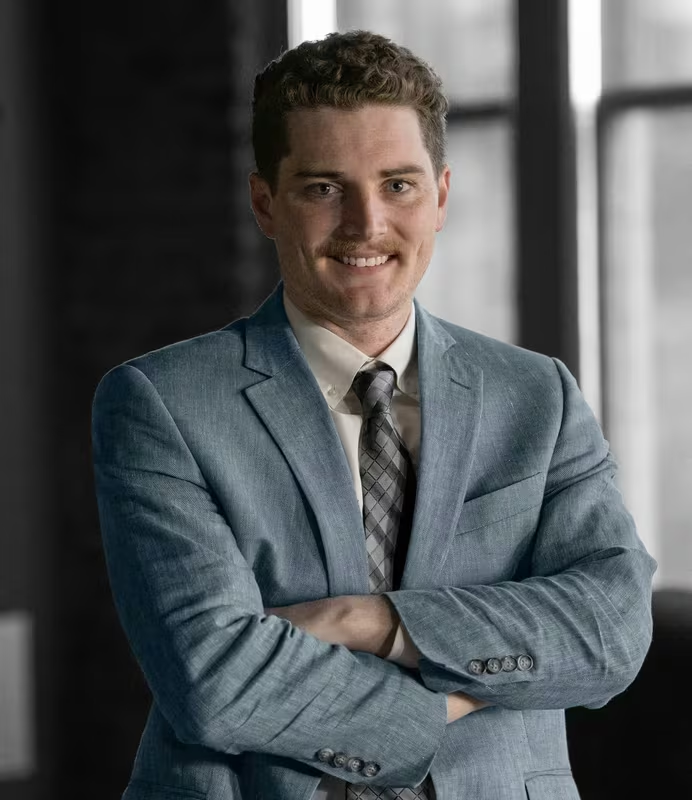
Your Richland Parish Trial Team
The lawyers who work your file. Every Richland Parish case is handled by the firm's own trial attorneys.






Contact a Richland Parish Injury Lawyer Today for a Free Consultation
If you were injured in Richland Parish and you are weighing your options, the next step is a conversation. A consultation is informational. You describe what happened, we explain how a claim would work under Louisiana law, and you decide whether to move forward. There is no obligation tied to that first call.
Consultations with Trey Morris Injury Lawyers are free. Bring what you have, even if it is incomplete: the crash report or incident number, photos from the scene, names of any witnesses, the insurance information you exchanged, and any medical records or bills you have already received. If you do not have those yet, call anyway. We can help identify what to request and where to request it from.
When you call, expect a direct conversation. We will ask about the date and location of the incident, the parties involved, your injuries and treatment so far, and any deadlines that may already be running. Louisiana’s filing deadlines do not pause while a claim is being evaluated, so the sooner facts are gathered, the more options remain on the table.
Take the time you need to research attorneys. Compare experience, compare process, compare answers to the questions raised throughout this page. When you are ready to talk, reach out and we will schedule the consultation at a time that works for you.