








New Orleans has more personal injury law firms per capita than almost any city in the South. You have options. No one reads lawyer websites until they need one, and something has happened that brought you here.
Results for Louisiana Clients
- $409 MillionWrongful Death
A tragic case where an impaired driver of a commercial vehicle ran a red light, then collided with our client, causing serious bodily injury to the mother and the loss of life of her daughter.
- $49 MillionMotor Vehicle Accident
An impaired driver of a stolen vehicle driving the wrong way collided with our client head-on, resulting in brain injury and multiple broken bones.
- $32,195,000Industrial / Workplace
Failure to maintain proper safety protocols led to an explosion at an industrial plant causing a series of catastrophic injuries from broken bones, burns, spinal injury, and mental anguish.
- $31.5 MillionIndustrial / Workplace
Brain and spinal injuries followed an oil-field company failing to maintain equipment and provide a safe work site.
- $17.25 MillionCommercial Vehicle Accident
Client was struck head-on by a disconnected load of an 18-wheeler that crossed the median causing broken bones and amputation.
- $13 MillionCommercial Vehicle Accident
On the interstate, an 18-wheeler failed to yield right of way then made an unsafe lane change causing the accident which resulted in major bone breaks, damaged organs, and ultimately a leg amputation.
Past results do not guarantee future outcomes; each case is decided on its own facts.
This page explains how personal injury claims work in Orleans Parish, what Louisiana’s recent tort reform changes mean for your case, and how the city’s unique risk profile affects the claims process. Trey Morris Injury Lawyers has handled injury cases across Louisiana for over 20 years. Read this. Compare us to others. Make the decision that is right for your situation.
High-Traffic Corridors and Crash Patterns in Orleans Parish
Orleans Parish recorded 88 traffic fatalities in 2022. That was the highest total of any parish in Louisiana. The City of New Orleans Transportation Safety Dashboard tracks fatal, severe, and moderate injury crashes across the city using LaDOTD crash records and NOPD reports.
I-10 runs east-west through the city and carries heavy commuter and commercial traffic between Baton Rouge and Slidell. The I-10/I-610 interchange in Gentilly is one of the highest-crash locations in the parish. I-610 provides an inner-city bypass through Gentilly and Mid-City, and its merge points with I-10 produce frequent rear-end and sideswipe collisions during peak hours.
The Pontchartrain Expressway connects the CBD to the Westbank via the Crescent City Connection bridge. This corridor funnels traffic from Jefferson Parish into downtown New Orleans. Surface streets like Claiborne Avenue, Canal Street, and Elysian Fields Avenue carry high volumes and generate frequent intersection collisions.
Commercial truck accidents are common along the industrial corridors serving the Port of New Orleans. Tourism congestion in the French Quarter, CBD, and Warehouse District creates a different set of hazards. Pedestrians and cyclists share narrow streets with rideshare vehicles, delivery trucks, and tour buses. The city’s pedestrian accident rate exceeds both the state and national averages. If your car accident happened on one of these corridors, the crash location and traffic patterns become part of your case.
Ask any attorney you are evaluating whether they have handled cases involving the specific corridor where your accident occurred. New Orleans traffic patterns differ from parish to parish. An attorney who understands the I-10/I-610 interchange or the Tchoupitoulas Street industrial corridor brings different knowledge than one who primarily handles suburban crashes.
Local Coverage. Statewide Record.
- $1 Billion+
Outcomes for Louisiana clients
Verdicts and settlements won across the state by the same trial team that handles New Orleans cases.
- 11
Trial attorneys, one team
Your case is handled by the firm's own trial attorneys, and we respond in minutes, 24/7.
- 24/7
We come to you
An attorney travels to you in New Orleans, at home or at the hospital, or meets by video the same day. Free case review, and no fee unless we win.
- 127
Cases resolved over $1 million
Verdicts and settlements of $1 million or more, won by the same trial team that handles New Orleans cases.
Premises Liability and Tourism-Related Injuries in New Orleans
premises liability
A property owner’s legal responsibility for injuries that occur on their property due to unsafe conditions. The owner must have known or should have known about the hazard and failed to fix it or warn visitors.
New Orleans draws approximately 18 million visitors each year. Hotels, restaurants, bars, and entertainment venues operate at high volume. That volume creates premises liability exposure that most Louisiana cities do not have at this scale.
Slip-and-fall injuries happen on uneven French Quarter sidewalks, poorly maintained walkways, and wet bar or restaurant floors. The city’s older infrastructure means cracked pavement, loose tiles, and exposed tree roots are common. Property owners have a duty under Louisiana law to maintain safe conditions and warn visitors of known hazards.
Inadequate security claims arise at hotels, parking garages, and entertainment venues where criminal activity is foreseeable. If a property owner failed to provide reasonable security measures and you were assaulted or robbed on their premises, that creates a separate cause of action from any criminal case.
Mardi Gras and festival season produce injuries from crowd conditions, temporary structures, and float-related incidents. These cases involve multiple potential defendants: the krewe, the city, the property owner, and sometimes third-party vendors. Premises liability claims in New Orleans require identifying every responsible party early.
When evaluating an attorney for a premises case, ask how they investigate property conditions. Trey Morris Injury Lawyers sends investigators to document the scene before property owners make repairs. We photograph the hazard, pull maintenance records, and identify prior complaints. That evidence disappears fast in a city where repairs happen overnight.
If you were visiting New Orleans from another state, you can still file your claim in Orleans Parish. Louisiana venue rules allow cases to be filed where the injury occurred. You do not need to be a Louisiana resident.
New Orleans Practice Areas
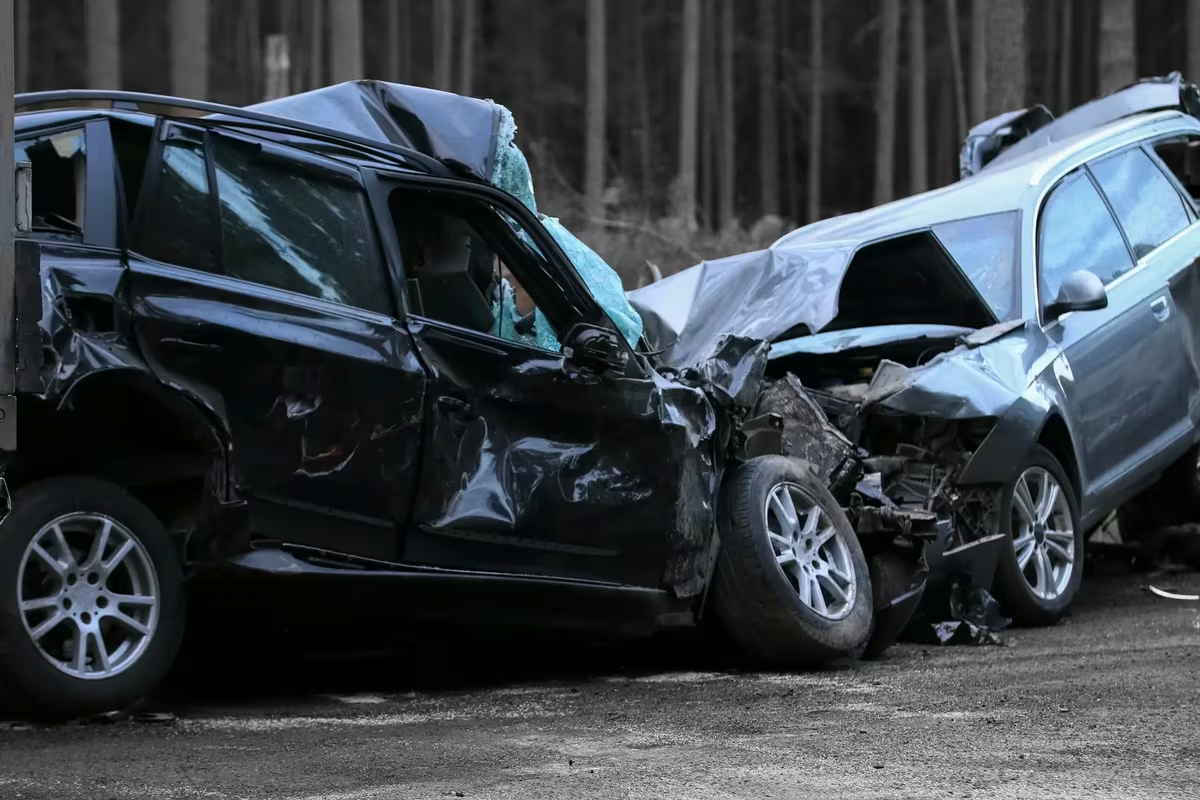 Car AccidentsRear-end, intersection, and highway collisions across Louisiana.
 Truck Accidents18-wheeler and commercial-vehicle wrecks governed by federal trucking rules.
 Catastrophic InjuryBrain, spinal-cord, amputation, and severe-burn injuries that change a life.
 Wrongful DeathClaims brought by families after a fatal accident or act of negligence.
 Premises LiabilitySlip-and-fall and unsafe-property injuries on someone else's premises.
 Product LiabilityInjuries caused by defective or unreasonably dangerous products.
 Oilfield AccidentsDrilling, pipeline, and refinery injuries across the energy sector.
 Industrial AccidentsPlant, warehouse, and heavy-equipment injuries in industrial settings.
 Offshore AccidentsRig, platform, and vessel injuries beyond the shoreline.
How Louisiana Tort Reform Changes Affect New Orleans Injury Cases
Louisiana passed significant tort reform legislation in 2024 and 2025. These changes directly affect every injury case filed in Orleans Parish.
Prescriptive Period
The Prescriptive Period for personal injury claims dropped from three years to two years, effective July 1, 2024. Under La. C.C. Art. 3493.1, you now have two years from the date of injury to file suit. Miss that deadline and your claim is gone.
Comparative Fault
The Comparative Fault threshold changed on January 1, 2026. Under La. C.C. Art. 2323, if you are 51% or more at fault, you recover nothing. This replaced the old pure comparative fault system where you could recover something at any fault percentage.
The collateral source rule also changed. Previously, evidence of insurance payments or other benefits was excluded from trial. New provisions allow certain collateral source evidence, which can reduce what a jury awards.
Louisiana’s direct action statute under La. R.S. 22:1269 allows a lawsuit directly against the at-fault party’s insurance company only in limited situations, such as when the insured is bankrupt, insolvent, or deceased, cannot be served, or when the claim is against your own uninsured motorist carrier. In most cases the suit names the at-fault party, and the insurer stays out of the caption.
These changes shift litigation strategy for cases filed in Civil District Court for Orleans Parish. Trey Morris Injury Lawyers works with accident reconstructionists to establish fault percentages before the insurance company builds their narrative. Read more about Louisiana personal injury law and how these reforms apply statewide.
How Do You Prove Negligence in a New Orleans Injury Case?
Louisiana negligence claims require four elements: duty, breach, causation, and damages. Louisiana uses a duty-risk analysis that is different from the standard negligence framework in most states.
Police reports from NOPD are important starting evidence but they are not dispositive. Witness statements, surveillance footage, and physical evidence from the scene build the factual record. New Orleans has extensive security camera networks in the French Quarter, CBD, and commercial districts. That footage is valuable but it gets overwritten. A preservation demand must go out fast.
Trey Morris Injury Lawyers engages reconstructionists and medical experts during the investigation phase so the evidence shapes our demand, not the other way around.
Insurance companies will try to shift blame onto you. In New Orleans, this often means arguing you were jaywalking, distracted, or violated a traffic signal.
Filing a Personal Injury Claim in Civil District Court for Orleans Parish
Civil District Court for the Parish of Orleans handles personal injury civil cases in New Orleans. The courthouse is at 421 Loyola Avenue. This court has its own procedures, timeline expectations, and judicial preferences that differ from other Louisiana district courts.
New Orleans is the one place in Louisiana where the courthouse works differently. The other 63 parishes route civil cases through a numbered Judicial District Court. Orleans Parish does not. Civil injury suits for Orleans Parish are filed in the Orleans Parish Civil District Court, known as the CDC, at 421 Loyola Avenue, not in a numbered Judicial District Court. Every other parish channels civil and criminal matters through a single numbered JDC, but Orleans Parish splits them: civil cases go to the Civil District Court, and criminal cases go to a separate Criminal District Court housed at Tulane and Broad. The CDC is a dedicated civil trial court for the parish, with its own elected judges and its own divisions. If you have read about a “1st JDC” or “26th JDC” elsewhere in Louisiana, that structure does not apply here. A litigant who knows the numbered-JDC system from elsewhere in the state will not find a numbered district in Orleans Parish, and naming the right court is the first step in filing an injury suit in New Orleans.
Venue rules determine where your case is filed. Generally, you file where the accident occurred or where the defendant resides. For accidents in New Orleans, that means Civil District Court. If the defendant is an insurance company, Louisiana’s direct action statute gives you additional venue options.
Orleans Parish has a distinct jury pool. The demographics, values, and expectations of Orleans Parish jurors differ from suburban or rural parishes. Insurance companies know this. Their settlement calculations factor in where the case will be tried. An attorney who understands Orleans Parish jury tendencies has an advantage in negotiations because the insurance company knows what a trial in this venue could produce.
Case timelines in Civil District Court vary. Simple auto accident cases may resolve in 12 to 18 months. Complex cases involving multiple defendants or catastrophic injuries can take two to three years. Mediation is common and the court encourages settlement conferences before trial. Ask your attorney for a realistic timeline based on your specific case facts.
Maritime and Port-Related Injuries in New Orleans
The Port of New Orleans is one of the busiest ports in the United States. It handles cargo along the Mississippi River and connects to Gulf of Mexico shipping lanes. Longshoremen, harbor workers, crane operators, and vessel crew face hazards that land-based workers do not encounter.
Jones Act
A federal maritime law (46 U.S.C. 30104) that allows seamen injured during employment to sue their employer for negligence. It provides broader protections than standard workers’ compensation, including the right to a jury trial and full damages.
The Jones Act covers seamen injured aboard vessels on the Mississippi River and Gulf waters. If you qualify as a seaman under federal law, you have the right to sue your employer for negligence. This is a more favorable standard than Louisiana workers’ compensation.
The Longshore and Harbor Workers’ Compensation Act covers dock and terminal workers who are not seamen. This federal program provides benefits for injuries sustained on navigable waters or adjoining areas like wharves and terminals. The benefits differ from Louisiana state workers’ compensation in both amount and scope.
Maritime cases involve a critical threshold question: does your case fall under federal maritime law or Louisiana state law? The answer determines your available damages, your filing deadline, and which court hears your case. Federal maritime claims have a three-year statute of limitations, which is longer than Louisiana’s two-year prescriptive period for state personal injury claims.
When talking to an attorney about a port or maritime injury, ask whether they have handled cases under the Jones Act and LHWCA specifically. These are specialized areas with different procedural rules than standard personal injury. Trey Morris Injury Lawyers handles both state and federal maritime claims and can advise on which framework applies to your situation. Learn more about boat and maritime accident claims.
What Compensation Does Louisiana Law Allow After an Injury in New Orleans?
Louisiana law allows three categories of compensation after an injury: economic damages, non-economic damages, and punitive damages.
Loss of Earning Capacity
Economic damages cover quantifiable losses. Loss of Earning Capacity measures the difference between what you could have earned and what you can earn now.
Loss of Consortium
Non-economic damages address losses that do not have a receipt. Pain and suffering, mental anguish, loss of enjoyment of life, and Loss of Consortium are all recognized categories under Louisiana law.
Punitive damages are rare in Louisiana. They are available only for specific statutory causes of action. DWI-related crashes under La. C.C. Art. 2315.4 are the most common example. Standard negligence cases do not qualify.
Medical liens affect your final settlement amount. Hospitals, health insurers, and Medicare/Medicaid may hold liens against your recovery for treatment costs they paid. Your attorney must negotiate these liens down to maximize what you keep. Ask any attorney how they handle lien resolution. Trey Morris Injury Lawyers negotiates medical liens as part of every case to ensure clients retain the maximum possible recovery.
What Our Clients Say
- Victoria M.
Very professional and very easy to work with throughout the whole case!Lane and Men helped make the whole process go smonthly with no stress
- Sarah S.
First time being injured and needing a lawyer they where very helpful.They answered my questions Id have very well. Highly recommend them.
- Dawn H.
Very professional, informed me of every step that was taken with the case and was always letting me know the status.Very nice people and was very respectful. Thanks a whole lot for the service Erin, Chelsea, and Morgan!!!
- Yamileth L.
Jessica has been great helping throughout our whole process at [Trey Morris Injury Lawyers]!She has been great with communication and making everything so easy!
- Sarah S.
Awesome people, they truly care about their clients.Give them a call today if you want to be taken care of the way you deserve to be.
- Kim K.
I have nothing but positive things to say about [Trey Morris Injury Lawyers].This firm went above and beyond to help me and I couldn’t have asked for a better outcome!!!
- Debra L.
They were extremely courteous, helpful and informative all along the process of our wrongful death suit.I recommend you talk to them if you need lawyer
- Nathan Y.
[Trey Morris Injury Lawyers] helped my wife receive compensation after an auto accident.They got the auto insurance companies to fully compensate for all her expenses. Things couldn’t have been easier and their rates were reasonable. Would recommend!
- Phat T.
I’m very happy with [Trey Morris Injury Lawyers].Thank you for taking care of me like we’re family. I will recommend anybody if you had an accident you need to call [Trey Morris Injury Lawyers]. They’re very Professional and they’ll take good care you like you’re their family. Thank again [Trey Morris Injury Lawyers].
- Jordyn L.
Hired them for an automobile accident and absolutely loved them.Very professional and reliable. Highly recommend!
- Jillian E.
[Trey Morris Injury Lawyers] are the best personal injury lawyers!They helped me with my car accident and were professional from beginning to end.
- Connie B.
Great lawyers when you need someone you can count on!!They always make you feel like you're their TOP priority, they listen to every details and explain what's next to do. Thanks for your help.
Testimonials do not constitute a guarantee, warranty, or prediction regarding the outcome of your legal matter. Past results do not guarantee future outcomes.
Your New Orleans Trial Team
The lawyers who work your file. Every New Orleans case is handled by the firm's own trial attorneys.











What to Do After an Accident in New Orleans
Call 911 and request a police report. In New Orleans, NOPD or Louisiana State Police will respond depending on the location.
Document everything at the scene. In New Orleans, bystanders and tourists often have cell phone video that captures what happened.
Seek medical attention promptly. University Medical Center New Orleans, Ochsner Medical Center, and Tulane Medical Center are the major trauma and emergency facilities in Orleans Parish.