









A Franklin Parish injury lawyer handles a claim from the first call after a wreck through a settlement check or a verdict in the Fifth Judicial District Court in Winnsboro. The work starts with evidence that disappears fast, including premises surveillance video that overwrites on a 30-day loop and trucking driver logs and ECM data that only a spoliation letter preserves.
Results for Louisiana Clients
- $409 MillionWrongful Death
A tragic case where an impaired driver of a commercial vehicle ran a red light, then collided with our client, causing serious bodily injury to the mother and the loss of life of her daughter.
- $49 MillionMotor Vehicle Accident
An impaired driver of a stolen vehicle driving the wrong way collided with our client head-on, resulting in brain injury and multiple broken bones.
- $32,195,000Industrial / Workplace
Failure to maintain proper safety protocols led to an explosion at an industrial plant causing a series of catastrophic injuries from broken bones, burns, spinal injury, and mental anguish.
- $31.5 MillionIndustrial / Workplace
Brain and spinal injuries followed an oil-field company failing to maintain equipment and provide a safe work site.
- $17.25 MillionCommercial Vehicle Accident
Client was struck head-on by a disconnected load of an 18-wheeler that crossed the median causing broken bones and amputation.
- $13 MillionCommercial Vehicle Accident
On the interstate, an 18-wheeler failed to yield right of way then made an unsafe lane change causing the accident which resulted in major bone breaks, damaged organs, and ultimately a leg amputation.
Past results do not guarantee future outcomes; each case is decided on its own facts.
What Does a Franklin Parish Injury Lawyer Do?
A Franklin Parish injury lawyer represents people who were hurt because someone else was careless. The work covers everything from the first phone call after a wreck through a settlement check or a courtroom verdict. Most of it happens out of view, which is why people often misunderstand what they are actually paying for.
The job is part investigator, part negotiator, part litigator. You hire an attorney for the parts of an injury claim that you cannot do well on your own while you are also trying to heal.
Investigates what happened and who is responsible
The first job is figuring out the facts. That means pulling the crash report, photographing the scene, identifying witnesses, requesting 911 audio, and preserving vehicle data before insurers send the truck to salvage. In premises cases it means subpoenaing surveillance footage before it gets overwritten on a 30-day loop. In trucking cases it means sending a spoliation letter so the carrier holds the driver logs, ECM data, and dashcam files.
Fault is rarely as simple as the police report suggests. A second car, a road defect, a vehicle component, or an employer’s policy can all share blame. Identifying every responsible party early is how cases get valued correctly later.
Builds the medical and damages record
An injury claim is only as strong as the documentation behind it. Your lawyer collects medical records and bills from every provider, coordinates with treating doctors to clarify causation, gathers wage records from your employer, and tracks out-of-pocket costs. When injuries are serious, life-care planners, vocational experts, and economists may be retained to project future medical needs and lost earning capacity.
Ask any attorney how they handle treatment gaps and pre-existing conditions. Those two issues sink more claims than anything else, and the answer tells you whether they have actually tried these cases or simply settled them quickly.
Handles every conversation with the insurance company
Once you are represented, the adjuster stops calling you. Recorded statements, medical authorization forms, and lowball offers all route to the lawyer. That matters because adjusters are trained to ask questions that minimize the value of a claim, and answers given in the first week often follow a file for years.
The lawyer also identifies every available coverage layer: the at-fault driver’s liability policy, any employer or umbrella policy, your own uninsured and underinsured motorist coverage, and medical payments coverage. Missing a coverage layer is how money gets left on the table.
Files the lawsuit and litigates when the claim does not settle
Many cases settle without a lawsuit. Many do not. When the insurer will not pay a fair number, the lawyer files suit in the appropriate court, conducts written discovery, takes depositions, retains experts, defeats defense motions, and tries the case to a jury if it gets that far. Trial readiness is what gives a pre-trial demand its weight. Insurers know which firms try cases and which firms always fold, and they price offers accordingly.
Negotiates liens and gets the net compensation into your hands
The last job is the one clients see least. Health insurers, Medicare, Medicaid, ERISA plans, and medical providers all have reimbursement rights against a settlement. A good lawyer negotiates those liens down, calculates the net figure honestly, and disburses funds with a clear closing statement. The gross settlement number is not the number that matters. The net number, after fees, costs, and liens, is what you actually take home.
Local Coverage. Statewide Record.
- $1 Billion+
Outcomes for Louisiana clients
Verdicts and settlements won across the state by the same trial team that handles Franklin Parish cases.
- 11
Trial attorneys, one team
Your case is handled by the firm's own trial attorneys, and we respond in minutes, 24/7.
- 24/7
We come to you
An attorney travels to you in Franklin Parish, at home or at the hospital, or meets by video the same day. Free case review, and no fee unless we win.
- 127
Cases resolved over $1 million
Verdicts and settlements of $1 million or more, won by the same trial team that handles Franklin Parish cases.
What Types of Injury Cases Does a Franklin Parish Lawyer Handle?
Franklin Parish sits along U.S. 425 and Louisiana Highway 15, with farm equipment, log trucks, and commercial traffic moving through Winnsboro, Wisner, and Gilbert daily. The injury cases that land in a lawyer’s office here track the parish’s rural mix of agriculture, timber, oilfield work, and two-lane highway driving. Below is the practical landscape of case types, not a marketing list.
Motor Vehicle Collisions
Car wrecks are the most common file. Rear-end crashes at the slowdowns coming into Winnsboro, T-bone collisions at rural intersections without signals, and head-on crashes on Highway 15 where the shoulders are narrow and the passing decisions are bad. The lawyer’s job in these cases is to lock down the police report, photograph the scene before crops or weather change it, and identify every insurance policy that may respond: the at-fault driver’s liability coverage, your own uninsured/underinsured coverage, and any commercial policy if a work vehicle was involved.
Commercial Truck and 18-Wheeler Wrecks
Log trucks, grain haulers, and tractor-trailers running between the Mississippi River ports and the I-20 corridor pass through Franklin Parish constantly. These cases are not large car wrecks. They involve federal motor carrier regulations, driver hours-of-service logs, electronic control module data, and corporate defendants with defense counsel on retainer. Evidence disappears fast. A spoliation letter to the carrier within days of the wreck is often the difference between a documented case and a swearing match.
Oilfield, Industrial, and Workplace Injuries
Franklin Parish workers go offshore, work the Haynesville and Austin Chalk, run timber crews, and staff industrial facilities across northeast Louisiana. Workplace injury cases here often involve more than a workers’ compensation claim. A third-party contractor, a defective piece of equipment, or a premises owner can be liable separately from the employer. Sorting which claims belong in comp and which belong in tort is the threshold question.
Agricultural and Equipment Injuries
Row-crop farming, catfish operations, and timber work generate injury patterns specific to the region: tractor rollovers, PTO entanglements, grain bin engulfments, chemical exposure, and ATV crashes on private land. Liability often turns on equipment maintenance records, training documentation, and whether a manufacturer’s safety device was bypassed.
Premises Liability
Slip-and-fall and trip-and-fall claims at grocery stores, gas stations, and restaurants in the parish. Louisiana premises law puts a real burden on the injured person to prove the hazard existed, that the owner knew or should have known, and that the owner failed to act. Surveillance video and incident reports get overwritten on short cycles, so early preservation matters.
Wrongful Death
When a fatal crash, workplace incident, or act of negligence takes a family member, Louisiana law allows specific surviving relatives to bring claims for their own losses and for the losses suffered by the deceased. These cases require careful handling of the family relationships, the succession, and the claims themselves.
Catastrophic Injury
Traumatic brain injuries, spinal cord injuries, severe burns, and amputations are handled differently from soft-tissue cases. Life-care planners, vocational economists, and treating specialists become part of the case team. The damages model is built around future medical care and lost earning capacity, not just past bills.
If your situation does not match a category above, that does not mean you do not have a case. It means the first conversation with a lawyer is about facts, not labels.
Franklin Parish Practice Areas
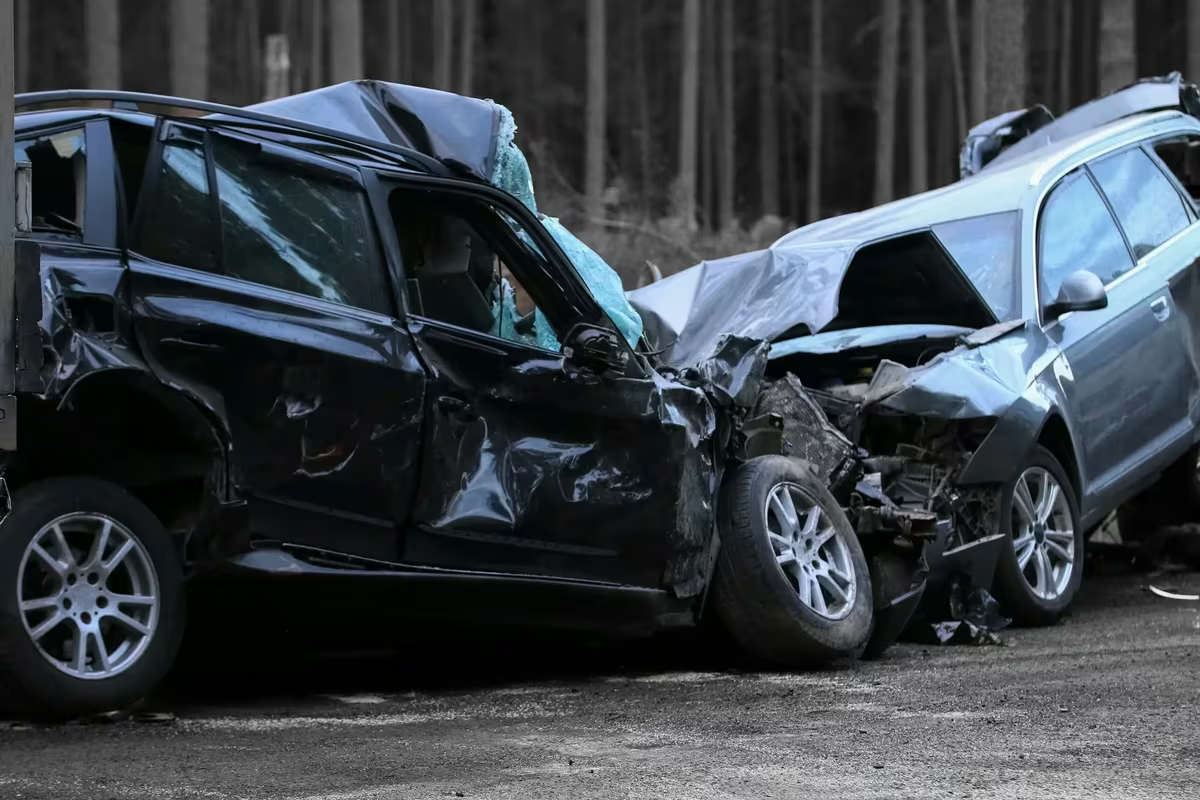 Car AccidentsRear-end, intersection, and highway collisions across Louisiana.
 Truck Accidents18-wheeler and commercial-vehicle wrecks governed by federal trucking rules.
 Catastrophic InjuryBrain, spinal-cord, amputation, and severe-burn injuries that change a life.
 Wrongful DeathClaims brought by families after a fatal accident or act of negligence.
 Premises LiabilitySlip-and-fall and unsafe-property injuries on someone else's premises.
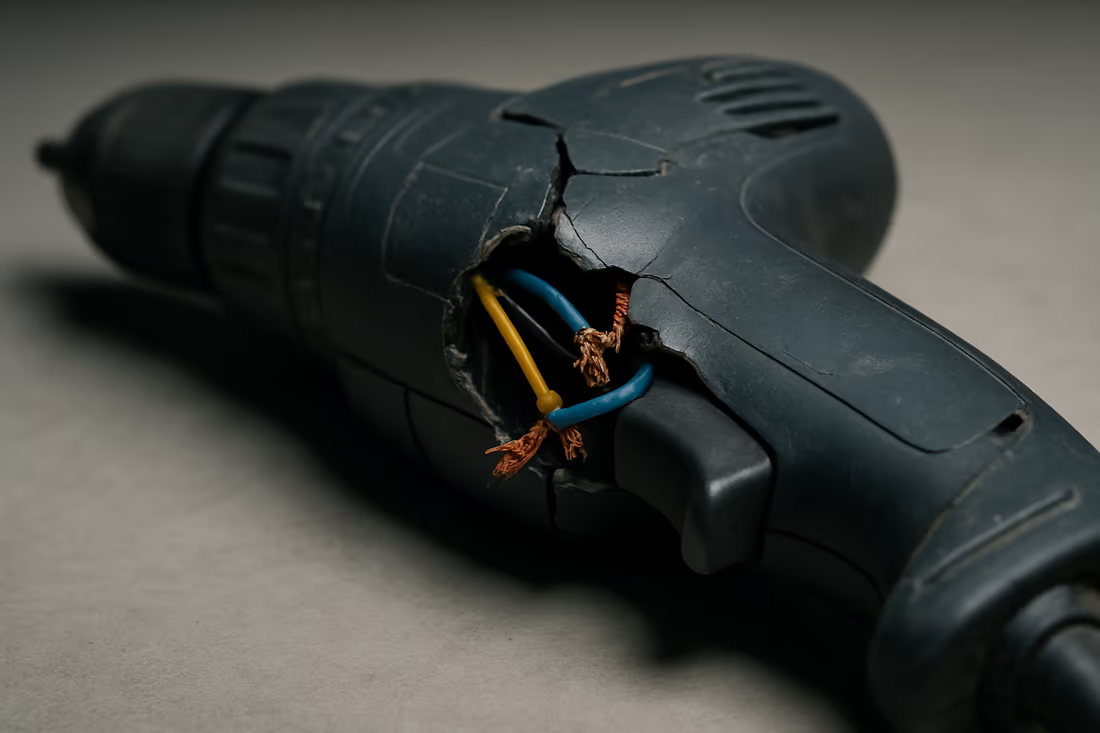 Product LiabilityInjuries caused by defective or unreasonably dangerous products.
 Oilfield AccidentsDrilling, pipeline, and refinery injuries across the energy sector.
 Industrial AccidentsPlant, warehouse, and heavy-equipment injuries in industrial settings.
 Offshore AccidentsRig, platform, and vessel injuries beyond the shoreline.
Do You Need a Franklin Parish Injury Lawyer After an Accident?
Not every accident requires an attorney. Some claims are small, liability is clear, and the insurance company pays without a fight. Other claims involve serious injuries, disputed fault, or an insurer that delays and lowballs. The honest answer is that the decision depends on a few specific factors, and you can usually tell which category your situation falls into within the first week.
Use this section to evaluate your own circumstances. Ask any attorney you interview the same questions. The answers should match what you read here.
When you probably do not need a lawyer
If you walked away from a minor fender-bender, the other driver was clearly at fault, the property damage is modest, and you have no injuries beyond soreness that resolves in a few days, you can often handle the claim yourself. Get a repair estimate, send it to the at-fault driver’s insurer, and accept payment for the car. Keep the release narrow to property damage only so a later-discovered injury is not waived.
Claims that tend to resolve without counsel share three traits. Liability is undisputed. Medical treatment is brief or unnecessary. The insurer pays the documented bills without argument.
When hiring a lawyer usually makes sense
Several conditions shift the math toward representation. Any one of them is enough to justify a free consultation.
- You went to the emergency room, were admitted to a hospital, or needed imaging beyond a basic x-ray.
- A doctor has recommended physical therapy, injections, or surgery.
- You missed work or expect to miss work in the future.
- The other driver disputes fault, or the police report is unclear about who caused the wreck.
- More than one vehicle was involved, or a commercial truck, rideshare driver, or government vehicle was part of the crash.
- The at-fault driver was uninsured or underinsured.
- The insurance adjuster has asked for a recorded statement, a broad medical authorization, or a quick settlement before you finish treating.
- You have pre-existing conditions in the same body part that was injured, which insurers routinely use to reduce offers.
These situations have a common thread. The value of the claim is high enough, or the proof of the claim is contested enough, that the insurer has a financial reason to pay less than the case is worth. An attorney changes that calculation.
Warning signs the insurer is not on your side
Insurance adjusters are professional negotiators paid to close files for as little as possible. A few patterns show up in claim after claim.
The adjuster calls within 48 hours and offers a settlement before you have seen a doctor. The adjuster pressures you to give a recorded statement and asks open-ended questions about pre-existing conditions, hobbies, and prior accidents.
What an attorney actually changes
Hiring counsel does three concrete things. It stops direct insurer contact, so adjusters communicate through the lawyer instead of working on you. It puts a professional on the other side of the negotiation who handles these claims every week and knows what comparable cases settle for. It preserves the option of filing suit before the prescriptive deadline runs, which is two years for injuries after July 1, 2024 under La. C.C. Art. 3493.1 and the shorter earlier deadline under La. C.C. Art. 3492 for injuries on or before that date. That filing right is the only real leverage a claimant has if the insurer refuses to pay fairly.
Ask any attorney you interview how they handle the first 30 days of a case. The answer should include a litigation hold letter to preserve evidence, contact with treating providers to coordinate records, and a written notice of representation to every insurer involved. If the answer is vague, keep interviewing.
How to decide in your own case
Most free consultations take 20 to 30 minutes. There is no obligation and no fee. A useful consultation gives you a candid assessment of three things. Whether your injuries and damages are significant enough to justify representation. Whether the liability picture is strong, mixed, or weak. Whether the deadlines and evidence in your case favor moving quickly or allow time to keep treating before deciding.
If an attorney tells you the case is not worth pursuing, that is useful information. If an attorney explains exactly how they would build the claim and what the realistic range of outcomes looks like, that is the conversation you came for. Either way, you leave the call with a clearer picture than you had before.
What Should You Do Immediately After an Accident in Franklin Parish?
The first hours after a crash or injury shape every claim that follows. Franklin Parish is rural, response times can be longer on parish roads off US 425 and LA 15, and tow trucks can move vehicles before anyone photographs the scene.
Call 911 and Report the Accident
Call 911 from the scene. In Franklin Parish, that routes to the Franklin Parish Sheriff’s Office for parish roads and unincorporated areas, to Winnsboro Police for incidents inside Winnsboro city limits, or to Louisiana State Police Troop F (based in Monroe) for crashes on state highways and US routes. Ask for a written crash report.
Get Medical Attention
Accept EMS evaluation at the scene if it is offered. If you decline transport, go to an emergency department the same day. Franklin Medical Center in Winnsboro is the local hospital; serious trauma cases are often transferred to facilities in Monroe.
Document the Scene
Before vehicles are moved, photograph everything. If the accident happened on a business or private property, photograph the hazard that caused the injury and the surrounding area.
Exchange and Collect Information
Get the full name, address, phone number, driver’s license number, license plate, insurance carrier, and policy number from every other driver. Get names and phone numbers from every witness before they leave.
Avoid Statements About Fault
Do not apologize, do not speculate about who caused the accident, and do not minimize injuries at the scene or to any insurance adjuster who calls in the following days. If an adjuster for the other driver’s insurer requests a recorded statement, decline until you have spoken with a lawyer.
Notify Your Insurer and Preserve Evidence
Report the accident to your own insurance company promptly. Most policies require notice within a defined period, and failing to report can affect uninsured motorist and medical-payment coverage available under your own policy.
Preserve the physical evidence. Do not repair the vehicle until it has been photographed and inspected.
What Compensation Can You Recover After an Injury in Franklin Parish?
Louisiana tort law allows an injured person to ask for two broad kinds of money damages under La. C.C. art. 2315: economic damages, which have receipts and invoices behind them, and non-economic damages, which compensate the human cost of the injury. A Franklin Parish claim is built by documenting each category separately, then proving the connection between the defendant’s conduct and the harm.
Economic damages
Economic damages cover the out-of-pocket and provable financial losses tied to the injury. In lawsuits filed on or after January 1, 2026, past medical expenses are limited to what your health insurer or Medicare actually paid, plus your own deductibles and co-pays (La. R.S. 9:2800.27).
Non-economic damages
Non-economic damages compensate harm that does not show up on a bill. Louisiana courts recognize compensation for physical pain and suffering, mental anguish, disfigurement, scarring, permanent disability, loss of enjoyment of life, and loss of consortium for a spouse or close family member affected by the injury.
Wrongful death and survival damages
When an injury results in death, Louisiana recognizes two distinct claims. The survival action arises under La. C.C. Art. 2315.1. The wrongful death action arises under La. C.C. Art. 2315.2. The filing deadline for both is the longer of one year from the death or two years from the injury.
Punitive (exemplary) damages
Louisiana does not generally allow punitive damages. The Civil Code permits them only where a specific statute authorizes them. The most common example in injury cases is La. C.C. art. 2315.4, which allows exemplary damages against a defendant whose intoxication while operating a motor vehicle caused the injury. Outside those narrow statutory windows, a Louisiana injury claim is limited to compensatory damages.
What is not separately recoverable
Attorney fees are not a separate item of damages in a standard Louisiana tort claim unless a contract or statute provides for them. Court costs can be assessed against the losing party under La. C.C.P. art. 1920. Health insurers, Medicare, Medicaid, and workers’ compensation carriers that paid medical bills may assert subrogation or reimbursement rights against the settlement, which is handled as a lien negotiation rather than a reduction of what is asked for from the defendant.
The categories above describe what Louisiana law allows an injured person to ask for. What a specific Franklin Parish claim is actually worth depends on the evidence, the injuries, the available insurance, and fault allocation, which are addressed in the sections that follow.
How Much Is a Franklin Parish Injury Case Worth?
No honest lawyer can quote a case value during a first phone call. Case value depends on a handful of concrete variables, and until those variables are documented, every number is a range. Here is how those variables actually drive the math.
Medical Treatment and Cost
The single largest input is the medical record. What was diagnosed, what was treated, what the bills total, and what future care a treating physician expects. The diagnosis sets the floor and the projection sets the ceiling.
Lost Income and Earning Capacity
Wages missed during treatment are documented through pay stubs, tax returns, and an employer letter. The harder number is reduced earning capacity, which applies when an injury limits what the person can do for a living going forward.
Pain, Suffering, and Life Disruption
Louisiana juries are allowed to award general damages for physical pain, mental anguish, and loss of enjoyment of life. There is no formula. Value comes from how clearly the impact on daily life is shown: the activities that stopped, the sleep that does not happen, the hobbies that ended, the relationships that strained.
Liability Clarity and Available Coverage
A strong case on damages can still settle low if liability is contested or if the at-fault party carries minimal coverage. Commercial policies, employer policies, and the injured person’s own underinsured motorist coverage often expand what is actually collectible. The collectible number, not the theoretical number, is what a case is worth.
Why Ranges, Not Promises
A careful evaluation looks at all four inputs together, then produces a range with a low end and a high end based on similar cases that have actually resolved. The range narrows as treatment finishes, the medical picture stabilizes, and coverage is confirmed.
Can You Still Recover Compensation If You Were Partly at Fault in Louisiana?
It depends on when the accident happened. For accidents on or after January 1, 2026, Louisiana applies a modified comparative fault system under La. C.C. Art. 2323 as amended by Act 15 of the 2025 Regular Session (HB 431). A plaintiff found 51% or more at fault recovers nothing, and a plaintiff at 50% or less has the award reduced by that share of fault. For accidents before January 1, 2026, the prior rule governs, and an injured person assigned a share of fault could still recover from other at-fault parties with the award reduced by that share rather than eliminated.
How Louisiana’s Comparative Fault Rule Works
A jury or judge assigns a percentage of fault to each party involved in the incident. The total damages are then reduced by the plaintiff’s percentage.
Louisiana is one of the more permissive states on this question. Some states bar any compensation once an injured person crosses a 50% or 51% fault threshold. Louisiana does not. A plaintiff found 60%, 70%, or even 90% at fault is still legally entitled to collect the remaining percentage from other parties who share fault.
How Insurance Adjusters Use Fault Allocation
Fault percentage is one of the first numbers an insurance adjuster tries to push up. Every percentage point of fault assigned to the injured person reduces what the carrier has to pay.
What This Means for a Franklin Parish Claim
A Franklin Parish injury claim is almost never a clean 100/0 fault scenario. Rural highway collisions, agricultural equipment incidents, and premises cases often involve arguments about visibility, speed, awareness, or prior knowledge of a hazard. Expect the other side to argue for some share of fault on the injured person, and expect that argument to start early.
The practical question to ask any attorney handling the claim is how they plan to investigate and contest fault allocation. That includes what evidence gets preserved, how witness statements are taken, whether reconstruction is needed, and how comparative fault arguments are addressed in negotiation and at trial. Those answers shape the final number more than almost any other factor in the case.
How Long Do You Have to File an Injury Claim in Louisiana?
Louisiana injury claims run on a strict clock. The deadline is set by state statute, and once it expires, courts dismiss the case regardless of how strong the underlying facts are. If you were hurt in Franklin Parish, the most important date in your file is the date of the accident, because every other deadline keys off of it.
The deadline to file a lawsuit is called a prescriptive period in Louisiana. The length depends on the injury date. For injuries after July 1, 2024, the period is two years under La. C.C. Art. 3493.1, and for injuries on or before that date the shorter deadline under La. C.C. Art. 3492 still governs. Talking to insurance adjusters, gathering medical records, or waiting on a settlement offer does not pause the clock. Only filing a lawsuit in the proper court stops it.
When does the clock start?
The clock generally starts on the date the injury occurred. For a car wreck on Highway 15 outside Winnsboro, that is the date of the collision. For a slip and fall at a store in Wisner, that is the date of the fall.
Different claims, different deadlines
Not every claim follows the same timeline. Wrongful death claims, claims against governmental entities, contract-based claims, and workers’ compensation claims each have their own filing rules and notice requirements. Claims against a public body, for example, require service to be requested within 90 days after suit is filed, and missing that step can be just as fatal as missing the lawsuit deadline.
Why early filing matters even when the deadline is far off
Evidence disappears. A claim filed close to the deadline is harder to prove than the same claim worked from week one, even if both are technically timely.
A Franklin Parish injury lawyer who takes the file early can send preservation letters, pull 911 audio, request crash reports from local law enforcement, and lock down witnesses while memories are still fresh. The deadline sets the outside boundary. The work inside that window determines the outcome.
What Is the Personal Injury Claim Process Step-by-Step in Franklin Parish?
A Franklin Parish injury claim moves through a predictable sequence: medical treatment, investigation, demand, negotiation, and, if necessary, suit in the Fifth Judicial District Court at the Franklin Parish Courthouse in Winnsboro. Most claims resolve through negotiation before trial, but the file is built from day one as if a jury will see it.
-
Get Medical Care and Document Injuries
The first step is treatment. Prompt care also matters for proof: for injuries on or after May 28, 2025, the fact that you had no similar symptoms before the incident no longer creates a presumption that the incident caused the injury (La. Code Evid. Art. 306.1), so medical or expert testimony is required. Your medical records are the spine of the claim. 2. ### Hire Counsel and Open the File
An attorney sends letters of representation to the at-fault party and every known insurer. Those letters stop direct contact from adjusters and route everything through the lawyer.
-
Investigate and Preserve Evidence
The investigation pulls the crash or incident report, photographs the scene, identifies witnesses, and sends preservation letters for vehicles, video, and electronic data. The point is to lock the facts before they go cold.
-
Complete Medical Treatment or Reach Maximum Medical Improvement
The claim does not get valued accurately until treatment plateaus. That point is called maximum medical improvement, and it is when doctors can say what is permanent and what is not.
-
Send the Demand Package
Once treatment stabilizes, counsel assembles a demand package: liability narrative, medical records, bills, wage-loss documentation, and a settlement figure. The package goes to the at-fault party’s insurer.
-
Negotiate
Negotiation is structured back-and-forth, not a single offer. Many Franklin Parish claims resolve at this stage.
-
File Suit If Negotiation Stalls
If the insurer will not pay fair value, counsel files a petition for damages in the Fifth Judicial District Court, Parish of Franklin, in Winnsboro. Filing must occur before the prescriptive deadline for the claim, which is two years under La. C.C. Art. 3493.1 for injuries after July 1, 2024 and the shorter La. C.C. Art. 3492 deadline for injuries on or before that date. If a government body is a defendant, no pre-suit notice of claim is required, but service of citation must be requested within 90 days of filing under La. R.S. 13:5107(D). Suit puts the case on a court schedule and gives the plaintiff subpoena power and formal discovery tools. 8. ### Discovery
Discovery is the formal exchange of information. Both sides answer written questions (interrogatories), produce documents, and sit for depositions.
-
Mediation or Settlement Conference
Before trial, the court often orders mediation or a settlement conference. A neutral mediator works with both sides to try to close the gap.
-
Trial, Judgment, and Disbursement
If the case does not settle, it goes to trial before a judge or jury at the Franklin Parish Courthouse. After a verdict or final settlement, funds are paid to the firm’s trust account, medical liens and case costs are resolved, the contingency fee is calculated, and the client receives the net proceeds with a written settlement statement.
What Happens If the At-Fault Driver Has No Insurance in Louisiana?
An uninsured or underinsured at-fault driver does not automatically end a Louisiana injury claim. The path to compensation shifts from the other driver’s liability policy to your own uninsured/underinsured motorist (UM/UIM) coverage, to other potentially responsible parties, and in some scenarios to the at-fault driver’s personal assets. The questions below walk through how those options work when the person who caused the wreck cannot pay.
How Does Uninsured/Underinsured Motorist Coverage Work?
UM/UIM coverage sits on your own auto policy and is designed to step in when the at-fault driver has no insurance or not enough insurance to cover your losses. A UM/UIM claim is filed against your own insurer, but it is still an adversarial claim.
Can You Pursue Other Parties If the Driver Has No Insurance?
The at-fault driver is often not the only party with potential responsibility. A careful investigation looks beyond the person behind the wheel to identify any other party whose conduct contributed to the wreck and who may carry insurance or have assets. Possibilities to investigate include:
- An employer, if the driver was working at the time of the crash.
- The owner of the vehicle, if different from the driver.
- A commercial entity that loaned, rented, or entrusted the vehicle.
- A third party whose separate negligence contributed to the collision.
Whether any of these apply turns on documented evidence: a log showing the driver was on a delivery run, a title showing a different registered owner, a rental contract, a phone record placing a third party in the chain of events. These are investigative leads, not legal conclusions, and the evidence has to support the claim before it can be pursued.
What If You Did Not Carry UM Coverage?
Louisiana drivers are given the option to reject or reduce UM coverage in writing. If you signed a valid UM rejection, that coverage is not available on your policy, even if the at-fault driver is uninsured. In that situation, the remaining options are claims against other responsible parties, if any exist, and a direct claim against the at-fault driver personally.
Why a Lawyer’s Investigation Matters When the Other Driver Has No Insurance
When the obvious source of compensation, the at-fault driver’s liability policy, is missing, the case turns on details that are easy to overlook. Was the driver on the job? Who owns the vehicle? Is there a UM policy on your car, a household member’s car, or a resident relative’s car that can be accessed? Did the responding agency document the uninsured status correctly? These are the questions that decide whether an injured person walks away with nothing or with a meaningful claim against a real source of funds. That investigation is the work, and it is the reason this is the kind of case where having counsel involved early matters most.
How Much Does a Franklin Parish Injury Lawyer Cost? Contingency Fees Explained
Most Franklin Parish injury lawyers, including Trey Morris Injury Lawyers, take cases on a contingency fee. You pay nothing upfront. The lawyer’s fee is a percentage of the compensation collected at the end of the case. If there is no compensation, there is no fee.
That structure exists because injury clients usually cannot afford to hire counsel by the hour after a serious accident. The fee agreement aligns the lawyer’s interest with yours. A bigger result for you means a bigger fee for the firm. A zero result means the firm absorbed the work and the costs.
What a Contingency Fee Actually Covers
A contingency fee covers the lawyer’s time and legal work. The percentage is set in a written contract you sign before representation begins. The contract states the percentage, the events that change the percentage (if any), and what happens to case costs.
Ask any attorney you interview to walk you through the fee agreement line by line before you sign. Ask what the percentage is, whether it changes if the case goes into litigation or trial, and whether the percentage is calculated before or after case costs are deducted. Those three answers tell you what you will actually take home.
Case Costs Are Separate From the Fee
A personal injury case has out-of-pocket costs that are not the lawyer’s fee. Common costs include medical record charges, accident reconstruction, expert witness fees, court filing fees, deposition transcripts, and mediation fees. On a serious case these costs can run into the thousands.
Most contingency firms, including ours, advance these costs during the case. They are then reimbursed from the settlement or judgment at the end. Ask the firm in writing: Do you advance costs? Are costs deducted before or after the fee is calculated? What happens to costs if the case loses? The answer to the last question matters most. At Trey Morris Injury Lawyers, if there is no compensation, you owe no fee and no costs.
What You Take Home After Fees, Costs, and Liens
The gross settlement number is not the number that hits your account. From the gross, the firm deducts the contingency fee, the case costs, and any liens (health insurance subrogation, Medicare or Medicaid, hospital liens, workers’ compensation liens). What is left is the net to you.
A competent injury lawyer negotiates those liens down before disbursement. That work is part of the representation and should not be a separate charge. Before you sign with any firm, ask to see a sample disbursement sheet so you understand how the math works on a real case. A firm that cannot or will not show you one is telling you something.
Free Consultation, No Obligation
The initial consultation with a Franklin Parish injury lawyer should be free. That is the standard across the local market. Use the consultation to ask about the fee structure, costs, lien handling, and who at the firm will actually work on your file. If a firm charges for the first meeting on an injury case, that is unusual and worth a direct question about why.
You are hiring a professional for one of the more consequential decisions you will make this year. Read the contract. Ask the questions above. Compare answers across two or three firms. The right firm will welcome the comparison.
Why Should You Hire a Local Franklin Parish Injury Lawyer?
A local injury lawyer brings working knowledge of the courthouse in Winnsboro, the judges who hear civil dockets, the adjusters who cover claims in northeast Louisiana, and the roads where these collisions actually happen. That ground-level familiarity changes how a case is investigated, filed, and presented. Ask any attorney how often they appear in Franklin Parish and who they’ve worked across the table from. The answer tells you whether they know the venue or are reading it off a map.
Familiarity with the Fifth Judicial District Court
Franklin Parish civil cases are filed in the Fifth Judicial District Court, which also covers Richland and West Carroll Parishes. Local scheduling practices, motion-day customs, and how a particular division handles discovery disputes are not in a treatise. A lawyer who has filed petitions and argued motions in that courthouse already knows the clerk’s office procedures, the local rules for setting trial, and how the bench tends to handle continuances. That saves time the first time a deadline gets contested.
Knowledge of Local Roads, Employers, and Crash Patterns
Claims in Franklin Parish often involve specific stretches of US 425, LA 15, and the rural two-lane routes between Winnsboro, Wisner, and Gilbert. Agricultural traffic, log trucks, and oilfield-related vehicles share these roads with passenger cars. A local lawyer can identify the likely sight-line problems at a specific intersection, pull the right Louisiana State Police Troop F crash report, and recognize when a commercial vehicle’s route ties back to a regional employer. That context shapes how liability gets investigated rather than guessed at.
Relationships With Local Medical Providers and Investigators
Medical documentation drives injury claims. A lawyer who works in the region knows which clinics and hospitals serve Franklin Parish residents, how to request records from Franklin Medical Center, and which orthopedic and neurology specialists in Monroe and Alexandria local clients are typically referred to. The same applies to accident reconstructionists, treating physicians willing to provide narrative reports, and process servers who can locate defendants in rural addresses. Ask a prospective attorney how they handle records collection and expert retention in northeast Louisiana. A clear answer beats a vague one.
Accessibility When the Case Is Active
An injury case generates questions. Medical bills arrive. An adjuster calls. A recorded statement gets requested. A local or regional firm can meet in person when a meeting is warranted, take a phone call without a three-day delay, and respond to a document request the same week. Distance alone does not disqualify an out-of-state firm, but accessibility is a fair question to ask. How quickly do calls get returned? Who handles the file day to day? Will the lawyer named on the contract appear at the deposition? These are questions to put to every firm under consideration, including ours.
What Our Clients Say
- Dakota R.
Where should I start!?Trey Morris Injury Law Firm was a great fit for me! During this wild time of getting into a car wreck, dealing with insurance, and other third parties, Mrs. Brooke and Mrs. Nerren were extremely helpful! They were there for me through the whole process and never once did I doubt their professionalism. They will fight tooth and nail for you and get you what you deserve. I would recommend them to anyone.
- Janet C.
Best personal injury lawyers ever!!!They did everything they said they would do, and never left me wondering what was going on with my case!
- Michael C.
Lane Robinson and his team were great.When he took the accident case for my wife he was very concerned, friendly, and professional. He never gave up but pushed until she was fully compensated for her injuries. We couldn’t be anymore grateful with the outstanding outcome. Thanks Lane
- Ahmillyah T.
I would like to thank Attorney Coleman Nerren for handling my case.I can honestly say he is the best Attorney I’ve ever had. He is caring and straightforward. I spoke with him on and off with throughout my case and received nothing but the highest respect. They will go above and beyond to satisfy their clients. 10/10 will definitely use again and will highly definitely recommend.
- Denise
Handling my case with care and made a stressful situation much easier.Communication was always clear and timely, and I felt like they genuinely had my best interest in mind. I would recommend them to anyone needing legal help.
- Patty P.
Thanks to Kaden for answering all my questions.He was knowledgeable and very polite. Joe and Jamie were also very helpful.
- Meredith F.
Jaime and the Ruston team were fantastic.They were super knowledgeable and answered all my questions!
- Naasia C.
Jaime is very professional!She is very awesome answer all of questions accurately & professionally. I would recommend this place.
- Willie W.
I would like to share this review to the consumer protection group that took my case thank you very much for helping on my case I knew something could be done about the situation but I did not know how to go about it I really appreciate the service that you rendered to me and I will be glad to recommend you guys to anyone and everyone who needs help again thank you very much and you have a great great day.Sincerely Willie [W.] Jr
- Gracyn J.
I was pretty nervous about everything at first, but Attorney Shavers and my case manager Leanna made the whole process a breeze.They were patient, kept me updated, and explained things in a way that made sense. Really glad I chose them!
- Karessa L.
⭐️⭐️⭐️⭐️⭐️ From start to finish, [Trey Morris Injury Lawyers] exceeded all expectations.Everyone from the front desk to the legal team was professional, kind, and truly helpful. They made a stressful situation so much easier to manage and always kept me informed throughout the process. I felt supported every step of the way. Highly recommend this firm to anyone needing injury law representation
- Maram Z.
I just want to express how pleased I am with [Trey Morris Injury Lawyers].Their caring team made a huge difference in my experience. From the moment I reached out, they were attentive and supportive, guiding me through every step of the process. They truly took the time to listen to my concerns and made me feel valued as a client. I highly recommend their services to anyone in need of a compassionate and dedicated legal team!
Testimonials do not constitute a guarantee, warranty, or prediction regarding the outcome of your legal matter. Past results do not guarantee future outcomes.
Your Franklin Parish Trial Team
The lawyers who work your file. Every Franklin Parish case is handled by the firm's own trial attorneys.







How Long Does a Franklin Parish Injury Case Take to Resolve?
There is no fixed timeline. A straightforward soft-tissue claim with clear liability and cooperative adjusters can wrap up in a few months. A disputed claim with serious injuries, multiple defendants, or contested fault can run a year or longer, and litigation pushes that further. The honest answer is that the case is ready to resolve when the medical picture is clear and the value can be defended with documents, not before.
Three variables drive the clock more than anything else. Ask any attorney how each one applies to your situation.
Reaching Maximum Medical Improvement
Settling before the treating physician documents maximum medical improvement is how claims get undervalued. Until the doctor can say what permanent impairment looks like and what future care will cost, the damages number is a guess. A back strain that resolves in eight weeks reaches that point quickly. A surgical case, a traumatic brain injury, or an injury that may require future procedures takes much longer to document with the precision a serious demand requires.
The trade-off is real. Waiting protects the value of the claim. Waiting also means bills accumulate while the file sits open. A competent attorney will explain why the wait matters in your specific situation rather than push for a fast settlement that closes the door on later treatment.
Investigation, Liability, and the Insurance Posture
Liability disputes extend the timeline. When the adjuster contests fault, denies the mechanism of injury, or argues a pre-existing condition explains the symptoms, the case shifts from negotiation to evidence-building. That means scene investigation, records collection, witness statements, photographs, and in many cases retained experts on accident reconstruction or medicine.
The insurer’s posture matters. Some carriers evaluate a documented demand and respond in weeks. Others delay, lowball, or refuse to engage until suit is filed. Ask a prospective attorney how often they file suit in Franklin Parish injury cases rather than settle pre-litigation. The answer signals whether the firm is set up to push when pushing is required, or whether it works only the cases that settle on the first round.
Filing Suit and Court Scheduling
Once a petition is filed, the Fifth Judicial District Court sets the schedule. Discovery, depositions, motion practice, mediation, and trial date selection all add time. A filed case that proceeds through discovery and reaches mediation commonly takes a year or more from petition to resolution. A case that goes to trial takes longer. Rural-parish docket pacing and the availability of expert witnesses both affect that timeline.
Filing suit does not mean trial. Most filed cases still settle, often after depositions when the insurer can see how the case will present to a jury. The point of filing is to move the case forward when negotiation has stalled, not to guarantee a courtroom.
What a Realistic Timeline Conversation Sounds Like
An attorney who promises a quick settlement before reviewing your medical records is selling, not advising. An attorney who refuses to give any range is not engaging with the question. The useful answer sounds like this: based on the injuries documented so far, the carrier involved, and the liability picture, here is what comparable cases have taken, and here is what would shorten or lengthen yours. Ask for that conversation. The answer reveals whether the attorney has actually worked cases like yours through to resolution.