










Bastrop, Louisiana Injury Lawyers: Who Can Help After an Accident?
There are qualified attorneys across Morehouse Parish who serve the people of Bastrop. You are doing research, which means something happened, and it was serious enough to make you look for a lawyer. No one reads lawyer websites until they need one.
Results for Louisiana Clients
- $409 MillionWrongful Death
A tragic case where an impaired driver of a commercial vehicle ran a red light, then collided with our client, causing serious bodily injury to the mother and the loss of life of her daughter.
- $49 MillionMotor Vehicle Accident
An impaired driver of a stolen vehicle driving the wrong way collided with our client head-on, resulting in brain injury and multiple broken bones.
- $32,195,000Industrial / Workplace
Failure to maintain proper safety protocols led to an explosion at an industrial plant causing a series of catastrophic injuries from broken bones, burns, spinal injury, and mental anguish.
- $31.5 MillionIndustrial / Workplace
Brain and spinal injuries followed an oil-field company failing to maintain equipment and provide a safe work site.
- $17.25 MillionCommercial Vehicle Accident
Client was struck head-on by a disconnected load of an 18-wheeler that crossed the median causing broken bones and amputation.
- $13 MillionCommercial Vehicle Accident
On the interstate, an 18-wheeler failed to yield right of way then made an unsafe lane change causing the accident which resulted in major bone breaks, damaged organs, and ultimately a leg amputation.
Past results do not guarantee future outcomes; each case is decided on its own facts.
What follows is a plain account of what an injury lawyer actually does, where this firm works, and when reaching out makes sense. Read it. Compare what you find here to other firms. Decide what fits your situation.
A personal injury claim in Louisiana runs on a defined set of rules: who owed a duty, who breached it, and what the law allows you to claim. Later sections walk through deadlines, fault, and damages in detail. This section starts with the basics of who can help and how.
What a Personal Injury Lawyer Does for an Injured Client
A personal injury lawyer represents people hurt by someone else’s conduct, both individuals and businesses harmed in Northeast Louisiana. The work starts before any lawsuit. The lawyer investigates how the injury happened, identifies who is responsible, gathers evidence while it still exists, and deals with the insurance adjusters so the injured person does not have to.
Most of a case happens outside a courtroom. The lawyer values the claim, assembles medical records and proof of lost income, builds a demand to the insurer, and negotiates. If the insurer refuses a fair number, the lawyer files suit and tries the case. Ask any attorney you interview how many of their injury cases have actually gone to trial. The answer tells you whether they prepare every file as if it might.
The lawyer also handles the procedural traps that sink unrepresented claims: the filing deadline, the comparative fault arguments insurers raise, and the special rules for claims against merchants, healthcare providers, or government bodies. Those rules are covered in their own sections below.
Service Area: Bastrop, Morehouse Parish, and Northeast Louisiana
Trey Morris Injury Lawyers represents injured people throughout Northeast Louisiana, including Bastrop and the surrounding Morehouse Parish communities. The firm handles claims for individuals and for businesses harmed by another party’s negligence.
Bastrop sits at the junction of several busy routes, and injuries here range from collisions on the highways through town to falls, workplace incidents, and animal attacks. Cases that arise in Morehouse Parish are tied to the local court system and to records held by local agencies, which a later section addresses directly. The point for now is simple: a Bastrop case is rooted in Bastrop, and the representation should understand that ground.
The firm operates offices across Louisiana, with its headquarters in Shreveport. That reach across Louisiana and Texas courts means a Bastrop claim is handled by a firm that tries cases statewide, not only in one parish.
When to Call a Bastrop Injury Lawyer
The best time to talk to a lawyer is early, while evidence is fresh and the deadline is far off. Surveillance footage gets overwritten, witnesses move, and skid marks fade. Calling before you give a statement to the other side’s insurer protects you from saying something that gets used to cut your claim.
You do not need a complicated case to make the call worthwhile. If you were hurt and someone else may have caused it, an early conversation tells you whether you have a claim and what it is worth. Most injury lawyers, including this firm, review the case at no charge and take injury cases on contingency, so the consultation costs nothing and carries no obligation.
If the injury was severe, if a death occurred, if a government entity or healthcare provider is involved, or if the insurer is already pushing you to settle, those are reasons to talk to a lawyer sooner rather than later. The deadlines and the proof requirements are unforgiving, and the sections that follow explain why.
Local Coverage. Statewide Record.
- $1 Billion+
Outcomes for Louisiana clients
Verdicts and settlements won across the state by the same trial team that handles Bastrop cases.
- 11
Trial attorneys, one team
Your case is handled by the firm's own trial attorneys, and we respond in minutes, 24/7.
- 24/7
We come to you
An attorney travels to you in Bastrop, at home or at the hospital, or meets by video the same day. Free case review, and no fee unless we win.
- 127
Cases resolved over $1 million
Verdicts and settlements of $1 million or more, won by the same trial team that handles Bastrop cases.
What Types of Injury Cases Do Bastrop, Louisiana Injury Lawyers Handle?
Personal injury lawyers in Bastrop handle the range of cases that arise when one person’s carelessness injures another. That covers roadway collisions, falls on someone else’s property, workplace injuries, animal attacks, and the fatal cases that leave a family to pursue a claim on behalf of someone who died. The categories below are the ones that come up most often in Morehouse Parish, both for individuals and for the businesses operating across northeast Louisiana. Each carries its own proof problems and its own set of defendants, which is why the type of case shapes how it gets built from day one.
Car and Truck Accidents on US-165, US-425, and LA-2
Vehicle collisions are the most common injury cases in the Bastrop area, and the local road network drives much of that traffic. US-165 runs north and south through Morehouse Parish toward Monroe, US-425 carries through-traffic, and LA-2 moves east and west across the region. Commercial trucks share these routes with passenger cars, and a wreck involving an 18-wheeler is a different case than a two-car collision. Truck cases can involve the driver, the motor carrier, a maintenance contractor, and federal motor-carrier safety rules enforced through the FMCSA. More potential defendants means more insurance coverage in play, and it also means more parties pointing fingers at each other. Ask any attorney how they handle a crash with a commercial carrier. The answer tells you whether they have worked these cases or only car-on-car claims.
Motorcycle, Pedestrian, and Bicycle Accidents
Motorcyclists, pedestrians, and cyclists have almost no protection in a collision, so their injuries tend to be severe even at lower speeds. These cases share a recurring problem: the insurer often argues the rider or walker was the careless one. A driver who never saw a motorcycle will still claim the rider was speeding or lane-splitting, and a pedestrian struck in a crosswalk gets accused of darting out. Building these claims means recovering scene evidence early, before it disappears. Skid marks fade, vehicles get repaired, and surveillance footage gets overwritten on a short cycle. The negligence framework is the same one that governs car wrecks, but the factual fight over who did what is sharper.
Slip and Fall and Premises Liability Cases
A fall on someone else’s property is a premises liability case, and how it gets proved depends on where the fall happened. A fall inside a store, restaurant, or other merchant’s premises runs through a different proof standard than a fall on a private residence or other non-retail property. The two paths turn on the kind of property owner involved, and this page covers the merchant notice standard and the custody articles in the sections on Louisiana injury laws and how lawyers prove liability. Either way, the surveillance video, incident report, and cleaning logs often matter more than the fall itself, because they fix what the condition was and how long it had been there.
Workplace Injuries and Workers’ Compensation Claims
Northeast Louisiana has industrial, manufacturing, and agricultural employers, and workers get hurt on the job. A workplace injury usually starts as a workers’ compensation claim, which pays medical care and a portion of lost wages regardless of fault but does not pay for pain and suffering. Many injured workers stop there because they assume comp is the only option. It often is not. When a party other than the employer caused the injury, a defective machine, a negligent subcontractor, or a third-party driver, a separate negligence claim can run alongside the comp claim and reach damages that comp does not cover. Ask an attorney whether they look for a third-party claim in every workplace injury. Many do not, and the worker leaves real damages on the table.
Dog Bites, Wrongful Death, and Catastrophic Injuries
Louisiana treats dog bites under a strict-liability rule set by a single Civil Code article. The citation to read is La. C.C. art. 2321, published in full by the Louisiana Legislature, which makes an animal’s owner answerable for the damage the animal causes when the owner could have prevented it and failed to do so. The rule rests on that article alone, and reading it takes a minute. The injured person does not have to prove the dog had bitten anyone before. Catastrophic injuries, the spinal cord damage, brain injuries, amputations, and severe burns, sit at the other end of the spectrum, because they involve lifelong medical needs and lost earning capacity that have to be valued for a lifetime, not just to the date of trial. When an injury is fatal, the case becomes a wrongful death and survival matter brought by surviving family members. Those cases carry their own elements and their own deadlines, covered in a separate section of this page.
Bastrop Practice Areas
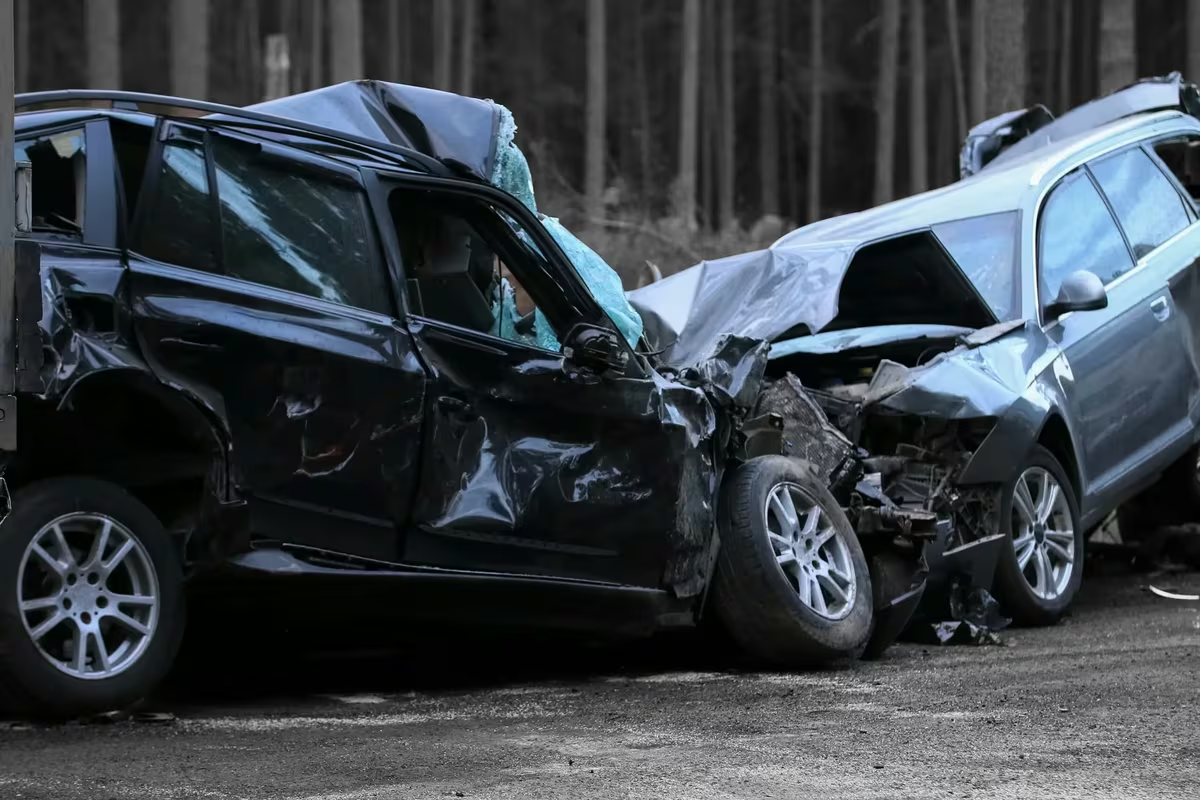 Car AccidentsRear-end, intersection, and highway collisions across Louisiana.
 Truck Accidents18-wheeler and commercial-vehicle wrecks governed by federal trucking rules.
 Catastrophic InjuryBrain, spinal-cord, amputation, and severe-burn injuries that change a life.
 Wrongful DeathClaims brought by families after a fatal accident or act of negligence.
 Premises LiabilitySlip-and-fall and unsafe-property injuries on someone else's premises.
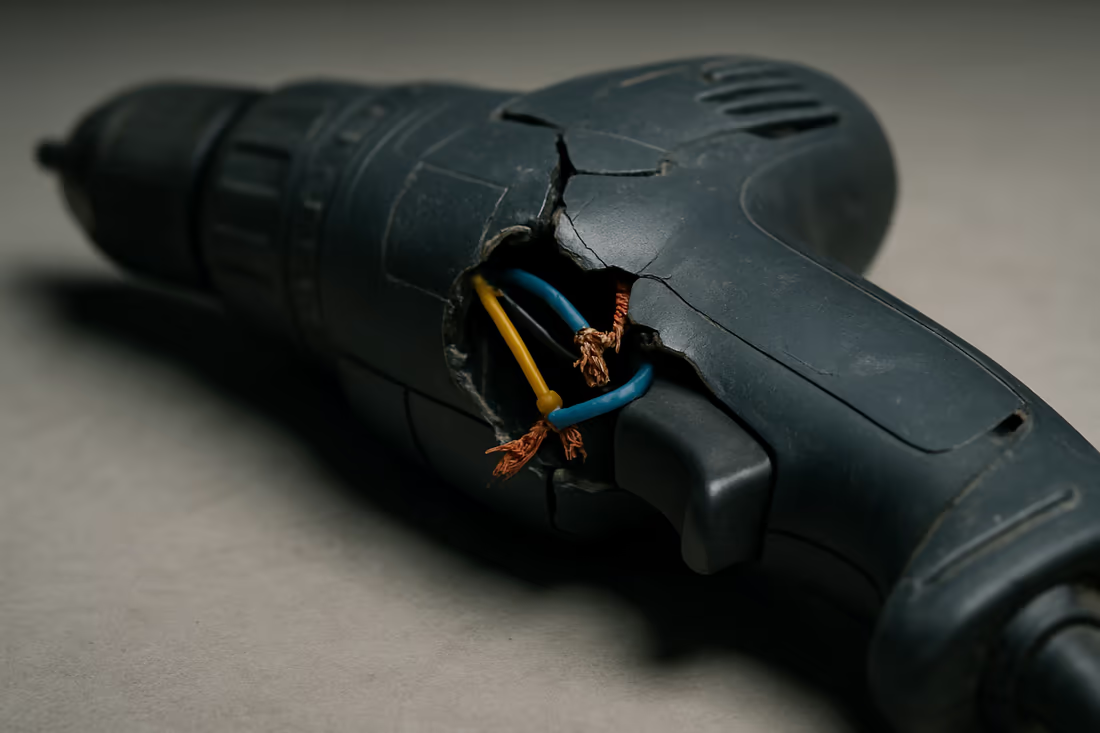 Product LiabilityInjuries caused by defective or unreasonably dangerous products.
 Oilfield AccidentsDrilling, pipeline, and refinery injuries across the energy sector.
 Industrial AccidentsPlant, warehouse, and heavy-equipment injuries in industrial settings.
 Offshore AccidentsRig, platform, and vessel injuries beyond the shoreline.
Do You Have a Valid Personal Injury Claim in Bastrop, Louisiana?
A valid Louisiana personal injury claim turns on four pieces: duty, breach, causation, and damages. If any one of them is missing, the claim fails no matter how badly someone was hurt.
Duty, Breach, Causation, and Damages
Duty is the legal obligation one person owes another. Breach is the failure to meet that duty. Causation links the breach to the harm. Damages are the actual harm: medical bills, lost income, physical pain, and the lasting effects of the injury.
When the Insurance Company Blames You
A shift of blame does not end a Louisiana claim. The state apportions fault by percentage rather than barring a claim outright the moment the injured person shares some responsibility.
Evidence That Establishes a Claim
Each piece has to be proven, and proof comes from evidence gathered close to the event. Duty and breach are usually shown through the crash report, scene photographs, the physical layout of an intersection, or a property condition that a witness saw. Causation is built on medical records that connect the diagnosis to the date and mechanism of the injury. Damages are documented through bills, wage records, and the treating physician’s account of what the injury will require going forward.
The strongest claims are the ones where the evidence was preserved early, before vehicles were repaired, surfaces were cleaned, and memories faded. A gap in any element is where a defense is built, so the value of a claim often comes down to whether someone secured proof while it still existed.
If your Bastrop accident involves a clear duty, a breach you can point to, a documented link between that breach and your injury, and real losses, you likely have a claim worth evaluating. Whether it is worth pursuing depends on the strength of each element, and that is a question a Louisiana personal injury attorney can answer once the facts and records are in front of them.
What Should You Do Immediately After an Injury in Bastrop?
The hours and days right after an accident shape what a claim looks like later. Medical records, the police report, photographs, and witness contact information are the proof that an insurer reads before it decides anything. The steps below are the ones that protect both your health and the evidence, and most of them happen before you ever talk to a lawyer.
Seek Medical Care and Document Your Injuries
Get medical attention first, even if you feel like you can wait. Bastrop and Morehouse Parish have emergency and urgent-care options, and a same-day or next-day visit creates the first written record tying the injury to the accident. Adrenaline masks pain, and conditions like concussions, soft-tissue damage, and internal injuries often surface a day or two later. A gap between the accident and the first medical visit is the single most common argument an insurer uses to claim you were not really hurt. Follow the treatment plan, keep every appointment, and save discharge papers, prescriptions, and bills.
Report the Accident to Police, Property Owners, or Employers
Report the incident to the right authority for where it happened. For a crash, call law enforcement so an officer documents the scene and generates a report. For a fall in a store or on someone’s property, notify the manager or owner and ask that an incident report be created, then request a copy. For an on-the-job injury, tell your supervisor or employer in writing as soon as you can. A contemporaneous report removes any later dispute about whether, when, and where the incident occurred.
Preserve Photos, Witnesses, and Scene Evidence
Evidence at the scene disappears fast. Vehicles get repaired, spills get mopped, and conditions change. If you are able, photograph the vehicles, the roadway, any hazard that caused a fall, your visible injuries, and the surrounding area from several angles. Get the names and phone numbers of anyone who saw what happened. Write down what you remember while it is fresh: time, weather, road conditions, and what each party said. These details are easy to capture in the moment and nearly impossible to reconstruct months later.
Do Not Give a Recorded Statement Before Legal Advice
An insurance adjuster will often call within days and ask for a recorded statement. You are not required to give one to the other party’s insurer, and doing so before you understand your own injuries can hurt you.
Contact a Bastrop Injury Lawyer Before Deadlines Run
Speaking with a lawyer early protects evidence that is still recoverable, such as surveillance footage or vehicle data that gets overwritten or destroyed on a schedule. Louisiana sets firm filing deadlines, and claims involving government entities carry extra procedural requirements, including a 90-day deadline to request service after filing suit. When you interview a lawyer, ask how they investigate cases like yours, who handles your file day to day, and how they communicate. The answers tell you whether a firm actually works these claims or simply intakes them. A consultation also tells you where your specific deadline falls before any window closes.
What Is Louisiana’s Deadline to File a Personal Injury Lawsuit?
Most Louisiana personal injury lawsuits must be filed within two years of the injury. That deadline comes from La. C.C. art. 3493.1, which the Legislature enacted by 2024 La. Acts No. 423 with an effective date of July 1, 2024.
The Prescriptive Period Under Louisiana Civil Code
Louisiana calls its filing deadline prescription, not a statute of limitations, but the practical result is the same.
The two-year period applies to causes of action arising after July 1, 2024. For injuries on or before that date, the older one-year prescriptive period governed, and that shorter window still controls those earlier claims.
Wrongful Death and Survival Action Deadlines
A fatal accident produces two distinct claims, and two separate Civil Code articles govern them. The survival action under La. C.C. art. 2315.1 carries the claim the deceased person could have brought for their own injuries before death. The wrongful death action under La. C.C. art. 2315.2 belongs to surviving family members for their own losses.
The two claims run from different events. A survival action under La. C.C. art. 2315.1 runs from the date of the underlying injury. A wrongful death claim under La. C.C. art. 2315.2 runs from the date of death, which can fall later than the injury when someone survives for a time before passing. Confusing the two articles can cost a family the right to file, so the date of death and the date of injury both belong on the calendar.
Exceptions That Can Extend or Toll the Deadline
The prescriptive period does not always run in a straight line. La. C.C. art. 3493.1 itself states that prescription does not run against minors or interdicts in actions involving permanent disability brought under the Louisiana Products Liability Act or the state product liability law in effect at the time of the injury. That is a narrow carve-out written into the same article that sets the two-year rule, not a general extension for every minor’s claim.
Other doctrines can suspend or interrupt prescription in specific circumstances, and they are fact-driven rather than automatic. Whether an ongoing concealment, a claimant’s incapacity, or another suspension ground applies to a particular case is something an attorney evaluates against the record. The safe assumption is that the two-year clock under La. C.C. art. 3493.1 runs from the injury, and any exception must be proven.
Why Morehouse Parish Claimants Often Miss the Window
Injured people in Bastrop and across Morehouse Parish lose claims for ordinary reasons, not exotic ones. Medical treatment stretches out, an insurer keeps talking, and the two-year mark under La. C.C. art. 3493.1 arrives before suit is filed. An adjuster’s friendly tone does not pause prescription. Only filing in the proper court, or a recognized legal interruption, stops the clock.
Fix the injury date, count forward two years, and have a lawyer confirm the controlling deadline well before it arrives rather than weeks before it expires. For a fatal accident, do the same count twice, once from the date of injury for the survival action under La. C.C. art. 2315.1 and once from the date of death for the wrongful death action under La. C.C. art. 2315.2.
How Does Louisiana’s Comparative Fault Rule Affect Your Claim?
Comparative Fault Under Louisiana Civil Code Art. 2323
Louisiana allocates fault under La. C.C. art. 2323. The rule carries a threshold tied to when your claim arose. For causes of action arising on or after January 1, 2026, a claimant found 51 percent or more at fault takes nothing. At 50 percent fault or less, the claimant still collects damages, but the award is reduced by the assigned fault percentage.
The date your injury occurred controls which version of the rule applies, so the analysis on an older crash can differ from one that happened after the threshold took effect.
What Louisiana Injury Laws Affect a Bastrop Personal Injury Claim?
A Bastrop injury claim runs on Louisiana law, and several statutes can change what a claim is worth or whether it survives at all. Some of these rules cut against an injured person. Some add procedural steps that have nothing to do with the merits. Knowing them before you talk to anyone, including an adjuster, keeps a workable claim from quietly collapsing. The rules below come up most often in Morehouse Parish car wrecks, medical cases, and claims that involve a public agency.
Louisiana No Pay, No Play Law for Uninsured Drivers
Louisiana’s No Pay, No Play law bars an uninsured driver from collecting the first $100,000 in bodily injury damages and the first $100,000 in property damage from the at-fault driver’s insurer regardless of fault, a penalty codified at La. R.S. 32:866, listed among the state’s insurance-reform measures by the Louisiana governor’s office, and tied to drivers who fail the compulsory-coverage command at La. R.S. 32:861.
Minimum Auto Insurance Requirements in Louisiana
Louisiana drivers must maintain liability insurance under La. R.S. 32:861, and drivers who do maintain it avoid the No Pay, No Play penalty in La. R.S. 32:866 after a crash, because that statute targets uninsured operators. Coverage also matters because the at-fault driver’s policy is often the first source compensation comes from, and underinsured or uninsured motorist coverage on your own policy fills the gap when the other driver carried too little.
In rural Northeast Louisiana, low-limit policies and uninsured drivers are common.
Medical Malpractice Deadlines and Review Panel Requirements
Medical claims do not follow the ordinary injury path. A malpractice claim against a qualified healthcare provider must first clear a pre-suit medical review panel under La. R.S. 40:1231.8 and runs on a separate deadline under La. R.S. 9:5628.
Under La. R.S. 9:5628, a malpractice claim must be brought within one year from the act or from the date it was discovered, and never more than three years from the malpractice itself, regardless of when it was found.
Claims Against Government Entities in Louisiana
When the responsible party is the state or a political subdivision, such as a parish, a municipality, or a public agency, the claim follows special procedural rules under La. R.S. 13:5101 et seq., including the 90-day service requirement at La. R.S. 13:5107(D) and the general-damages cap at La. R.S. 13:5106. These rules lengthen and complicate the timeline, and missing a step of this kind can derail a claim that would have succeeded against a private defendant.
This comes up in Bastrop more than people expect. A wreck involving a government vehicle, a fall on public property, or an injury tied to a public road or facility can pull a claim into the governmental-liability track set by La. R.S. 13:5101 et seq. The procedural traps are why these claims are screened carefully and early. Ask any attorney how they handle service and notice on a public-entity defendant. The answer shows whether they have actually litigated against a government party.
Wrongful Death and Survival Action Rules
When an injury results in death, Louisiana law splits the claim into two distinct actions. A survival action carries the claim the deceased person would have had for the harm they suffered before death, and a wrongful death action belongs to the surviving family members for their own losses. These are separate causes of action with separate damages, and both are governed by their own Civil Code provisions and deadlines covered elsewhere on this page.
The point worth holding onto here is that a fatal accident does not extinguish the legal claim. It changes who brings it and what damages are available. The interaction between these two actions, and the specific deadline that controls a death case, deserves its own careful review with counsel rather than a guess.
How Much Is a Bastrop Personal Injury Case Worth?
Case value is the sum of your provable losses, adjusted by the strength of the liability evidence and reduced by any fault assigned to you.
Economic Damages: Medical Bills, Future Care, Lost Wages
Economic damages are the losses with a receipt or an invoice behind them. They include emergency treatment, hospital stays, imaging, surgery, physical therapy, medication, and the mileage to and from every appointment. They also include income lost while you could not work, and the value of work you can no longer perform if the injury is permanent.
Future care is the category insurers most want to shortchange.
Non-Economic Damages: Pain, Suffering, Loss of Consortium
Non-economic general damages cover losses that have no printed invoice: physical pain, mental anguish, disfigurement, scarring, and the loss of the ability to enjoy normal activities.
Loss of consortium is a separate non-economic claim that belongs to the injured person’s close family for the companionship, support, or services they lost: the spouse and children first, then the parents if there is no spouse or child, then the brothers and sisters, then the grandparents.
Punitive Damages: When They Apply Under Louisiana Law
Louisiana does not award punitive, or exemplary, damages in the ordinary personal injury case. The narrow authorization that surfaces most in injury practice is La. C.C. art. 2315.4. That article allows exemplary damages when the injury was caused by the wanton or reckless disregard of an intoxicated motor vehicle operator whose intoxication was a cause in fact of the crash.
When art. 2315.4 applies, the article sets no cap on the exemplary award. That makes the drunk-driving case different from a routine collision. If a Bastrop crash involves a driver under the influence, the intoxication evidence is not just proof of fault. It can open the door to the exemplary damages art. 2315.4 authorizes. Outside that statutory window, an offer that promises punitive money is overstating what the article allows.
Wrongful Death Damages for Surviving Family Members
When an injury is fatal, surviving family members can pursue their own damages for the loss. These reflect the family’s grief, the loss of the deceased person’s love and companionship, and the financial support the family no longer receives.
Factors That Increase or Reduce Settlement Value
Value rises when liability is clear, when treatment is consistent and well-documented, when the injury is permanent or required surgery, and when the at-fault party carried adequate insurance. Value falls when treatment gaps suggest the injury was minor, when records are thin, or when available coverage caps what any settlement can reach.
Where Are Bastrop Injury Claims Filed, Investigated, or Resolved?
A Bastrop injury claim touches several institutions before it resolves. The lawsuit itself runs through the district court that serves the Bastrop area. The facts behind it come from the agencies that responded to the scene and the providers who treated the injuries. Knowing where each piece lives tells you where the work happens and what records a lawyer pulls first.
Fourth Judicial District Court for Morehouse Parish Cases
The Fourth Judicial District Court serves Morehouse and Ouachita Parishes, and injury suits arising from accidents in the Bastrop area are handled in that district. The clerk of court accepts the petition, assigns a docket number, and maintains the record as the case moves forward. Which court a particular suit belongs in is a venue question that turns on where the accident happened and where the defendant is located. A lawyer confirms proper venue against those two points before filing, because the correct court for one claim is not always the correct court for another.
Most injury claims settle before they reach a courtroom. Filing suit still matters. It forces the defense to answer under oath and opens formal discovery. A claim that resolves at the negotiation stage was usually built as though it would be tried in this court.
Bastrop Police Department and Morehouse Parish Sheriff Reports
Where the crash or incident happened determines which agency wrote the report. A wreck inside Bastrop city limits is typically documented by the Bastrop Police Department. An incident on a rural road or in the unincorporated parts of the parish falls to the Morehouse Parish Sheriff’s Office. That report records the responding officer’s findings, the parties and witnesses, any citations issued, and a diagram of the scene.
A police report is not the last word on fault, but it is an anchor. The officer’s narrative and any citation shape how an insurer first reads the claim. Ask any lawyer how quickly they request these reports and how they handle a report that gets the fault wrong. The answer shows whether they treat the report as evidence to test rather than a verdict to accept.
Louisiana State Police Crash Reports
Crashes on highways and state routes through Morehouse Parish, including the major US and Louisiana highways running through Bastrop, are often investigated by Louisiana State Police. Trooper crash reports tend to carry more detail on serious collisions: measurements, vehicle positions, and in some cases a reconstruction. These reports are requested through the state’s crash records system rather than the local department.
For a commercial vehicle or a multi-car wreck, the state police report can be the spine of the investigation. It identifies every driver, insurer, and registered owner and records the trooper’s read on what caused the collision.
Local Medical Treatment and Injury Documentation
The medical record is where the injury becomes provable. Treatment in Bastrop and the surrounding northeast Louisiana area, from the emergency room through follow-up care and physical therapy, generates the records that connect the accident to the harm. Gaps in treatment or long delays before the first visit give the insurer room to argue the injury came from something else.
A lawyer gathers the full chart, the imaging, the bills, and where needed the treating provider’s opinion on causation. This documentation drives the damages figure and supports the timeline behind it. Louisiana law sets firm deadlines for filing, and the two-year prescriptive period under La. C.C. art. 3493.1 for most delictual actions arising after July 1, 2024 runs whether or not the records are in order, so the gathering starts early. The medical file built in Morehouse Parish is what a demand package and, if needed, a trial in the Fourth Judicial District Court are built on.
How Do Bastrop Injury Lawyers Prove Negligence and Liability?
Proving a Louisiana injury claim means building each legal element with evidence, not assertion. The injured person carries the burden of proof, which means the lawyer assembles a record that establishes who owed a duty, how that duty was broken, that the breach caused the harm, and what the harm cost. Insurers do not pay on a theory. They pay when the documents make the conclusion difficult to dispute. The sections below show what that proof looks like and what to ask any attorney about how they gather it.
Duty, Breach, Causation, and Damages
Every negligence case rests on four building blocks: a duty to act reasonably, a breach of that duty, a causal link between the breach and the injury, and actual damages.
Police Reports and Crash Investigations
A crash report is often the first objective record of what happened. It captures the responding officer’s observations, the position of the vehicles, statements made at the scene, any citations issued, and the officer’s narrative of how the collision occurred. The report is not the final word on fault, and an officer’s opinion is not binding on a court. It is a starting point that other evidence either confirms or contradicts.
A thorough investigation goes beyond the report. That can mean returning to the scene to photograph sightlines and skid marks, obtaining the 911 audio, and pulling traffic-camera or nearby business surveillance footage before it is overwritten. Commercial-vehicle wrecks add a layer: driver logs, maintenance records, and dispatch data. Ask how quickly an attorney moves to preserve this material. Footage and electronic data disappear on short retention cycles, and a letter demanding preservation needs to go out early.
Medical Records and Expert Opinions
Medical records translate an injury into evidence. They document the diagnosis, the treatment, the prognosis, and the connection between the accident and the condition. Consistent treatment from the date of injury forward builds a stronger record than scattered visits with long gaps the defense can exploit. The records also support the damages calculation, fixing the cost of past care and the projected cost of future treatment.
When the injury is serious or the causation is contested, expert opinions carry the proof further. A treating physician can explain how the trauma produced the injury. A vocational expert can quantify lost earning capacity. An accident-reconstruction engineer can rebuild the collision from physical evidence when the parties disagree about speed, angle, or fault. Ask whether an attorney has working relationships with the experts a case may require. Retaining the right expert at the right time often decides the value of a serious claim.
Witness Statements, Surveillance, and Black Box Data
Independent witnesses can resolve a fault dispute that would otherwise come down to one driver’s word against another’s. Their statements are most reliable when taken promptly, before memories fade and before parties refine their accounts. Locating and interviewing witnesses early is part of preserving the case.
Physical and electronic data often outweighs testimony. Surveillance footage from a nearby business can capture the collision itself. Most modern vehicles record event-data-recorder information, the so-called black box, which can show pre-impact speed, braking, and throttle position. Commercial trucks carry electronic logging devices and telematics that document hours of service and vehicle movement. This data is objective, but it is also perishable and sometimes overwritten or lost if no one acts to preserve it. Ask how an attorney secures it before it is gone.
Premises Liability Evidence and Notice
Premises claims are proven differently from auto claims because the central question is notice: whether the property owner knew or should have known about the hazard. For a fall inside a store, restaurant, or other merchant’s premises, La. R.S. 9:2800.6 frames what the evidence has to establish. Proving how long a spill or hazard sat on the floor tends to be the practical fight in most merchant fall cases.
The evidence that addresses notice includes incident reports, inspection and cleaning logs, surveillance footage showing how long the hazard was present, and employee testimony about maintenance routines. Whatever the property, the footage and records that bear on notice tend to be in the owner’s hands and subject to deletion, so a preservation demand early in the case matters. Ask any attorney how they obtain and lock down premises evidence before it disappears.
How Does the Personal Injury Claim Process Work in Bastrop, Louisiana?
A Bastrop personal injury claim moves through predictable stages: an initial consultation, an investigation while you treat for your injuries, a demand to the insurer, settlement negotiations, and a lawsuit if the insurer will not pay fairly. Most claims settle before trial. Knowing the sequence helps you see where your case stands and what to ask any attorney you interview.
Free Consultation and Case Screening
The process starts with a conversation. An attorney reviews what happened, who was involved, what injuries you sustained, and whether the facts support a claim. This screening tells you whether the case is worth pursuing and what the realistic obstacles are. A lawyer who has handled Northeast Louisiana cases can spot problems early, such as a gap in treatment or a fault dispute, before they cost you leverage.
Ask the attorney what they think the case turns on. The answer reveals whether they have actually screened the facts or are simply taking the file. You can reach out to a Bastrop injury lawyer when you are ready to have that conversation.
Investigation, Evidence Preservation, and Medical Treatment
Once you hire counsel, the work shifts to building proof. The lawyer gathers the crash report, photographs, witness contacts, and any video before it disappears. Surveillance footage and electronic data often vanish within weeks, so preservation letters go out early.
Your medical treatment runs alongside the investigation. Consistent care creates the record that connects the incident to your injuries and documents what they cost. Settling before you reach maximum medical improvement risks undervaluing future care, so a careful attorney waits until the medical picture is clear before making a demand.
Insurance Demand Package and Settlement Negotiations
When treatment stabilizes, the attorney assembles a demand package: medical records, bills, wage documentation, and a written explanation of liability and damages sent to the at-fault party’s insurer. The insurer responds with an offer, a denial, or a counter. Negotiation follows.
Insurers evaluate a file partly on whether the attorney across the table tries cases. A firm known to file suit and go to trial negotiates from a different position than one that always settles. Ask how an attorney handles a lowball offer. The answer tells you whether the insurer has reason to take the demand seriously.
Filing Suit in the Fourth Judicial District Court if Needed
If negotiations stall or the prescriptive deadline approaches, the attorney files a lawsuit. Personal injury suits arising in Morehouse Parish are filed in the Fourth Judicial District Court, which serves the parish under La. R.S. 13:477. Filing suit does not end settlement talks; it adds the leverage of a court schedule and the discovery tools that come with litigation.
Discovery, Mediation, Trial, or Resolution
After suit is filed, both sides exchange information through discovery: written questions, document requests, and depositions under oath. Many cases reach mediation, where a neutral third party helps the parties find a number both can accept. Most resolve there or shortly after.
If no agreement is reached, the case proceeds to trial, where a judge or jury decides liability and damages.
How Much Does It Cost to Hire a Bastrop Personal Injury Lawyer?
Most Bastrop personal injury lawyers charge nothing up front. They commonly work on a contingency fee, which means the fee comes out of the settlement or award at the end, and typically only if the case produces money. Often no money changes hands when you sign. Ask any attorney how they get paid before you agree to anything. The answer tells you whether your interests and theirs are aligned.
Contingency Fee Model Explained (No Win, No Fee)
A contingency fee ties the lawyer’s payment to the outcome of your case. The attorney advances the work and waits to be paid until the case resolves. Under a typical contingency arrangement, if the case produces no compensation, you owe no attorney fee. That structure lets an injured person pursue a claim without writing a check while medical bills are still arriving.
Ask the lawyer to put the fee agreement in writing and read it before you sign. A written contract spells out the percentage, what counts as a case cost, and how money is distributed once the claim resolves. Ask the lawyer to walk you through each line. A clear explanation up front is a good sign; vague answers about money are not.
Typical Contingency Percentages in Louisiana Injury Cases
Contingency percentages are set in the written fee agreement, and they often vary with how far the case goes. A claim that settles before suit is filed may carry a lower percentage than one that goes through litigation and trial, because litigation demands more attorney time and risk. The agreement should state both the percentage and the trigger that changes it, so there are no surprises later.
Ask whether the percentage is calculated before or after case costs are deducted. That single distinction changes what reaches your pocket. A lawyer who explains the math plainly, with a sample breakdown, is showing you exactly how a settlement gets divided. That is the kind of transparency worth measuring other firms against.
Case Costs and Litigation Expenses Deducted From Settlement
Case costs are separate from the attorney fee. They are the out-of-pocket expenses needed to build the claim: filing fees, copies of police reports and medical records, expert witness charges, deposition transcripts, and similar items. In many arrangements the firm advances these costs during the case and is reimbursed from the settlement at the end.
Get clear on two questions before signing. First, are case costs deducted before or after the fee percentage is applied? Second, if the case does not succeed, are you responsible for repaying advanced costs? Different firms handle that differently, and the written agreement controls. A lawyer who hands you a sample distribution sheet, showing the gross settlement, the fee, the costs, and the net to you, has nothing to hide on price.
Free Initial Consultation
The first meeting with most Bastrop injury lawyers costs nothing. A free consultation lets you describe what happened, hear an honest read on whether you have a claim, and learn how the fee and costs would work, all before committing to anything. It also lets you judge the lawyer: do they explain things clearly, answer your questions directly, and treat your case seriously.
Use that meeting to compare. Ask each attorney the same questions about fees, costs, and how a settlement is divided. Take the written fee agreement home and read it. No one should pressure you to sign on the spot. The decision is yours, and a firm confident in its work will give you the time to make it.
How Do You Choose the Best Injury Lawyer for a Bastrop Case?
The right injury lawyer for a Bastrop case is one who has actually tried Louisiana personal injury cases to verdict, knows how Morehouse Parish handles them, and tells you the truth about what your claim is worth. This section is not a pitch. It gives you the questions to ask any attorney you interview, and it shows you what a good answer sounds like, so you can measure every firm you consider against the same standard. Take your time, talk to more than one lawyer, and pick the one whose answers hold up.
Louisiana Personal Injury Experience and Trial Readiness
Ask any attorney how many cases they have taken through trial, not just settled. Insurance carriers track which firms file suit and which ones fold at the first low offer. A lawyer who never sees the inside of a courtroom has less leverage in negotiation, because the adjuster knows the threat of trial is empty. Louisiana practice also carries traps a general practitioner can miss, including the two-year prescriptive period under La. C.C. art. 3493.1 for injuries after July 1, 2024, and the comparative fault rules under La. C.C. art. 2323 that decide how much a claimant collects.
A capable injury lawyer can explain how those rules apply to your specific facts in plain language. If an attorney cannot tell you how prescription and comparative fault work in your case, that is a signal worth weighing. The answer tells you whether they have handled these claims before or are learning on yours.
Knowledge of Morehouse Parish and the Fourth Judicial District Court
Bastrop injury suits are filed in the Fourth Judicial District Court, which serves Morehouse and Ouachita parishes. A lawyer who knows that court knows its filing procedures, its judges, and how local juries tend to view injury claims. Ask whether the attorney has filed cases there and how recently.
Local knowledge also covers the practical sources of evidence in this area: where Bastrop Police Department and Morehouse Parish Sheriff reports come from, how Louisiana State Police crash reports are pulled, and which area providers document injuries in a way that holds up. An attorney who already works with these sources moves faster than one starting from scratch.
Communication, Availability, and Case Updates
You should know who handles your case and how to reach them. Ask whether you will work with the attorney you meet or get handed to a junior associate or a paralegal you never spoke with. Ask how often you get updates and through what channel. A claim can run a year or more, and the lawyer who returns your calls during the quiet stretches is the one who will not leave you guessing at the critical ones.
Clear communication is also part of competent representation. The lawyer should explain each step before it happens: the investigation, the demand package, settlement talks, and the decision to file suit if the offer stays unreasonable. If the answers about communication are vague at the consultation, they rarely improve after you sign.
Past Results and Client Reviews
Past results show a firm has handled cases like yours and reached real outcomes. Ask to see results that match your type of claim, whether a car wreck, a fall, or a fatal accident. You can review a firm’s case results and read what former clients say about how the firm treated them. Reviews from people in similar situations tell you about responsiveness, honesty, and whether the firm prepared the case or pushed for a quick settlement.
Be skeptical of any lawyer who promises a specific dollar figure at the first meeting. No one can value a claim before the medical treatment is complete and the evidence is gathered. A straight answer about value sounds like a range tied to facts, not a guarantee tied to a signature.
Why Hire a Local Bastrop Lawyer Instead of a Monroe Firm
Monroe is roughly 30 miles south of Bastrop, and many injury claimants in Morehouse Parish look there first. A firm that serves Bastrop directly understands the Fourth Judicial District Court, the local crash-report sources, and the providers who treat injured people in this area. Proximity matters when you need to meet, deliver records, or appear for proceedings.
What matters more than an office address is whether the lawyer will give your case the same attention it would get if it were the only file on the desk. Ask any firm, local or in Monroe, how they staff Morehouse Parish cases and how often they appear in the Fourth Judicial District Court. The firm that answers those questions concretely is the one that has done the work before. Compare the answers, then choose the firm whose competence you can verify.
What Our Clients Say
- Dakota R.
Where should I start!?Trey Morris Injury Law Firm was a great fit for me! During this wild time of getting into a car wreck, dealing with insurance, and other third parties, Mrs. Brooke and Mrs. Nerren were extremely helpful! They were there for me through the whole process and never once did I doubt their professionalism. They will fight tooth and nail for you and get you what you deserve. I would recommend them to anyone.
- Janet C.
Best personal injury lawyers ever!!!They did everything they said they would do, and never left me wondering what was going on with my case!
- Michael C.
Lane Robinson and his team were great.When he took the accident case for my wife he was very concerned, friendly, and professional. He never gave up but pushed until she was fully compensated for her injuries. We couldn’t be anymore grateful with the outstanding outcome. Thanks Lane
- Ahmillyah T.
I would like to thank Attorney Coleman Nerren for handling my case.I can honestly say he is the best Attorney I’ve ever had. He is caring and straightforward. I spoke with him on and off with throughout my case and received nothing but the highest respect. They will go above and beyond to satisfy their clients. 10/10 will definitely use again and will highly definitely recommend.
- Denise
Handling my case with care and made a stressful situation much easier.Communication was always clear and timely, and I felt like they genuinely had my best interest in mind. I would recommend them to anyone needing legal help.
- Patty P.
Thanks to Kaden for answering all my questions.He was knowledgeable and very polite. Joe and Jamie were also very helpful.
- Meredith F.
Jaime and the Ruston team were fantastic.They were super knowledgeable and answered all my questions!
- Naasia C.
Jaime is very professional!She is very awesome answer all of questions accurately & professionally. I would recommend this place.
- Willie W.
I would like to share this review to the consumer protection group that took my case thank you very much for helping on my case I knew something could be done about the situation but I did not know how to go about it I really appreciate the service that you rendered to me and I will be glad to recommend you guys to anyone and everyone who needs help again thank you very much and you have a great great day.Sincerely Willie [W.] Jr
- Gracyn J.
I was pretty nervous about everything at first, but Attorney Shavers and my case manager Leanna made the whole process a breeze.They were patient, kept me updated, and explained things in a way that made sense. Really glad I chose them!
- Karessa L.
⭐️⭐️⭐️⭐️⭐️ From start to finish, [Trey Morris Injury Lawyers] exceeded all expectations.Everyone from the front desk to the legal team was professional, kind, and truly helpful. They made a stressful situation so much easier to manage and always kept me informed throughout the process. I felt supported every step of the way. Highly recommend this firm to anyone needing injury law representation
- Maram Z.
I just want to express how pleased I am with [Trey Morris Injury Lawyers].Their caring team made a huge difference in my experience. From the moment I reached out, they were attentive and supportive, guiding me through every step of the process. They truly took the time to listen to my concerns and made me feel valued as a client. I highly recommend their services to anyone in need of a compassionate and dedicated legal team!
Testimonials do not constitute a guarantee, warranty, or prediction regarding the outcome of your legal matter. Past results do not guarantee future outcomes.
Your Bastrop Trial Team
The lawyers who work your file. Every Bastrop case is handled by the firm's own trial attorneys.










Frequently Asked Questions About Bastrop Personal Injury Claims
These are the questions people in Bastrop ask most often after an accident. The short answers below explain the rules that decide each one. The detailed treatment of deadlines, fault, damages, and the claim process lives in the sections above.
What if the at-fault driver had no insurance?
You may still have a path to compensation, but the source changes. When the at-fault driver carries no liability coverage, your own uninsured or underinsured motorist coverage often becomes the place your damages are paid.
Under Louisiana’s No Pay, No Play law, La. R.S. 32:866, an uninsured driver cannot recover the first $100,000 in bodily injury damages or the first $100,000 in property damage from the at-fault driver’s insurer. Before August 1, 2025, the limits were $15,000 for bodily injury and $25,000 for property damage.
What is my case worth if I have pre-existing injuries?
A pre-existing condition does not erase your claim. Louisiana law follows the principle that a negligent party takes the injured person as they find them. If a crash aggravates an old back injury or worsens an existing condition, the additional harm caused by the accident is compensable.
The practical question is separation. The records have to show what changed after the accident. Treatment history before the incident, a clear baseline, and medical opinions tying the new symptoms to the crash are what distinguish a recoverable aggravation from a condition the defense will argue was already there. Honest, complete medical documentation protects this kind of claim.
Can I still recover if I was partly at fault?
Often, yes. Louisiana applies comparative fault under La. C.C. art. 2323. Your damages are reduced by your percentage of fault rather than barred outright in most situations.
The full mechanics of how that percentage is decided, and how the rule has changed for causes of action arising on or after January 1, 2026, are covered in the comparative fault section above.
Can family members sue for wrongful death in Bastrop?
Yes. When a person dies from another’s fault, Louisiana law gives specific surviving family members the right to bring a wrongful death claim. La. C.C. art. 2315.2 and the related survival provisions set out who may file and what may be claimed.
The right runs in a defined order: a surviving spouse and children first, then parents, then siblings, then grandparents, depending on who survives.
Will my Bastrop injury case go to court?
Most personal injury claims resolve through settlement rather than trial.
That said, the willingness to file suit and try a case in front of a Morehouse Parish jury affects negotiations. You can review the firm’s case results to see the range of matters handled.